Music of the Spheres
A short play about William and Caroline Herschel
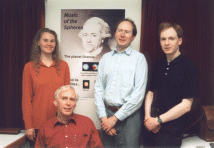
Colin Axon and John
Barrett (1933 - 2006)
The year 2000 was the 200th anniversary of William Herschel's discovery of
infra-red, and the 250th anniversary of Caroline's birth. William and his sister
were not only scientists, but were celebrated musicians, and were equally happy
in either sphere. These elements have been worked into a play and hands-n workshop,
which in the first instance was funded through a Millennium Award, and continued
through PPARC. After the play, the audience are invited to take part in 'hands-on'
activities about practical telescopes, light, sound, and musical instruments.
A number of images from the Play are available.
Background
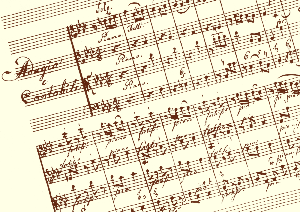 The aim is to enhance
the public image of science by highlighting the integration of science with
the rest of society and especially with art and music, by portraying the excitement
and emotion of scientific discovery through this 40 minute play about the lives
of William and Caroline Herschel. In 1781, William gained instant fame for the
discovery of the planet Uranus; Caroline was not only his constant collaborator,
but also an important astronomer in her own right. Simultaneously with their
scientific work, including designing and laboriously making their own telescopes,
both were following highly successful careers as professional musicians: William
as a celebrated organist, conductor and composer, and Caroline as an accomplished
singer. The Herschels saw no conflict between the two 'incompatible' careers
- they practised both and excelled at both, Indeed, their mathematical and scientific
development evolved out of their musical studies.
The aim is to enhance
the public image of science by highlighting the integration of science with
the rest of society and especially with art and music, by portraying the excitement
and emotion of scientific discovery through this 40 minute play about the lives
of William and Caroline Herschel. In 1781, William gained instant fame for the
discovery of the planet Uranus; Caroline was not only his constant collaborator,
but also an important astronomer in her own right. Simultaneously with their
scientific work, including designing and laboriously making their own telescopes,
both were following highly successful careers as professional musicians: William
as a celebrated organist, conductor and composer, and Caroline as an accomplished
singer. The Herschels saw no conflict between the two 'incompatible' careers
- they practised both and excelled at both, Indeed, their mathematical and scientific
development evolved out of their musical studies.
The play expresses the notions that discovery includes argument, interpretation
and craftsmanship, and that the divide between art and science is artificial.
It vividly communicates the synergy between music and science, through clear
demonstrations of the stages of the Herschels' scientific discoveries, 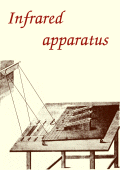 and
of the seamless nature of their lives as each day they switched between music
and science. The play also emphasises that the Herschels were amongst the first
to use what would today be called 'the scientific method'. Carefully constructed
dialogue and music, demonstration of scientific and musical equipment, hands-on
audience participation, and many opportunities for comedy have been combined
to show that the excitement of discovery of each part of the scientific jigsaw
was very similar to the feelings Herschel experienced as he wrote and performed
his musical compositions.
and
of the seamless nature of their lives as each day they switched between music
and science. The play also emphasises that the Herschels were amongst the first
to use what would today be called 'the scientific method'. Carefully constructed
dialogue and music, demonstration of scientific and musical equipment, hands-on
audience participation, and many opportunities for comedy have been combined
to show that the excitement of discovery of each part of the scientific jigsaw
was very similar to the feelings Herschel experienced as he wrote and performed
his musical compositions.
More than a century before Marie Curie, Caroline Herschel herself forged a
significant career as an astronomer. Her individual scientific contributions
were recognised by awards from George III amongst others, and she became the
first female member of the Royal Astronomical Society. Portraying Caroline's
achievements conveys a modern message about equality in the laboratory, scientific
creativity, and society as a whole.
Dazzling Demonstrations
 The cast are
drawn from the Saltford Drama Club, who have benefited immensely from the opportunity
to develop and extend their range of skills and experience of acting an entirely
new type of material. The actors and the stage management staff have been exposed
to a variety of scientific ideas and the problems in communicating them. This
includes developing skills as facilitators of 'hands-on' activities, both scientific
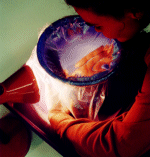
and musical. Examples include 'the bucket microscope', cut-away telescopes,
useable 'drainpipe' telescopes, waves on a string, pipes to show octaves, a
range of ray optics experiments, a giant solar system jigsaw, pull apart eyes
and ears, and an orrery. They were often 'home-made' from materials easily available
which has given people the sense that they could try things themselves.
The cast are
drawn from the Saltford Drama Club, who have benefited immensely from the opportunity
to develop and extend their range of skills and experience of acting an entirely
new type of material. The actors and the stage management staff have been exposed
to a variety of scientific ideas and the problems in communicating them. This
includes developing skills as facilitators of 'hands-on' activities, both scientific
and musical. Examples include 'the bucket microscope', cut-away telescopes,
useable 'drainpipe' telescopes, waves on a string, pipes to show octaves, a
range of ray optics experiments, a giant solar system jigsaw, pull apart eyes
and ears, and an orrery. They were often 'home-made' from materials easily available
which has given people the sense that they could try things themselves.
The Local Connection
The Herschels are 'local heroes' for us in Bristol and Bath - many of the
performances so far have been close to home, and have been in a variety of venues:
community halls, St. Mary Redcliffe Church, in the open at Green Park Station
(Bath) as part of the National Science Week festival held there, the Bath Royal
Scientific and Literary Institution; at a joint meeting of the Bristol Astronomical
Society, the West of England Branch of the British Association for the Advancement
of Science, and the South Western Branch of the Institute of Physics held at
the Physics Department at University of Bristol; and 3 performances in the theatre
of Explore@Bristol.
 Going
National - a West-End Debut!
Going
National - a West-End Debut!
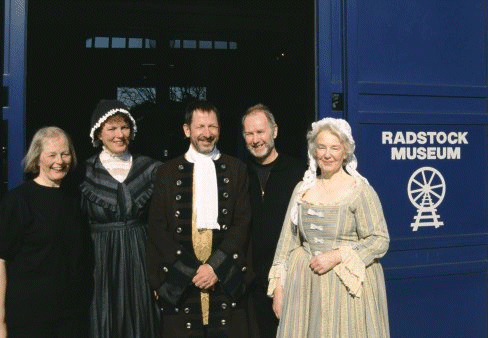
In addition, we have been able to mount performances further afield. We have
been to the Rutherford-Appleton Laboratory at Didcot, Radstock Musuem, and The
Royal College of Art in London.
So Did it Work?
Success so far has been measured on two levels: through press and radio coverage
in the local media, and through the size of the audiences together with their
reaction. The indoor public performances have been followed by discussions and/or
workshops during which members of the audience have given comment, on have filled
in evaluation forms. Analysis of these showed that 93% said that the performance
was either 'very good' or 'excellent'. Further written comments included: 'very
impressed by content and execution', 'put life and achievements of William and
Caroline over in a very vivid and interesting way', 'excellent idea, well executed
and received', 'magnificent!', and 'significantly moves forward the public appreciation
of science'.
The Future
 The play was designed
so that all of the scenery, props, and hands-on kit will pack into a small van.
Further, it is possible to give street and school performances without the aid
of lighting and only minimal sound equipment. However, evening and some indoor
performances (depending on venue) do require the use of some basic stage equipment.
We aim to give at least 3 further performances over the next year. Venues to
which we would like to take the play include: Gloucester, Exeter, Salisbury,
Cardiff, and the Bath International Festival. Performances will be doubled up
where possible to make the most of the fixed hire costs. Ultimately, we see
future developments of the play lying in bringing theatre professionals on-board.
This is because the current cast are amateurs, and therefore daytime performances
during the week are virtually impossible, which means that taking the play into
schools is not feasible. In this coming year we will investigate ways forward
here. Firstly, we will continue discussions with the Bristol Old Vic Theatre
School, exploring the possibility for the play being used in their regular curriculum
of taking drama to local schools. Each year the play would be performed by a
new group of theatre students, who would add valuable new experience and approaches
to their portfolios, and gain exposure to science they would not get elsewhere.
Another way may be to train a group of professional actors who can be brought
together for occasional short tours. The practicalities and details need to
be explored this year with a view to making firm arrangements in 2002.
The play was designed
so that all of the scenery, props, and hands-on kit will pack into a small van.
Further, it is possible to give street and school performances without the aid
of lighting and only minimal sound equipment. However, evening and some indoor
performances (depending on venue) do require the use of some basic stage equipment.
We aim to give at least 3 further performances over the next year. Venues to
which we would like to take the play include: Gloucester, Exeter, Salisbury,
Cardiff, and the Bath International Festival. Performances will be doubled up
where possible to make the most of the fixed hire costs. Ultimately, we see
future developments of the play lying in bringing theatre professionals on-board.
This is because the current cast are amateurs, and therefore daytime performances
during the week are virtually impossible, which means that taking the play into
schools is not feasible. In this coming year we will investigate ways forward
here. Firstly, we will continue discussions with the Bristol Old Vic Theatre
School, exploring the possibility for the play being used in their regular curriculum
of taking drama to local schools. Each year the play would be performed by a
new group of theatre students, who would add valuable new experience and approaches
to their portfolios, and gain exposure to science they would not get elsewhere.
Another way may be to train a group of professional actors who can be brought
together for occasional short tours. The practicalities and details need to
be explored this year with a view to making firm arrangements in 2002.