Dr. Timothy Cribbin
BSc (Hons), MSc, PhD, PGCert
Lecturer Department of Information
Systems and Computing (DISC)
Brunel
University UK
Office: +44(0)1895 266046 Email:
timothydotcribbinatbruneldotacdotuk
(decode if you're human)
|
|
|
Last
changes published on 12th May 2013 |
Brief
CV
2001-present : Lecturer, DISC, Brunel University
2007 : PGCert (Brunel) Learning and Teaching in Higher Education
2005 : PhD (Brunel) "Classifying
complex topics using spatial-semantic document visualization: an
evaluation of an interaction model to support open-ended search tasks"
BURA
2000-2001 : LIC funded
research assistant at DISC, Brunel University (PI: Dr Chaomei
Chen)
1998-2000
: EPSRC funded research assistant at Psychology Institute, Aston
University (PI: Dr Stephen Westerman)
1996 : MSc (Hull) Industrial Psychology,
awarded Tom Hoyes memorial prize for dissertation (DOI)
1994 : BSc (Portsmouth) Psychology
Research
Interests
Visual text analytics, social media analysis, bibliometric analysis, search
user interfaces, information
visualisation, human-computer
interaction
My main interest is in the
field visual text analytics (VTA). VTA is sub-class of data mining that
aims to create visualizations of semantic structure that lies latent
within unstructured or semi-structured collections of textual data. Most
of my work has focused on the spatial-semantic or
spatialization approach. Spatialization
invokes a spatial-semantic (distance-similarity) metaphor, to produce point maps or
node-link graphs
that summarise the general semantic relationships between documents in a
corpus. Spatializations provide the searcher or analyst with both a
thematic overview of the corpus and an intuitive context in which to
search and explore.
Recent projects have investigated ways to optimise the cognitive
plausibility (validity) of spatial-semantic structures as well as to
improve the efficiency/scalability of content-based similarity
computation. Earlier work involved foundational work on the usability of spatializations for a variety of
information seeking tasks (e.g. see
Westerman and Cribbin,
2000;
Cribbin and Chen, 2001;
Chen et al., 2002).
I use a 'bag of words' vector space
model approach as the basis for document similarity modelling. There are
many ways to improve both the structural properties of both the dis(similarity) matrix and
the resulting spatial layout. A particularly effect method
for improving the similarity matrix is
second-order similarity analysis (SOSA).
SOSA
transforms the first-order (i.e. term overlap) document similarity matrix to one of mutual neighbourhood (second-order)
similarities. This transformation uncovers latent relationships that are not
detected by first-order similarity metrics. The more near
neighbours two documents share, the more likely they are to be about the same
topic, which is reflected in the SOS coefficient. Recent experimental results (Cribbin,
2011)
showed that SOSA can produce significantly better topic clustering than latent
semantic analysis (LSA) whilst being simpler to apply because it is parameter free.
A drawback of SOSA is that the run-time grows cubically with N. However, my experiments also showed
that it is possible to reduce run-times significantly, without harming
similarity measures, by truncating the
similarity vectors prior to matrix multiplication.
Regardless of the quality of the
similarity matrix, projecting these complex, high-dimensional spaces onto a
2D plane is a difficult problem. My work has focused on graph-theoretic
approaches, which help to deal with the non-linearity and violation of
metric assumptions associated with these spaces. I have observed good
results using the Isomap
method, in which the original dissimilarities are transformed to geodesic
distances. These distances are estimated by computing shortest paths within
a neighbourhood graph of some kind. Traditionally this might be a k-nn
graph, although this presents the problem of selecting the k-parameter - too
large and the graph will contain disruptive "short-circuits"; too small and
the graph becomes disconnected. My work has shown that minimum-spanning
trees (MST) or minimal (q=N-1) pathfinder networks tend to produce equally
good spatial-semantic results without the need to tune any parameters (Cribbin,
2006,
2010).
In
my PhD thesis (Cribbin,
2006), I also proposed two novel
interactive interactive techniques (see image) to support visual
navigation and exploration. Concept signposts are contextually
relevant key words that are used to dynamically label neighbours of
a selected document. The idea is that while the spatial-semantic
structure tells the user which documents are neighbours,
signposts explain why they are related. Concept pulses, on
the other hand, allow the user to see quickly how locally salient
words and phrases are distributed more globally across the document
map by dynamically inflating then deflating document nodes according
to their degree of match. |
|
MST
spatialization, incorporating semantic signposts and concept pulses |
|
A second, current line of my
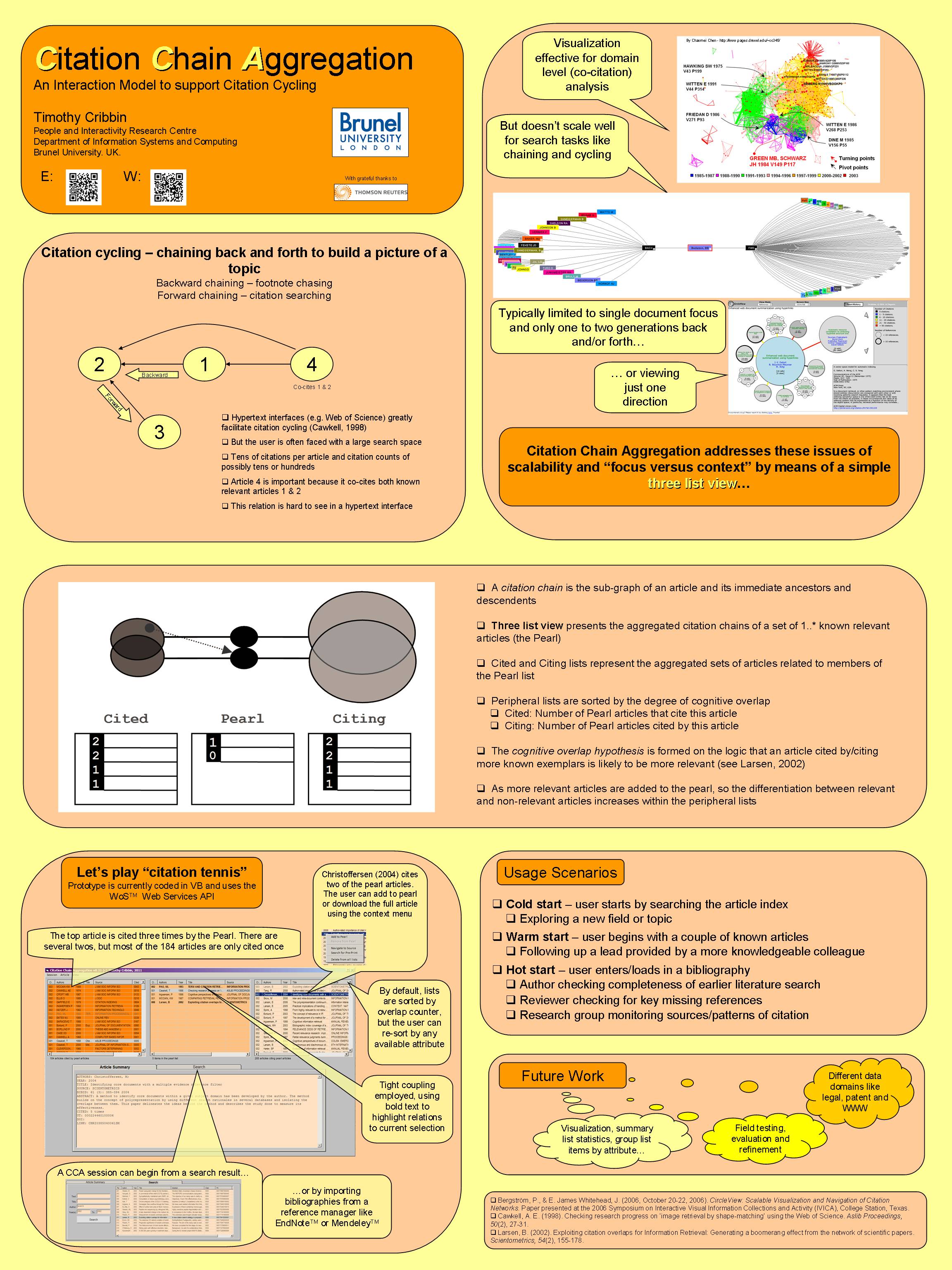
research is Citation Chain Aggregation (CCA:
Cribbin, 2011). CCA is
an interaction model I developed to support search and analysis tasks within
citation networks. Traditionally, citation chaining activity (footnote
chasing and citation searching) is conducted within page-based hypertext
interfaces. This results in the focus and context problem, whereby the user
is attempting to gain an overview of a complex network of citations (i.e. to
find relevant items and determine their relations and relative importance)
but can only see a small part of that network at any one time. CCA attempts
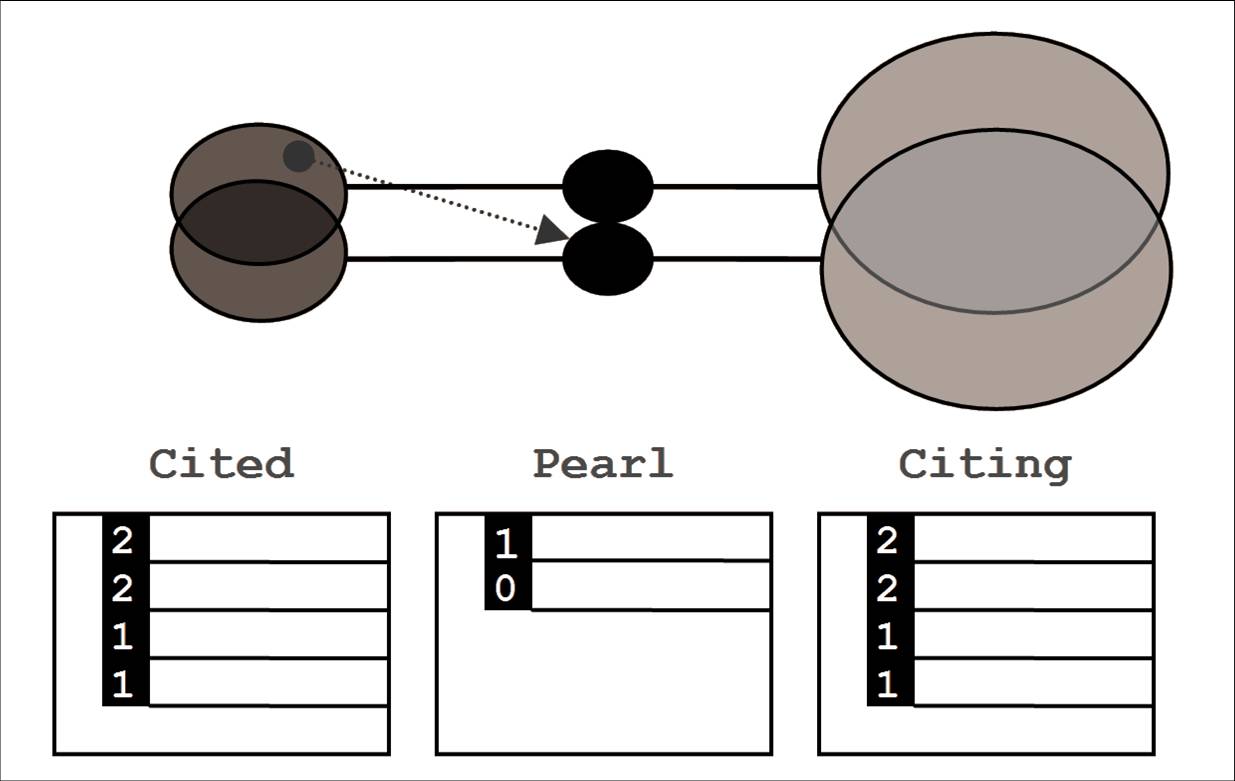
to solve this problem by means of a three-list view, which displays the
aggregation of first-order citation chains (cited<-article<-citing)
surrounding a set or 'pearl' of known relevant articles (see below). As more
items are added to pearl, differences in the incidence of overlap between
their cited and citing articles provide a form of relevance feedback,
drastically reducing the size of the search space and avoiding the need to
'navigate', node by node, through the network. See the
paper and
poster for a more detailed explanation
of the concept. You can try CCA for yourself by downloading Oyster search
here.
 |
 |
I have recently begun to explore
the potential of VTA, including sentiment analysis, as a means of supporting
the analysis of social media data (e.g. Tweets, blogs, forums etc.). See
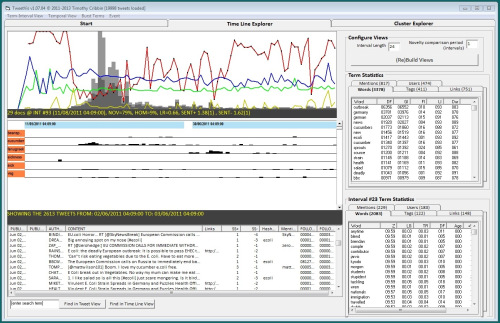
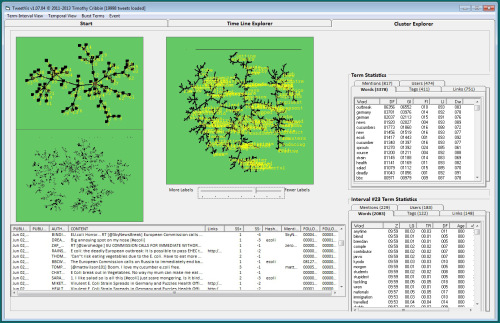
this blog for a summary of the work-in-progress on our Chorus
infrastructure, which comprises the Tweetcatcher, for managing
long-term Twitter queries and Tweetvis for analysing the retrieved
datasets. So far, the focus
has been within the domain of health informatics, looking for example at
public perceptions and responses to health-crises such as the 2011 e-coli
outbreak (see the foodRisC project)
and recent/current h1n1 flu pandemics. We are also interested in the
potential of social media as a source of information to support the
evaluation of medical devices (see the
MATCH project). A key long-term goal here is to develop tools for social
(and mainstream) media analysis that enable social scientists to readily
leverage the powerful methods developed by the text mining and information
visualization communities within the last two decades.
 |
 |
I currently belong to the People and Interactivity
Research Centre (PANDI) and the
Centre for Intelligent Data Analysis (CIDA)
within the Department of Information Systems and Computing and am also a
co-investigator on the
MATCH project.
If you are
interested in reading for a PhD in any of the topic areas mentioned
above, please
email me.
Publication history
|
de Folter, J & Cribbin, T
(2012). Facilitating insight into a simulation model using
visualization and dynamic model previews.
Journal of Visual Languages and Computing, 23(6), 344-353.
DOI
|
|
Cribbin, T (2011). Citation Chain
Aggregation: an interaction model to support citation cycling.
In the proceedings of the 20th ACM International Conference on
Information and Knowledge Management (CIKM '11), Glasgow (October
24-28, 2011).
DOI
BURA |
|
Cribbin, T (2011) Discovering latent topical structure by
second-order similarity analysis. Journal of the American Society for
Information Science and Technology, 62(6), 1188-1207.
DOI
|
|
Westerman, S.J.,
Cribbin, T. & Collins, J. (2010). Human assessments of
document similarity. Journal of the American Society for
Information Science and Technology, 61(8), 1535-1542.DOI
BURA
(post-print) |
|
Cribbin, T. (2010). Visualising the
structure of document search results: a comparison of graph
theoretic approaches. Information Visualization, 9(2), 83-97.
DOI |
|
Cribbin, T. (2006).
Classifying complex topics using spatial-semantic document
visualization: an evaluation of an interaction model to support
open-ended search tasks. Doctoral dissertation, Brunel University,
Uxbridge, UK. BURA |
|
Westerman, S. J.,
Collins, J., & Cribbin, T. (2005). Browsing a document
collection represented in two- and three-dimensional virtual
information spaces. International Journal of Human-Computer
Studies, 62(6), 713-736.
DOI |
|
Morar, S. S., Macredie, R., &
Cribbin, T. (2002). An investigation of visual cues used to create
and support frames of reference and visual search tasks in desktop
virtual environments. Virtual Reality, 6(3), 140-150.
BURA
DOI
|
|
Chen, C., Cribbin, T., Kuljis, J.,
& Macredie, R. (2002). Footprints of Information Foragers:
Behaviour Semantics of Visual Exploration. International Journal
of Human-Computer Studies, 57(2), 139-163.
DOI
BURA
(post-print)
|
|
Chen, C., Cribbin, T., Morar, S.
S., & Macredie, R. (2002). Visualizing and Tracking the Growth
of Competing Paradigms: Two Case Studies. Journal of the American
Society for Information Science and Technology, 53(8),
678-689.
DOI |
|
Westerman, S. J., Cribbin, T.,
& Wilson, R. (2001). Virtual information space navigation:
Evaluating the use of head tracking. Behaviour and Information
Technology, 20(6), 419-426.
DOI |
|
Morar, S. S., Macredie, R., &
Cribbin, T. (2001). Perceiving depth in desktop virtual
environments: Effects of motion parallax and object placement.
Paper presented at INTERACT 2001, Tokyo,
Japan.
|
|
Morar, S. S., Macredie, R. D.,
& Cribbin, T. (2001). A Study of the Relative Importance of
Visual Cues in Desktop Virtual Environments. Paper presented at
HCI International 2001, New Orleans, USA.
|
|
Cribbin, T., & Chen, C. (2001,
5-10 August). A study of navigation strategies in
spatial-semantic visualisations. Paper presented at the HCI
International 2001, New Orleans, USA.
BURA
(post-print)
|
|
Cribbin, T., & Chen, C. (2001,
9-13 July). Exploring Cognitive Issues in Visual Information
Retrieval. Paper presented at the Eighth IFIP TC.13 Conference
on Human-Computer Interaction, INTERACT 2001, Tokyo, Japan.
BURA
(pre-print)
|
|
Cribbin, T., & Chen, C. (2001,
January 21-26). Visual-Spatial Exploration of Thematic Spaces: A
Comparative Study of Three Visualisation Models. Paper presented
at Electronic Imaging 2001: Visual Data Exploration and Analysis
VIII, San Jose, CA.
PDF
(post-print)
|
|
Chen, C., & Cribbin, T.
(2001). Visualising and animating visual information foraging in
context. Paper presented at HCI International 2001, New Orleans.
BURA
(post-print)
|
|
Westerman, S. J., & Cribbin,
T. (2000). Cognitive ability and information retrieval: When less is
more. Virtual Reality, 5(1), 1-7.
DOI |
|
Westerman, S. J., & Cribbin,
T. (2000). Mapping semantic information in virtual space:
Dimensions, variance, and individual differences. International
Journal of Human-Computer Studies, 53(5), 765-788.
DOI |
|
Westerman, S. J., & Cribbin,
T. (1999). Navigating Virtual Information Spaces: Individual
Differences in Cognitive Maps. Paper presented at UK Virtual
Reality Special Interest Group Conference, Salford,
England.
|
|
Cribbin, T., & Westerman, S.
J. (1999, August 30-September 3). Spatial Data Management
Systems: Mapping Semantic Distance. Paper presented at INTERACT
99, IFIP TC.13 International Conference on Human-Computer
Interaction, Edinburgh, Scotland. |
|
Cribbin, T. (1999, August
30-September 3). Spatial Data Management Systems: Human Factors
Perspectives. Paper presented at INTERACT 99, IFIP TC.13
International Conference on Human-Computer Interaction, Edinburgh,
Scotland.
|
|
Westerman, S. J., & Cribbin,
T. (1998). Individual differences in the use of depth cues:
Implications for computer- and video-based tasks. Acta
Psychologica, 99(3), 293-310.
DOI | |
| Useful
Infovis sites...
Infovis Wiki - a new shared
space or "community platform", designed to bring together views,
news and other information from the length and breadth of the IV
community. Regular updates make this a resource worth
bookmarking.
Infovis.net
- an
online magazine which publishes regular articles and tutorials on
key topics in the field and a "Who's Who" directory of key
individuals.
An Atlas of
Cyberspace - a comprehensive classification of a wide range of
solutions to visualizing the content and structure of information
spaces. No longer updated but still a compelling read.
University of Maryland HCI laboratory
- an impressive archive of past and present projects that have
explored and proposed IV solutions to popular problems.
My Infovis
Links - part of my old web-site. Contains many useful links, but
some may be broken now. Please let me know if you find any.
Useful IR and Text Mining sites...
BCS IRSG
group - IR special interest group of the British Computer
Society. Links to upcoming events and the Informer news
letter.
Information Retrieval Facility
- a non-profit research organisation providing services to
information retrieval, including reference corpora and a
super-computing infrastructure
Lucene -
Apache Lucene(TM) is a high-performance, full-featured text search
engine library written entirely in Java. It is a technology suitable
for nearly any application that requires full-text search,
especially cross-platform.
Terrier
- Terrier is a highly flexible, efficient, and effective
open source search engine, readily deployable on large-scale
collections of documents. Research can easily be carried out on
standard TREC and CLEF test collections. Terrier is written in Java,
and is developed at the School of Computing Science, University of
Glasgow.
NaCTeM
- The National Centre for Text Mining (NaCTeM) is the
first publicly-funded text mining centre in the world. We provide
text mining services in response to the requirements of the UK
academic community.
GATE
- General Architecture for Text Engineering. University of
Sheffield. Provides open-source software and a research network. |
|
Top 10 IV Journals*
1. IEEE Transactions on
Visualization and Computer Graphics (165 cites, IF = 2.45)
2=
IEEE Computer Graphics
and Applications (68 cites, IF = 1.89) 2=
Information
Visualization (68 cites, IF = n/a) 4.
Communications of the ACM (66 cites,
IF = 2.65) 5.
ACM Transactions on
Graphics (62 cites, IF = 3.38) 6.
Journal of the American
Society for Information Science and Technology (44 cites, IF =
1.95) 7.
International
Journal of Human-Computer Studies (35 cites, IF = 1.77) 8=
IEEE Transactions on
Software Engineering (28 cites, IF = 3.57) 8=
ACM Transactions on Computer Human
Interaction (28 cites, IF = n/a) 8=
Journal
of Visual Languages and Computing (28 cites, IF =
0.86)
Click here to see lists of the top 10 most cited books,
journal and conference papers in IV.
*Based on
citations made by papers retrieved from ISI WOK that were published
in the period 2006-9 and contained the phrases "information
visualization" or "information visualisation" Impact factor (IF)
based on 2008 ISI data. |
| Useful Software
Third Party Tools
Citespace
- a freely available Java application for analyzing and visualizing
scientific literature. Written and maintained by Chaomei
Chen.
Graphviz - open-source software
for visualizing graphs and networks Infovis Toolkit - "An
Interactive Graphics Toolkit written in Java to ease the development
of Information Visualization applications and components"
Prefuse - "A Java-based toolkit for
building interactive information visualization applications"
Piccolo - "a toolkit
that supports the development of 2D structured graphics programs, in
general, and Zoomable User Interfaces (ZUIs), in particular"
Protovis - an open
source toolkit based on JS and SVG: "Protovis is a graphical
toolkit, designed for visualization. It retains some of the
conceptual simplicity and low-level control of graphical systems by
dealing directly with graphical elements (shapes, lines, i.e.,
marks), but specifies marks declaratively as encodings of data"
KDNuggets
- long list of links to commercial and free visualisation
software
My Datasets and Programs
Oyster search - a simple tool
implementing the CCA concept. Free to download
and use.
I have now made datasets used in
Cribbin (2010)
available for other researchers to use. In due course, I will make
other datasets and software available as well.
Click here to go to this micro-site. |
|
|
|
|