As part of Brunel University of London’s continuing 60th anniversary celebrations, Lord Wilfred Brown has been honoured for his pivotal role in the creation of the University.
A new plaque in the campus building which bears his name, unveiled by Lord Brown’s grandson Cameron, pays tribute to the pioneering and innovative industrialist who oversaw the transition of Brunel College of Advanced Technology to university status.
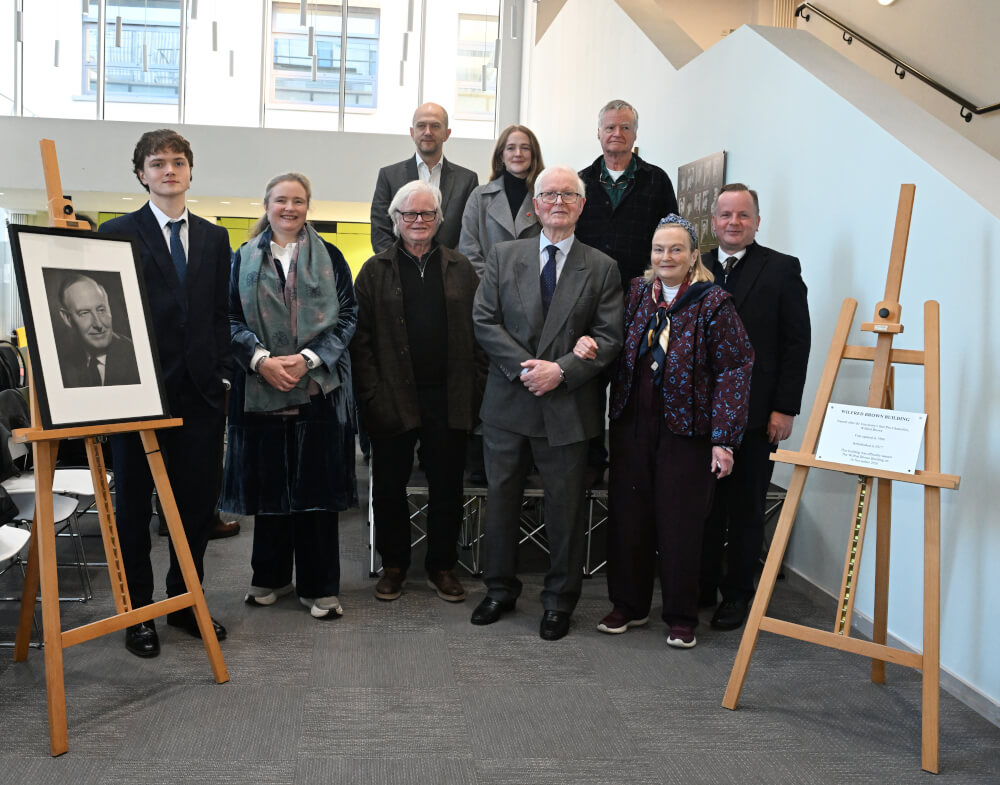
Lord Brown’s three sons Richard, Angus and Michael as well as extended family gathered at Brunel for the plaque-unveiling ceremony. They also gifted the University a framed print of their father, commissioned by the National Portrait Gallery in 1966.
As Chairman of Governors of Acton Technical College and later Brunel College, Lord Brown championed applied technological education. He believed that the ‘sandwich degree’ combining lecture theatre learning with workplace experience would boost UK innovation and productivity.
He played a key role in persuading council planners that a modern technological university should be built on a vacant 170-acre site in Uxbridge, instead of a large housing development. And he helped draft the University’s first constitution.
Ennobled in 1964, Lord Brown of Machrihanish became Minister for Trade in Harold Wilson’s Labour government which was intent on placing a post-war Britain at the forefront of scientific revolution. Brunel’s ethos was central to delivering that vision.
Professor Andrew Jones, Vice-Chancellor and President of Brunel University said: “Lord Brown left an extraordinary legacy. He wanted Brunel’s graduates to be skilled innovators who found solutions to real-world problems.
“Encouraging this new breed of student would in turn widen access to university. His vision is as relevant today as 60 years ago, underpinning everything Brunel still stands for.
“We are grateful to Lord Brown’s family for donating the National Portrait Gallery print of him to the University, a reminder to us of the immense part he played in shaping Brunel.
“And we are delighted to have been able to welcome Lord Brown’s family to Brunel and to honour his extraordinary contribution.”
Wilfred Brown was born in 1908 in Greenock, the Scottish shipbuilding town. He did not attend university, instead joining the Glacier Metal Company in North London as a costing clerk.
By 30 he had become Managing Director and Chairman of the bearings company which played an important role in the war effort. For this, he was awarded an MBE.
Wanting to improve employee conditions and productivity, he collaborated with the renowned organisational researcher Elliott Jaques to pioneer workplace democracy, compensation structures, and management theory.
The Glacier Project lasted 17 years and remains one of the most famous studies of employee behaviour in industrial history. At the time, it aligned with Wilson’s vision of a skilled, well-managed workforce which would drive economic growth.
As Brunel’s Pro-Chancellor, Lord Brown encouraged the University to establish a School of Social Sciences, with Elliott Jaques as its first Professor.
Family connections with Brunel continue to this day. His son, Richard, took one of the first ‘thin sandwich degrees’, graduating in 1964. Richard’s brother, Angus, was one of the architects behind the Fleming Hall of Residence.
And Lord Brown’s grandson, Cameron Brown KC of Red Lion Chambers, is partnering with Brunel Law School on a research project looking at how AI could potentially cut the case backlog in UK courts.
“My grandfather would be enormously proud to see what Brunel has become,” said Cameron Brown KC. “On behalf of our family, thank you for remembering him, for recognising his contribution and particularly for this plaque.
“It is a wonderful and very touching way of ensuring that his connection with Brunel continues. Thank you.”
The plaque and the photo of Lord Brown can be seen in the foyer of the Wilfred Brown building, the University’s central hub for the College of Engineering, Design and Physical Sciences.