From Mardi Gras to murals, a new book reveals the importance of arts and culture in managing urban challenges — and what the rest of the world can learn
On August 29, 2005, Hurricane Katrina hit the Gulf Coast. About 80% of New Orleans flooded, more than 1,800 people died. Over a million had to leave their homes. Several investigations later found that local, state and federal agencies were unprepared and slow to respond.
Performing New Orleans, just released, shows how arts and culture can help cities deal with disasters and emergencies. The city's creative scene responds to sudden shocks and long-term problems in inventive ways. In New Orleans, real resilience means seeing how creative performance helps people get through tough times.
From music and Mardi Gras to impromptu street parties, New Orleans is a city of performances, say writers and performance researchers, Stuart Andrews and Patrick Duggan. “Early in our research, we began to sense the significance of performance to life in the city,” said Dr Andrews, who lectures in performance, place, and resilience at Brunel University of London. “At the same time, we knew New Orleans is too often understood in limited ways, such as through narratives of tourism and indeed in terms of the legacy of Hurricane Katrina.”
The book reveals many ways people of New Orleans use performance to address critical issues in the city, whether as arts practice or in everyday life. There’s the rise of House Floats, or ‘Yardi Gras’, when locked-down locals turned their homes into carnival displays when parades were cancelled. There’s Float Lab, a floating artwork installed in coastal waters that highlights the consequences of land loss. There’s a focus on individual performance projects, including the celebrated Cry You One, which addressed the impacts of climate change on southeast Louisiana, and analysis of the critical importance of art spaces in the city, like the André Cailloux Center, home to Black theatre in the city.
This isn’t a study of quintessential performances of the city, instead, it looks at works rarely discussed beyond New Orleans, but which tell real stories about the city as it is. The span is broad. Performing New Orleans is aimed at people in or interested in arts, culture, and resilience, and in areas like architecture, climate action, geography, sustainability, urban studies and water management.
The book is an invitation to look at the city in new ways. As Professor Patrick Duggan reflects, ‘New Orleans is a vital global city, it is essential that we recognise the breadth of performance here and move away from simplistic readings of the city, particularly of New Orleans as a party town, that undermine the breadth of performance practice and the importance of this work in revealing contemporary thinking in the city.’
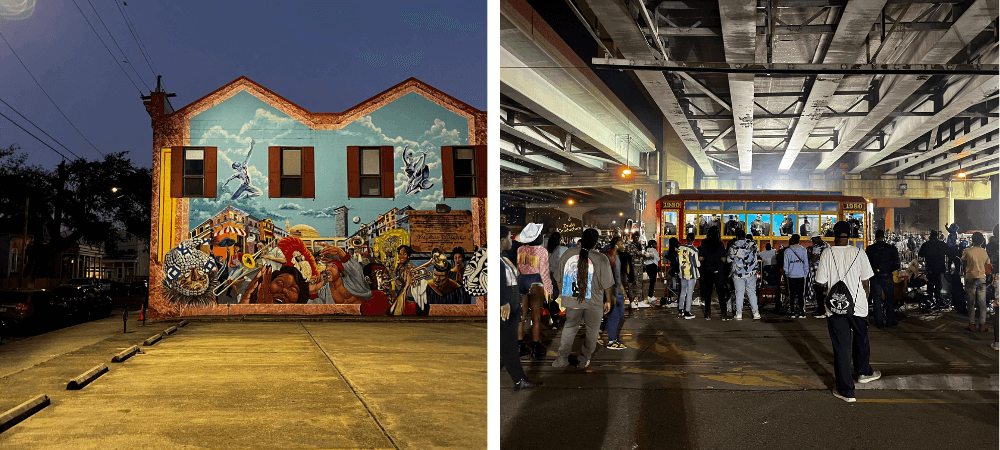
“I continue to be amazed by the breadth of artistic practice in the city,” said Dr Andrews. “In venues, in mural practice, and particularly on the streets. Performance really matters in this city and speaks profoundly of people, communities and places.”
Reported by:
Hayley Jarvis,
Media Relations
press-office@brunel.ac.uk