Algorithms! From shaping our social media feeds to optimising our travel routes or receiving personalised marketing.
It’s almost impossible to imagine many aspects of contemporary life removed from the influence of algorithms. Today, the word has been firmly rooted in our daily working vocabulary to refer to any defined stepwise approach to accomplishing tasks or solving problems, yet references to its etymology are often obscured. The word algorithm is derived from the latinised name (Algortimi) of ninth Century Persian mathematician, Muhammad Ibn Musa Al-Khwarizmi who laid the foundations of algorithmic function. Al-Khwarizmi, through his book Kitab al-Jabr wal-Muqabala (The Book of Restoring and Equating), introduced simple algebraic manipulation, reduced quadratic equations to their simplest forms and inspired the name of the discipline (algebra from al-Jabr) while also earning the title of ‘Father of Algebra’ (Knuth, 1980). Al-Khwarizmi is just one of the exceptional pioneers within the fields of mathematics and science that emerged during the early Islamic civilisation, yet he is seldom recognised for his contributions.
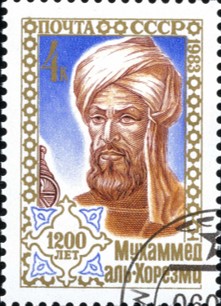
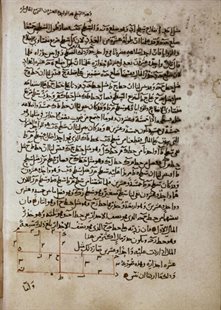
Fig 1. (Left) Impression of Al-Khwarizmi on U.S.S.R postage stamp (1983) (Right) Algebraic manuscript from ‘The book of Restoring and Equating’ by Al-Khwarizmi (1342)
The story of scientific development within modern classrooms is often presented as a linear progression with its origins rooted in the rational enquiry of ancient Greece and its rebirth during the European Renaissance following almost a millennium of intellectual stagnation. Today, the Eurocentric narrative frames science as a uniquely Western endeavour, born out of the scientific revolution and culminating in the globalised science form we are familiar with today. However, the Islamic civilisation from which Al-khwarizmi emerged, saw almost six centuries worth of extraordinary scientific, medical, philosophical, mathematical and technological innovation the fruits of which, some argue, paved the way for Europe out of the Middle Ages to inspire the European Renaissance (Saliba, 2004). Sadly, this story of scientific advance is too often dismissed or reduced to a footnote in history books. If students are to truly appreciate how science has evolved, the value of cultural exchange and the nature of knowledge itself, schools must restore the missing chapter. In a bid to counteract the insularity of Eurocentric narratives and to decolonise the curriculum, the contributions of the Islamic civilisation to science must be taught as a core component of the scientific story.
Read: In the name of thy lord Who createth,
Createth man from a clot.
Read: And thy Lord is the Most Bounteous,
Who teacheth by the pen,
Teacheth man that which he knew not”
(Qur’an 96:1-5)
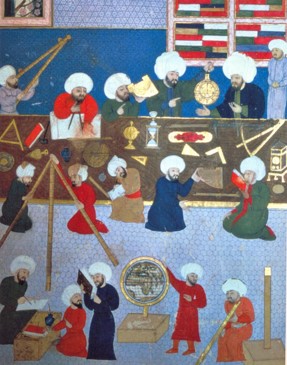
Fig 2. Ottoman astronomers at the Istanbul Observatory of Taqi ad-Din (Mansur-Shirazi, 1581)
In response to the first revealed words of Islamic scripture and the Qur’anic invitation to read and learn by the pen, early Muslims were inspired to explore the natural world in search of knowledge and divine order. Their learning led them to make huge strides within a plethora of disciplines during the period between the ninth and the fifteenth centuries, in a geographical space that stretched from Spain to Central Asia and India (King, 1996). The insistence on learning and scholasticism within the Islamicate was upheld rigorously from the outset. Less well known is the fact that the first university on record was established by a female scholar, Fatima al-Fihri, in Fes, Morocco, in 851 AD. Al-Qarawiyin University has been endorsed by UNESCO as the oldest currently operating university (UNESCO, 1981) and specialises in religious teaching as well as medicine, engineering and the social sciences.
Muslim scholars were rigorously engaged in the translation of large volumes of Greek, Persian, Syriac, and Indian scientific and philosophical texts into Arabic, the language of the Qur’an and the lingua franca of the Islamic world (Lyons, 2009). In a display of unprecedented preparedness for cross-cultural learning and dialogue, they accepted, refined or refuted longstanding theories while proposing novel ideas to bridge the past and future. Science and technology were appreciated as an enduring human enterprise that flourished by the exchange of ideas as opposed to thought in isolation.
And by the stars they are guided (Qur’an 16:16)
A special interest was taken in astronomy as it enabled Muslims to fulfil religious obligations that required accurately facing Makkah to pray, perform five daily prayers based on the accurate determination of the sun’s position and observing the holy month of Ramadan that is determined by lunar phases (King, 1996). Some consider that the astronomical tables and observational techniques devised by early Muslim astronomers formed the basis of subsequent European innovation (Saliba, 2004) and suggest that the early planetary models, such as those by fourteenth Century Ibn Al-Shatir ‘were mathematically identical to those of Copernicus some 150 years later’ (Alexakos and Antoine, 2005, p. 37-38). Muslim scientists perfected the earlier Greek astrolabe models, the equivalent of a modern-day GPS system. This instrument often embellished with intricate design, allowed navigation and time-telling based on the positions of celestial bodies. Today, over 160 stars are still referred to by their original Arabic names as documented extensively in tenth Century, Abd Al-Rahman al-Sufi’s The Book of Fixed Stars (Abdul Hamid, 2007). Today, an array of technical terms in English vocabulary are considered loan words and can be traced back to their Arabic origins, demonstrating the extensive appropriation of knowledge that took place during the late Middle Ages (Darwish, 2015). A few examples are alcohol (al-kohl), alkali (al-qaly), azimuth (al-sumut), elixir (al-iksir), alchemy (al-kimya), zero or sipher (sifr), sugar (sukkar) and admiral (amir-al).
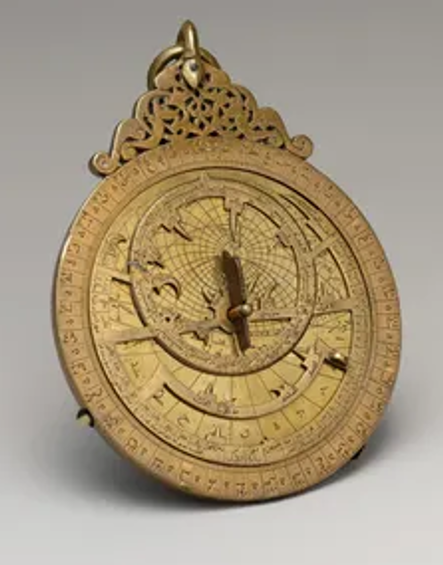
Fig 3. Astrolabe made from brass used for astronomical observations and determining prayer times, Yemen. (Umar ibn Yusuf, 1291)
There is evidence to suggest that the early characterisation of the scientific method itself was being drawn in eleventh Century Baghdad. Al-Hasan Ibn al-Haytham (latinised Alhazen) was a polymath whose scientific experimental method was the first on record to rely on repeatable controlled testing and observational reporting to study natural phenomena. El-Bizri (2018) considers him to be notably distinguished for the mathematising of physics and his contributions to the theories of light comportment, vision and optics that resolved longstanding disputes between Ptolemaic and Aristotelian traditions in natural philosophy. For example, he rejected Ptolemy’s emission theory that suggested that vision is facilitated by the emission of light rays from the eyes onto the object of sight. Instead, he correctly outlined that vision is enabled by the transmission or reflection of light rays off lit and visible surfaces in straight lines into the eyes. He supported his theories on vision by an extensive study of the anatomy of the eye to combine an intricate combination of physiology, neurology, psychology, physics and geometry to lay the foundation for understanding visual perceptions. His book Kitab al-Manazir (Book of Optics) was translated into Latin (Perspectiva) and distributed largely throughout Europe to shape scholarship and to serve as a foundational text in institutions such as the Franciscan college at Oxford up until the seventeenth Century. Ibn al-Haytham had multiple influences on the European Renaissance and impacted the work of Bacon and Keplar (El-Bizri, 2018). Without his work on the camera obscura, we may never have had the camera as we know it today.
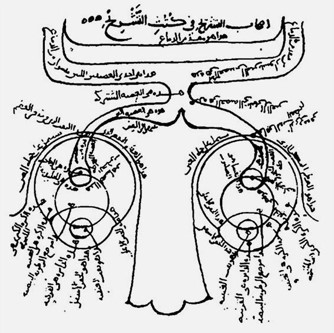
Fig 4. Schematic of the human visual system from Ibn al-Haytham’s Kitab al-Manazir (Book of Optics) (Ibn al-Haytham 1011-1021)
In medicine, the fourteen volume Al-Qanun fi al-tibb (The Canon of Medicine) by eleventh Century Ibn Sina (Latinised Avicenna) served as the primary medical text for physicians and universities in medieval Europe and the East for more than 700 years (Colgan, 2013). Within it, he documented the anatomy and physiology of the human body as well as diagnosis and treatment of disease while setting the foundations for the empirical study of pharmacological testing or modern-day clinical trials (Aligabi, 2020). He introduced holistic patient-centred treatment long before it was recognised in contemporary medicine. In many instances, bridging philosophical and scientific concepts from the Greco-Roman and Islamic periods to shape his theories (Aligabi, 2020).
Thirteenth Century Ibn-Al Nafis also made revolutionary discoveries of the pulmonary blood circulation that allowed us to understand the double pump system. This was documented in his eighty volume Al-Shamil fi al-Tibb (The Comprehensive Book on Medicine) to inspire the works of European physicians such as Michael Servetus and William Harvey (West, 2008).
“For although there is not a single aspect of European growth in which the decisive influence of Islamic culture is not traceable, nowhere is it so clear and momentous as in the genesis of that power which constitutes the paramount distinctive force of the modern world and the supreme source of its victory- natural science and the scientific spirit”
(Briffault, 1919, p.190)
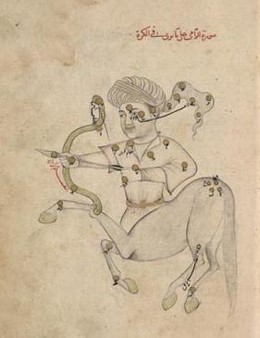
Fig 5. Illustration of the celestial constellation from a copy of Abd al-Rahman al-Sufi’s ‘The Book of Fixed Stars’ (Al-Sufi, 986)
These are just a few examples of the extraordinary breakthroughs and contributions made within the scientific realm. There is still much to be said about the work of early Muslim scholars of the golden age within the fields of philosophy, art, technology and agriculture that has made long lasting impacts to our lives today. A decolonised curriculum that honours the diversity of the very fabric of knowledge, far removed from tokenism, is needed. Science, a human enterprise, a beautiful tapestry woven a thread at a time from all cultures and times, possesses the capacity to dismantle stereotypes and instil tolerance and cohesion in a polarised world. A decolonised science curriculum delivers an enriched educational experience for all students by fostering an appreciation of science as a global collaborative endeavour that appreciates a plurality of knowledge systems. Championing a diversity whereby students see themselves and their cultural heritage represented in science cultivates educational equity and prepares them to engage with a multicultural world.
References
Abdul Hamid, Z. (2007) Arabic Star Names: A Treasure of Knowledge Shared by the World. Muslim Heritage, Available at: https://muslimheritage.com/arabic-star-names/?utm_source=copilot.com (Accessed 28 February 2026).
Alexakos, K. and Antoine, W. (2005). ‘The Golden Age of Islam and Science Teaching.’ The Science Teacher, 72(3) p. 36.
Aligabi, Z. (2020) ‘Reflections on Avicenna’s impact on medicine: his reach beyond the middle east’, Journal of Community Hospital Internal Medicine Perspectives, 10(4), pp. 310–312. doi: 10.1080/20009666.2020.1774301.
Al-Khwarizmi, M. (1342) Text pages with geometrical solutions to quadratic equations, Bodleian Library, University of Oxford.
Al-Sufi, A. (1417) Sagittarius constellation. From: Suwar al-kawakib al-thabita (The Book of Fixed Stars) Science Photo Library, Library of Congress.
Briffault, R. (1919). The Making of Humanity. London : G. Allen & Unwin.
Colgan, R. (2013). Advice to the Healer: On the Art of Caring. Boston, MA: Springer US. doi: 10.1007/978-1-4614-5170-9.
Darwish, H. (2015) ‘Arabic Loan Words in English Language.’ IOSR Journal Of Humanities And Social Science (IOSR-JHSS, [online] 20(7), pp.105–109. doi:https://doi.org/10.9790/0837-2077105109.
El Bizri, N. (2018) ‘Arabic classical traditions in the history of the exact sciences: The case of Ibn al Haytham’, European Physical Journal Plus, 133:271. doi:10.1140/epjp/i2018-12142-7.
Encyclopaedia Britannica (1983) Al-Khwarizmi U.S.S.R postage stamp, Encyclopedia Britannica, Available at: https://www.britannica.com/biography/al-Khwarizmi (Accessed: 2 March 2026).
Ibn al-Haytham (c. 1011–1021) Diagram of the eyes and related nerves. From: Kitāb al-Manāẓir (Book of Optics), vol. 1, fol. 81b. Süleymaniye Mosque Library, Istanbul.
King, D.A. (1996) ‘Islamic astronomy’, in Walker, C. (ed.) Astronomy Before the Telescope. London: British Museum Press, pp. 143–174.
Knuth, D.E. (1980) ‘Algorithms in modern mathematics and computer science’, in Traub, J.F. (ed.) Algorithms in Modern Mathematics and Computer Science. New York: Academic Press, pp. 81–97.
Lyons, J. (2009) The House of Wisdom: How the Arabs Transformed Western Civilization. New York: Bloomsbury Press
Mansur-Shirazi, A. (c. 1581) Astronomers at the Istanbul Observatory From: Shahinshah-nama, MS F 1404, fol. 57a
Saliba, G. (2004) Islamic Science and the Making of the European Renaissance. Cambridge, MA: MIT Press.
Umar ibn Yusuf (1291) Astrolabe of ‘Umar ibn Yusuf ibn ‘Umar ibn ‘Ali ibn Rasul al-Muzaffari [Brass] Available at: www.metmuseum.org (Accessed: 28 February 2026).
UNESCO (1981) Medina of Fez. World Heritage Centre. Available at: https://whc.unesco.org/en/list/170/ (Accessed: 27 February 2026).
West, J.B. (2008). ‘Ibn al-Nafis, the pulmonary circulation, and the Islamic Golden Age.’ Journal of Applied Physiology, [online] 105(6), pp.1877–1880. doi:https://doi.org/10.1152/japplphysiol.91171.2008.