Paris and London have long been two of Europe’s most popular tourist destinations. While today, the Eurostar is able to provide efficient and smooth travel to Paris from London, travelling this same journey was far more complicated and unpleasant in the nineteenth and twentieth centuries. One of the more notable routes across the English Channel during this period was from Newhaven to Dieppe, operated by the London Brighton and South Coast Railway (LB&SCR). While a quicker route was available from Dover to Calais, the LB&SCR prided itself in providing the cheapest route for customers to enjoy cross-Channel travelling.

The LB&SCR was established on the 27th July 1846. It was created through the merging of the London Brighton Railway and the Croydon Railway. It travelled along the coast from Hastings to Bournemouth and up to London. In 1847, the LB&SCR opened its line to Newhaven allowing for improvements of the Newhaven harbour. From the harbour a Newhaven-Dieppe ferry service was established. This service was abandoned and replaced with a Newhaven-Jersey service in 1850, but the Newhaven-Dieppe service was reinstated in 1853. The ferry service was run jointly by the LB&SCR and the French Western Railway (Chemins de Fer de L’Ouest) through the formation of the South Western and Brighton Railway Companies Steam Packet Service (SW&BRCSPS). By 1863, this route was being advertised as the cheapest and shortest route for travel between London and Paris. The LB&SCR obtained the Terminus Hotel in 1877 and owned the London and France Hotel near to the Newhaven Port to further encourage tourists to use the Newhaven-Dieppe route.
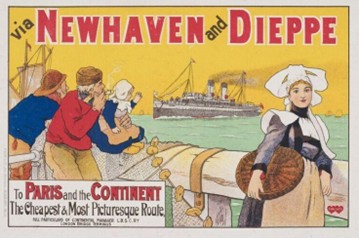
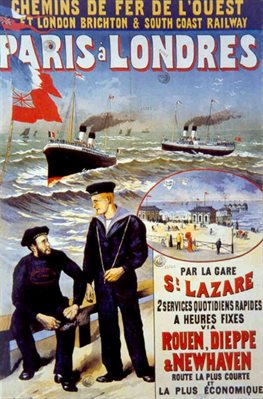
The Newhaven-Dieppe route began in London, consisting of a two-hour journey from London to Newhaven. The Brighton and Continental Steam Packet Company (BCSPC) ran three paddle steamers across the Channel in 1847 however, due to legal reasons these operations had to stop. The South-Eastern Railway Company disputed the legality of a Railway company owning steamboats, leading to their withdrawal from the service. In 1849, the formation of the SW&BRCSPS allowed for travel to continue. The boat journeys were overcrowded and unpleasant. The full journey from London to Paris would take twenty-four hours and the experience on the boats remained widely uncomfortable.
In 1860, the LB&SCR entered London’s Victoria station which is where passengers would depart from. Despite the remarkably long journey, in 1878, 135,000 people crossed the channel via the Newhaven-Dieppe route that year. It can be noted that from 1882 onwards the boats from Newhaven began carrying passengers in 1st, 2nd and 3rd classes. It allowed for the prices to be kept low enabling travel across the continent to become more accessible to working class customers.
While the overall conditions on the boats improved, the 3rd class passengers continued to travel in conditions of discomfort, although 1st and 2nd class passengers were able to experience a more enjoyable journey. The popularity of the Newhaven-Dieppe route continued to grow and up to 200,000 passengers used this route annually from 1888-1903. This was aided by the Thomas Cook travel agency providing cheap holiday excursions that were advertised as cheaper than holidaying in the UK. 1906 saw some of the first cross channel transportation of vehicles with 423 cars being transported using ferry services that year. In 1923 the LB&SCR became the Southern Railway Company and the Newhaven-Dieppe route remained popular with a record of 301,000 passengers using the route in 1926.
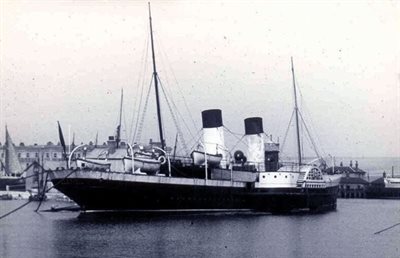
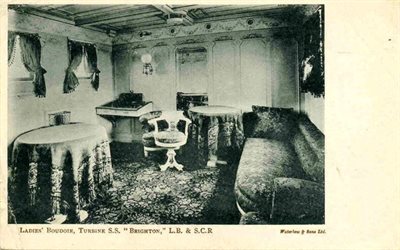
The LB&SCR continued to provide its services however, in the 1950’s, the Newhaven-Dieppe route was competing with quicker travel especially with the rise of air travel into Europe. Acknowledging the cross-Channel journeys of the past really highlight the efficiency that has been afforded to us today. Even with some of the delays we experience today (notably the recent Eurostar delays: Thousands of Eurostar passengers facing cancellations and severe delays after cable theft | UK News | Sky News), the journeys are still quicker than the routes within the last two centuries.
Images from :
The Newhaven - Dieppe service at the turn of the century | Cross channel ferries | Our Newhaven
To Paris and the Continent via Newhaven and Dieppe | Unknown | V&A Explore The Collections