Comedy often operates at social boundaries, testing limits, approaching taboo topics, and provoking debate about offence, taste and power. This theme explores how comedians, writers and audiences navigate controversial humour, including questions of censorship, regulation, Free speech and “cancel culture,” and the shifting boundaries of what can be said and laughed at. Research in this area considers both the risks and the possibilities of comedy as a space for social critique and public dialogue.
Lockyer, S., & Attwood, F. (2009) ‘The Sickest Television Show Ever’: Paedogeddon and the British Press. Popular Communication: The International Journal of Media and Culture, 7(1): 49-60.
Lockyer, S., & Pickering, M. (eds.) (2009) Beyond a Joke: The Limits of Humour. Basingstoke: Palgrave Macmillan.
Lockyer, S., & Pickering, M. (2008) You Must Be Joking: The Sociological Critique of Humour and Comic Media, Sociology Compass, 2(3): 808-820.
Lockyer, S., & Savigny, H. (2020) Rape Jokes Aren’t Funny: The Mainstreaming of Rape Jokes in Contemporary Newspaper Discourse, Feminist Media Studies, 20(3): 434-449.
Hunt, L., (2010) ‘Near the Knuckle? It nearly took my arm off! British Comedy and the “New Offensiveness”, Comedy Studies pp.181-189. ISSN 2040-610x.
Weaver. S. (2025) ‘Stand-up Comedy and Offence’, in O. Double (ed.) The Cambridge Companion to Stand-up Comedy. Cambridge: Cambridge University Press.
Lockyer, S. and S. Weaver (2024) ‘The Ethics of Humour and Comedy’, in T.E Ford, W. Chłopicki, and G. Kuipers (eds) De Gruyter Handbook of Humor Studies. De Gruyter.
Weaver, S. and L. Bradley (2016) ‘“I haven’t heard anything about religion whatsoever”: Audience perceptions of anti-Muslim racism in Sacha Baron Cohen’s The Dictator’ HUMOR, 29(2): 279-300. Special issue (ed. S. Lockyer).
Weaver, S. (2015) 'The rhetoric of disparagement humor: An analysis of anti-semitic joking online', HUMOR, 28 (2): 327-347.
Weaver, S. (2013) ‘A rhetorical discourse analysis of online anti-Muslim and anti-Semitic jokes’, Ethnic and Racial Studies, 36(3): 483-499.
Weaver, S. (2013) ‘‘Strangers’, ‘others’ and the unstable metaphors of race representation in liquid modernity: the case of the Gypsy weddings’. In Liquid Sociology. Metaphor in Zygmunt Bauman’s Writings on Modernity. M. Davis (ed.). pp. 121-137. Aldershot: Ashgate Publishing.
Weaver, S. (2011) The Rhetoric of Racist Humour: US, UK and Global Race Joking. Farnham: Ashgate Publishing.
Weaver, S. (2011) ‘Jokes, Rhetoric and Embodied Racism: A Rhetorical Discourse Analysis of the Logics of Racist Jokes on the Internet’, Ethnicities, 11(4): 413-35.
Weaver, S. (2011) ‘Liquid Racism and the Ambiguity of Ali G’, European Journal of Cultural Studies, 14(3) 249-64.
Weaver, S. (2010) ‘Developing a Rhetorical Analysis of Racist Humour: Examining Anti-black Jokes on the Internet’, Social Semiotics 20(5): 537-555.
Weaver, S. (2010) ‘The Reverse Discourse and Resistance of Asian Comedians in the West’, Comedy Studies 1(2): 149-157.
Weaver, S. (2010) ‘Liquid Racism and the Danish Prophet Muhammad Cartoons’, Current Sociology 58(5): 675-692.
Weaver, S. (2010) ‘The ‘Other’ Laughs Back: Humour and Resistance in Anti-Racist Comedy’, Sociology 44(1): 31-48.
Anti-racist Comedy Discussion on Thinking Allowed
Funding
- Research Seminar Series Awards 2019-2020, Brunel University of London, Centre for Comedy Studies Research (CCSR) ‘Beyond a Joke’: Censorship and Free Speech Seminar Series 2019-2020’, £2499.
- Research Seminar Series Award 2018-2019, Brunel University of London, Centre for Comedy Studies Research (CCSR) and Department of Education ‘Beyond a Joke’: Comedy and Critical Thought Seminar Series 2018-2019, £2494.
- Research Seminar Series Awards 2016-2017, Brunel University of London, Centre for Comedy Studies Research (CCSR) ‘Beyond a Joke’: Comedy, Identity and Offence Research Seminar Series 2016-2017, £2478.
Comedy on Campus: Censorship or Free Speech?
The Centre for Comedy Studies Research (CCSR) were proud to present an online panel discussion on 'Comedy on Campus: Censorship or Free Speech?'. This edited video features Dr Max Kinnings, Prof. Laura E. Little, Anvitha Paruchuri, Kate Smurthwaite and was hosted by Prof. William Leahy.
Brunel Public Webinar Series - Comedy Matters: Hope and Anxiety in Times of Crisis, May 2020
What does comedy reveal about our response to tumultuous times? Dr Simon Weaver, Dr Sharon Lockyer and Dr Tracey Platt discuss comedy as a mechanism for populism and anti-populism in the context of Brexit, and for managing fear and anxiety during the COVID-19 pandemic. In this special collaboration with the Centre for Comedy Studies Research (CCSR), we ask – what role does comedy play in times of crisis?
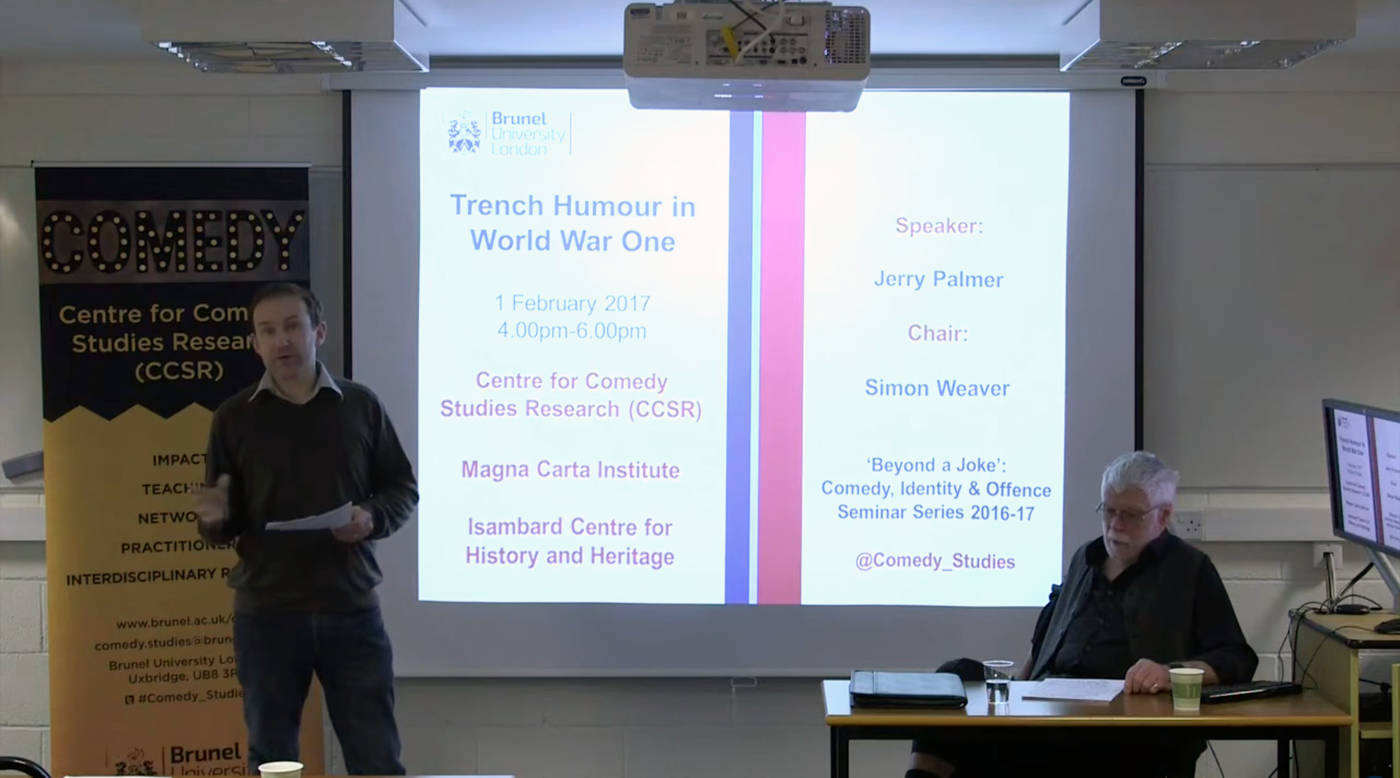
Trench Humour in World War One – 1 February 2017
In this video, Jerry Palmer analyses the type of humour associated with the trench warfare of World War One, a type of humour sometimes called ‘black humour’. The same phrase is used in French, and in German, it is called ‘gallows humour’. It is a well-known feature of writings about World War One, both at the time and subsequently. We see various examples, from all three languages. Two elements of the theory of humour provide a basis for Jerry’s analysis: incongruity, and the situation of utterance; the interaction between these two in discourse-based theories of humour is well known. Arguably, the black humour of the trenches stretches the perception of incongruity to the limits of commonplace recognition, largely because the context of utterance is beyond the scope of most people’s experience (then and now). The analysis focuses primarily on the question of the comprehensibility of this humour once it is taken out of the context in which it was originally made. Jerry Palmer is the former Professor of Communications at London Metropolitan University and Visiting Professor of Sociology at City University. Originally trained in languages and literature, he is the author of 6 books on various aspects of the mass media and popular culture. Two of these are on comedy and humour: The Logic of the Absurd (British Film Institute, 1987) and Taking Humour Seriously (Routledge, 1994); he also contributed to the collection Beyond a Joke: The Limits of Humour, edited by Sharon Lockyer and Michael Pickering (Palgrave Macmillan, 2005). He is currently preparing a book on soldiers’ memoirs of World War One in Britain, France, and Germany, from which this talk is taken.
Comedy and Care: The funny side of Social Work - 21st March 2017
To mark World Social Work Day the Division of Social Work at Brunel University London and the Centre for Comedy Studies Research presented Comedy and Care: The Funny Side of Social Work on 21 March 2017. A panel of experts and practitioners explored media portrayals of social work, the role of comedy in shaping discussions of social work, and much more.
CCSR 'Comedy Matters' Research Seminar Series 2013-14 - Dr May McCreaddie
Humour Use in Healthcare Interactions: A Risk Worth Taking - 15th January 2014 by May McCreaddie In this video Dr May McCreaddie (University of Stirling) examines the role humour in health care settings through analysis of spontaneous humour in nurse-patient interactions and among nurse-peer and patient-peer groups. The opportunities, limitations and impact of using potentially ‘problematic’ and ‘non-problematic’ humour in patient care are also explored.
Potential areas for further research include:
- who gets “protected” or “punished” when offence occurs — how social position, identity and power shape the consequences of causing or taking offence
- platform governance and the moderation of humour — how digital infrastructures, algorithms and policy regimes regulate comedic expression
- changing audience expectations across generations and communities— how norms around offence, taboo and acceptability shift over time and across groups
- the politics of taboo‑breaking — how comedians use transgression, shock or provocation, and how these tactics are interpreted
If you’d like to pursue research on this theme, we’re keen to explore possibilities with you. Please reach out via the Centre’s email to continue the discussion.