Comedy is deeply connected to questions of identity, belonging, and social experience. This theme examines how humour interacts with race, gender, sexuality, disability, class, nationality, and regional identity, affecting comedic works, the creation and performance of comedy, and audience reactions. It examines how comedy can both challenge stereotypes and promote solidarity, while potentially reinforcing inequalities through representation, exclusion, or cultural norms.
Hunt, L. (1998) British Low Culture: From Safari Suits to Sexploitation. London and New York: Routledge. ISBN 0-415-15183-X. Themes: Comedy & Identity; Comedy Forms & Formats.
Lockyer, S. (2010) Dynamics of Social Class Content in Contemporary British Television Comedy, Social Semiotics, 20(2): 121–138.
Lockyer, S. (2025) Stand-up Comedy, Disability and Social Justice. In Double, O. The Cambridge Companion to Stand-up Comedy. Cambridge: Cambridge University Press, pp. 175–188.
Lockyer, S., & De Benedictis, S. (2023) Performing pregnancy: Comic content, critique and ambivalence in pregnant stand-up comedy, International Journal of Cultural Studies, 26(3): 343–361. (Original work published 2022)
Lockyer, S., & Pickering, M. (eds.) (2009) Beyond a Joke: The Limits of Humour. Basingstoke: Palgrave Macmillan.
Malik, S. (2010) ‘How Little Britain does “race”’, in Lockyer, S. (ed.) Reading Little Britain: Comedy and Contemporary Television. London: IB Tauris Publishers, pp. 75–94. ISBN 13: 978 1845113993.
Malik, S. (2013) ‘The Indian family on UK reality television: Convivial culture in salient contexts’, Television and New Media, 14(6): 510–528. ISSN: 1527-4764.
Riesch, H., Virkki, P., Stephens, N., Lewis, J., & Martin, O. (2021) ‘“A Moment of Science, Please”: Activism, Community, and Humor at the March for Science’, Bulletin of Science, Technology & Society, 41(2–3): 46–57.
Weaver, S. (2011) ‘Definitions of the humorous in Chris Rock and Russell Peters fan blogs: A discussion of the problem of incongruity’, Participations: Journal of Audience and Reception Studies, 8(2): 257–275.
Weaver, S., & Lockyer, S. (2025) ‘Intersectionality and the Construction of Humour in Contemporary Stand-up Comedy’, European Journal of Cultural Studies, 28(6): 1551–1569.
Feeling Funny, Being Human: Comedy Festival, Brunel University London
Feeling Funny, Being Human: Comedy Festival, Brunel University London
A short promotional film produced for Brunel's Centre for Comedy Studies Research. Filmed as part of 'Sisters Productions' 21 November 2014 Brunel University London. A short promotional film produced for Brunel's Centre for Comedy Studies Research. Filmed as part of 'Sisters Productions'
Funding
- Research Seminar Series Awards 2016-2017, Brunel University of London, Centre for Comedy Studies Research (CCSR) ‘Beyond a Joke’: Comedy, Identity and Offence Research Seminar Series 2016-2017, £2478.
- School of Advanced Study: University of London, AHRC and BA, 2014, Being Human: A Festival of the Humanities, Feeling Funny, Being Human: What Can Humour Tell Us About Being Human?, £1500.
- Research Seminar Series Awards 2014-2015, Brunel University of London, Comedy Matters Research Seminar Series 2014-2015: Comedy, Health and Disability, £2494.
- Brunel Research Initiative & Enterprise Fund (BRIEF) 2013-2014, Brunel University of London, Examining ‘Race’, Racism and Representation: An audience reception study of the comedy of Sacha Baron Cohen, £13994.
- Sir Halley Stewart Trust Research Grant, Exploring the Potential of Disabled Comedians in Improving the Lives and Experiences of Disabled People, 2012, £3100.
SAGE Encyclopedia of Humor Studies
Alongside writing the Identity entry for the Encyclopedia of Humor Studies, Sharon Lockyer also edited the encyclopedia’s sociology section, shaping its disciplinary perspective.
Lockyer, S. (2014) 'Identity', in Attardo, S. (ed.) Encyclopedia of Humor Studies. Los Angeles and London : Sage. pp. 377 - 378.
‘Beyond a Joke’ 2016-2017: Comedy, Gender and Offence
Comedy, Gender, and Offence explores how comedians and comic discourse shape contemporary debates about gender identity and offence; how gender influences responses to comedy about gender; the ways comedy can maintain, disrupt or deconstruct gender relations; the ethical limits of gender‑based humour; and how questions of freedom of speech and censorship intersect with comedy. Speakers include: Kate Fox – stand‑up poet, comedian, writer and practice‑based researcher (University of Leeds) Joan Greening – award‑winning playwright and creator of ITV sitcoms The Cabbage Patch and Troubles and Strife Lynne Parker – Founder and Chief Executive of Funny Women; award‑winning producer, performance coach and writer Simon Weaver – Lecturer in Media and Communications, Brunel University London Chaired by Meredith Jones, Reader in Sociology and Communications, Brunel University London.
‘Beyond a Joke’ 2016-17: Comedy, Class and Offence
What are the roles of comedians and comic discourses in shaping discussions of class and offence in contemporary society? • How do our identities shape responses to comedy that draws on social class? • What are the range of responses to comedy that draws on social class? What is the relationship between comedy, offensiveness and the maintenance, disruption and deconstruction of ‘social cohesion’ in contemporary plural democracies? • To what extent are there, or should there be, ethical limits for comedians and comic discourses in relation to class? These questions, and more, are explored by a panel of experts in this Comedy, Class and Offence panel seminar. Speakers were: Mark Boosey: has been running British Comedy Guide for over 10 years. Comedy.co.uk delivers news, features, programme guides, and more besides to over 500,000 visitors a month.
Disability and Comedy is Easy | Becoming an Abnormally Funny Person
In this Comedy, Health and Disability seminar Simon Minty discusses his work and experiences as a disability activist and comedy producer. He entertainingly discusses the creation of the comedy troupe, Abnormally Funny People, and examines the relationship between disability and comedy today.
Centre for Comedy Studies Research (CCSR) Comedy Matters Research Seminar Series 2014/15: Comedy, Health and Disability
Dr Simon Weaver introduces this Comedy, Health and Disability Seminar that is presented by Margaret Montgomerie (De Montfort University, UK). Margaret investigates the ways in which disabled comedians function within popular television shows, focussing in particular on Channel 4’s The Last Leg and Sky 1’s Trollied. Margaret explores a range of questions including: do the formats of the programmes, the comedy chat show and the sitcom, automatically suspend normalcy for the purposes of entertainment, creating a temporary space where values and assumptions are turned upside down? And do these programmes have any relationship to the material produced by disabled comedians outside of the mainstream media?
Comedy and Mental Health Symposium
This symposium explored comedy and its relationship to mental health, with speakers discussing the psychology of the stand-up comedian, the use of stand-up comedy in reducing mental health stigma in the military and uses of comedy with mental health service users. Speakers included •Professor Gordon Claridge (University of Oxford) •Tim Sayers (Arts in Health co-ordinator at Leicestershire Partnership NHS Trust (LPT) •John Ryan (stand-up comedian and comedy researcher).
Centre for Comedy Studies Research (CCSR) | A Symposium on Italian Comedy Audiences
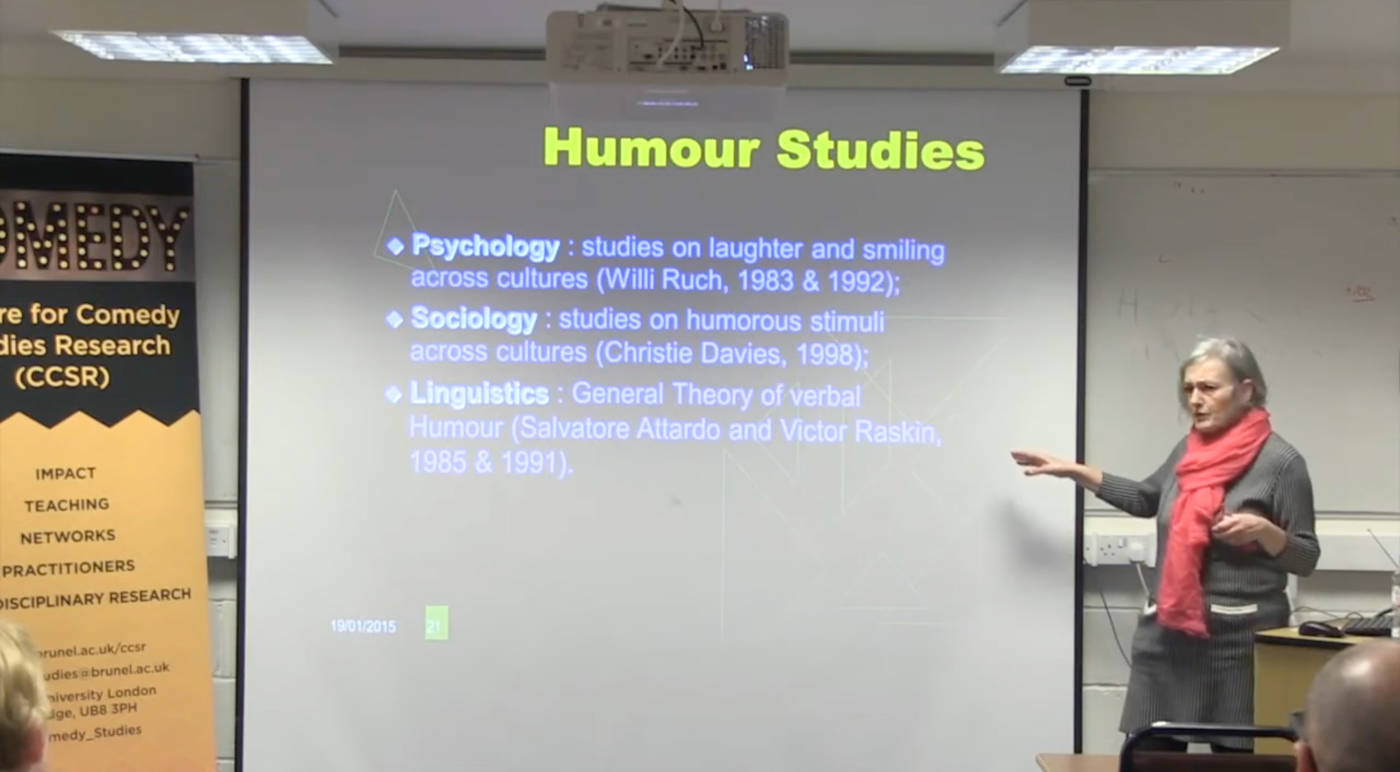
In this presentation Professor Delia Chiaro (University of Bologna) explores whether or not humour is culture specific and whether British people have a better sense of humour than anybody else. Professor Chiaro reports on a study that used examples of verbally expressed humour (VEH) from a number of ‘Made in Britain’ blockbusters to explore how Italian audiences perceive VEH when it is translated and how far translation might have an impact on individual humour responses. Spoiler Alert? Manipulating Comedy and TV Titles for Italian Audiences Dr Chiara Bucaria (University of Bologna at Forlì) discusses the importance of translated film and TV comedy titles as conveyors of cultural trends in the target language. In particular she looks at the strategies used in the adaptation of English titles for the Italian audience, which seem to suggest a conscious attempt by distributors at making Italian titles more explicit and genre-specific, often by disclosing significant elements of the plot of the film or TV show.
Potential areas for further research include:
- pathways into comedy careers and commissioning — access, commissioning cultures, and the sustainability of unpaid creative labour
- marginalised identities in mainstream formats and industries — how visibility, framing and industry structures shape representation
- audiences, belonging and the politics of “relatability” in comedy — how humour creates (and limits) recognition, identification and inclusion
If you’d like to pursue research on this theme, we’re keen to explore possibilities with you. Please reach out via the Centre's email to continue the discussion.