The dominant knowledge and imagination of the Himalayas have been largely constructed through a colonial-Eurocentric lens, which not only obscures the lived realities of people living therein but also their indigenous histories. Furthermore, traditional research approaches often involves a uni-directional flow of knowledge from 'experts' to the 'public' rather than embedding communities within a participatory process of mutual knowledge creation.
This public engagement project titled, 'Indigenising the Himalayas: reimagining its past, present and futures' is funded through the British Academy's inaugural SHAPE Involve and Engage 20203/24 grant. The aim of the project is to 'un-do' the public imagination of the Himalayas by centring the perspectives of its indigenous communities.
This is done in collaboration with the Royal Geographical Society - Institute of British Geographers (RGS-IBG), and through participatory engagement with UK-based Himalayan indigenous diaspora communities tracing ancestry to the Eastern Himalayas of Nepal and Northeast India. Thus, through a participatory approach to public engagement, this project aims to uncover 'hidden histories' of the Himalayas, thereby honouring the cultural knowledge of marginalised communities.
The key cultural partner for this project is the Royal Geographical Society- Institute of British Geographers (RGS-IBG), particularly by engaging with the RGS' extensive archival materials on the Himalayas. The project also actively incorporates the UK-based Himalayan indigenous diaspora communities as key participants/audiences, and all activities are co-developed with members of the three indigenous communities– the Limbu/Yakthung; Kirat Rai, and Newah, who trace their heritage to present-day Nepal and Northeast India.
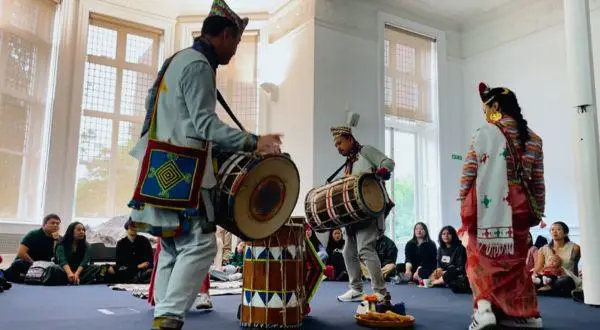 Storytelling through dancing -workshop at the Royal Geographical Society
This project involves two key public engagement activities:
- Reimagining the Himalayas through indigenous storywork: A day event at the RGS: This day-long workshop-style event took place in June 2024 at the RGS and included a 'storytelling through dancing' workshop involving traditional indigenous dance forms such as 'Silli', 'Chyabrung' and 'Lakhey' from the Himalayan region. This day will also include a walking tour within the RGS' Foyle Reading Room, where the public can directly engage with the displayed archival materials (photos, maps, artefacts, etc.).
- Digital exhibition within the RGS website: The stories gathered and archival materials will be curated within a digital exhibition titled, ‘Reimagining the Himalayas’ that will be launched in July 2024.
The project is led by Dr Rohini Rai, Lecturer in Sociology of Race at Brunel. The workshop and exhibition will be co-designed by Dr Rai, the RGS consultant, and community leaders from the diaspora organisations. The project is supported by the Critical Himalayan Collective as the key promotions and engagement partner.
This public engagement project will not only convey Dr Rai's research on racialisation and orientalism in the context of Himalayas directly to the public and communities, but will also act as a catalyst to develop her ongoing work on 'indigenous migrants' in the UK and indigenous communities in the Himalayan context.
Outside of academia, this project opens up cultural spaces for largely underserved ethnic minority and indigenous Himalayan communities, particularly the Nepali-speaking diaspora from Nepal and Northeast India (Sikkim and Darjeeling), who are often marginalised even within the already marginalised South Asian diaspora in the UK.
Hence, the insights and outputs from this project can be applied to the concerned communities but also wider minority ethnic communities in the UK and South Asia.
Meet the Principal Investigator(s) for the project

Dr Rohini Rai - Dr Rohini Rai is a sociologist of race, ethnicity, indigeneity and migration, and the Lecturer in Sociology of Race at Brunel University of London.
She earned her PhD at the University of Manchester, where her thesis titled, 'Northeastern Delhi: 'Race', Space and Identity in a Postcolonial, Globalising City' examined the racialisation of and everyday racism experienced by internal migrants from India’s Northeastern and Himalayan borderlands in Delhi. After her PhD, Rohini worked at the Centre on the Dynamics of Ethnicity (CoDE), University of Manchester, on an ESRC-funded project examining ethnic inequalities in UK higher education, focusing on decolonising British History and Geography.
Since joining Brunel in 2022, Rohini has led the British Academy SHAPE Involve and Engage Grant (2023-2024), on a project titled ‘Indigenising the Himalaya: Reimagining its past, present and futures’, in partnership with the Royal Geographical Society, which examined ‘diasporic indigeneity’ through archives, dance and stories. Rohini was also awarded with Brunel Public Engagement Funds (PEF, 2024) to curate a public engagement event– The London Himalayan Short Film Festival (2024) in collaboration with Brunel South Asia Studies Research Group, the Critical Himalayan Collective and Brunel Nepali Student Society. She currently leads a British Academy-Leverhulme Small Research Grants (2026-2028) project titled ‘Dancing Indigeneity in the Eastern Himalaya: Politics of Recognition and State Appropriation through Sakela Sili’, which examines the politics of indigeneity in Sikkim-Darjeeling Himalaya through the lens of Sakela Sili dance.
Rohini's work is interdisciplinary, collaborative, and community-engaged, involving diverse stakeholders such as UK-based Himalayan diasporic Indigenous organisations (including Kirat Rai Yayokkha, Kirat Yakthung Chumlung, and World Newah Organisation UK) and grassroots cultural-heritage groups in Sikkim and Darjeeling. She is the co-editor of European Bulletin of Himalayan Research (EBHR) and an international board member of Ethnic and Racial Studies journal. Outside academia, she has curated public events like the London Himalayan Short Film Festival (2024) and co-founded the Critical Himalayan Collective
Related Research Group(s)
Human Geography - Aims to develop and consolidate interdisciplinary research around space, place and society at Brunel. We provide a forum for engagement with geographical research, for sharing and receiving feedback on writing and developing new collaborations nationally and internationally.
Partnering with confidence
Organisations interested in our research can partner with us with confidence backed by an external and independent benchmark: The Knowledge Exchange Framework. Read more.
Project last modified 09/01/2025