Many people in the UK live with two or more long-term conditions while trying to manage work and everyday life.
This project uses digital storytelling to help people share their own experiences of health and work in their own words. By creating short personal stories, participants can help others better understand what living and working with two or more long-term conditions (also referred to as multiple long-term conditions; MLTC) is really like.
People living with MLTC must often balance their health, work, and everyday responsibilities, yet their experiences are rarely heard. Some groups, including people from ethnic minority and/or lower-income backgrounds, may face extra challenges and fewer opportunities to share their stories.
More specifically, seeking and maintaining work is a growing challenge for people with MLTC, an area that has received little attention in research.
Without understanding these real-life experiences, it is difficult for communities, employers, and services to offer the right support. With help from the research team, participants create a short digital story about their experiences. These stories will help highlight what support people really need and will contribute to developing more appropriate and responsive employment support programmes. This approach captures experiences often missed in traditional research and gives people a meaningful opportunity to be heard.
Background
Most MLTC research focuses on medical outcomes rather than people’s personal experiences. As a result, the challenges people face at work and in accessing support are often not well understood.
Aims
This project aims to understand what it is like to live and work with MLTC by listening directly to people’s stories. It aims to:
- Explore how people manage work alongside MLTC
- Understand the challenges and support people experience
- Give participants a chance to share their experiences in their own words
Method
In this study participants create a digital story using personal narratives, video, audio, images, and text. This approach captures experiences often missed in traditional research and gives people a meaningful opportunity to be heard. No technical skills are required, and support is provided throughout the process. Participants decide what they want to share and how they want to tell their story.
What will happen to the stories
With participants’ permission, the digital stories will be brought together to create a collective digital story, and the participant can decide if their digital story may be shared through research publications, online platforms, and engagement activities.
Why this project is being done
By hearing directly from people with lived experience, this project gives a voice to individuals whose perspectives are often unheard. The stories aim to highlight support needed and ensure that employment programmes and workplace practices are shaped by the experiences of the people they are designed to support. The project is part of the lead investigator’s PhD research and will also contribute to their ongoing doctoral work.
Interested?
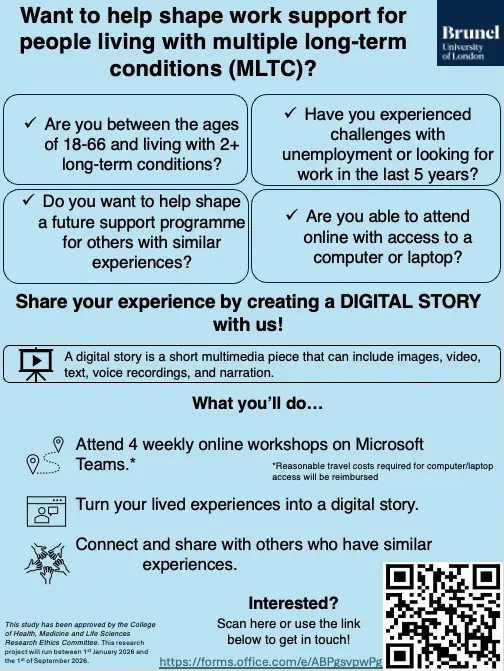
If you are interested in taking part in this project in-person in July/August 26 or would like further information, please use this link (https://forms.office.com/e/CyZPgE8RRu).
If you are interested in taking part in this project online in September 26 or would like further information, please scan the QR code on the poster or use this link (https://forms.office.com/e/ABPgsvpwPg).
You can also email your interest to Dyna Androulaki Korakaki at dyna.androulakikorakaki@brunel.ac.uk or Dr Emily Hunt at Emily.Hunt@brunel.ac.uk
Meet the Principal Investigator(s) for the project
Dynameni Androulaki Korakaki - I am a doctoral researcher with a keen interest in health behaviour change, intervention development, and the impact of health inequalities.
In my current project, I am using digital storytelling as a creative qualitative methodology to explore the lived experiences of health and work among people living with multiple long-term conditions. These stories will help inform the co-design of a future intervention.
Previously, I worked with a Tier 2 NHS Weight Management Service facilitating co-production workshops with local community groups to guide the development of behaviour change programmes.
Partnering with confidence
Organisations interested in our research can partner with us with confidence backed by an external and independent benchmark: The Knowledge Exchange Framework. Read more.
Project last modified 08/07/2026