In recent years, the world has witnessed a massive growth in mobile broadband traffic, due to increasing numbers of connected devices, such as smartphones and tablets.
Customers’ expectations for high-speed mobile broadband are on the rise as people rely more and more on real-time mobile applications, high-quality video content, cloud-based services and expected to stay connected anytime, anywhere. The existing cellular network suffers from inflexible and expensive equipment, complex control plane protocols, and vendor specific configuration interfaces.
This research designed an improved mobile Evolved Packet Core (EPC) architecture, called Software Defined Evolved Packet Core (SDEPC) which utilises Software Defined Networking (SDN) to introduce an abstraction layer separating the control plane from the underline data plane of 3GPP EPC. This architecture provides centralised control, programmable forwarding entities, and a highly flexible and scalable way to deploy new applications and services. As a result, it provides better performance in terms of mobility management and signalling utilisation with the advantage of low cost, less complex system implementations, and ease of network management and operation.
The proposed architecture consists of:
- centralized controller with high-level intelligent, control and configuration programmes (MME, SGW, PGW, network discovery) that specify the behaviour of an entire network
- forwarding plane represented by several OpenFlow switches, and enhanced eNodeB equiped with OpenFlow switch to send and receive OpenFlow messages to/from the controller.
The architecture leverages the centralised view feature of the SDN network to handle user traffic during mobility without implementing GTP tunneling used by 3GPP standards.
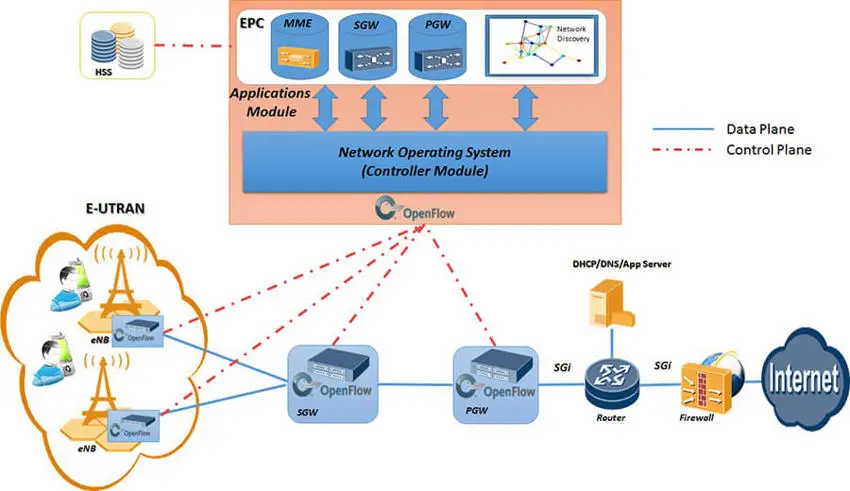 Software Defined Evolved Packet Core network
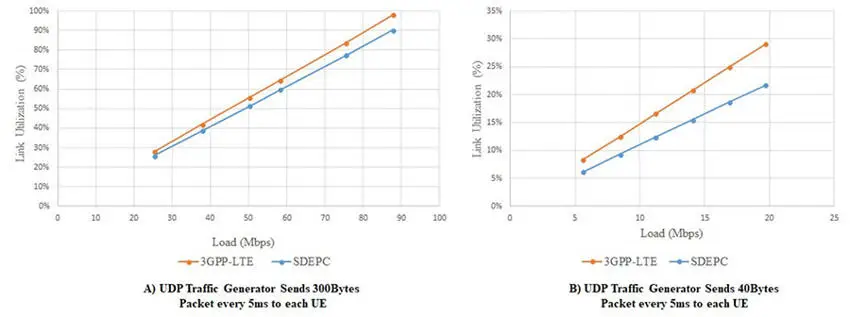 Load Vs Link Utilization
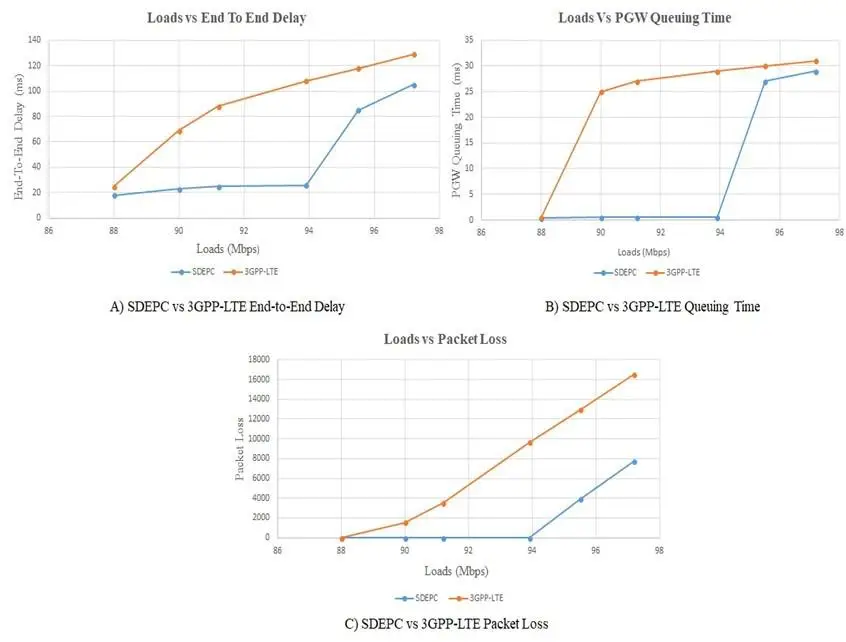 System performance comparison result
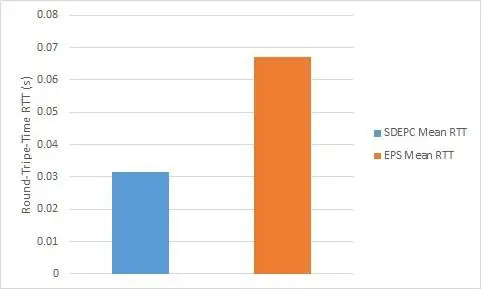 EPS vs SDEPC Mean Round-Trip Time (RTT)
Meet the Principal Investigator(s) for the project

Professor John Cosmas - John Cosmas is currently a Professor of Multimedia Systems in the College of Engineering, Design and Physical Sciences at Brunel University London. He is co- Director of the University Research Centre: Intelligent Digital Economy and Society Research Centre (IDEAS) and has been an associate editor of IEEE Transactions on Broadcasting.
His research interests are concerned with the development of Multimedia Networked Systems applied to Future of Broadcasting, Cellular Communications, 2D/3D digital video/graphics media and the synergies between these technologies towards their application towards the benefit of the smart homes, cities environment, health and societies.
He has participated in sixteen EU ICT and two EPSRC funded research projects since 1986 and he has led three of these (CISMUNDUS, PLUTO and 3D MURALE). He has graduated 36 PhD and 4 MPhil students and published over 91 research journal papers and 200 conference papers. His latest research is concerned with management of heterogeneous cellular networks, convergence of cellular and ad-hoc networks, 3D MIMO and efficient Software Defined Networks architectures.
Partnering with confidence
Organisations interested in our research can partner with us with confidence backed by an external and independent benchmark: The Knowledge Exchange Framework. Read more.
Project last modified 14/07/2021