
Overview
2nd in London for Politics - National Student Survey 2025
Who has political power? Why do they have it? To whom are they accountable? Is violent protest ever justified? If these questions evoke a response in you and raise more questions in turn, politics is the degree for you.
Politics is an exciting and dynamic subject, simulating debate and offering insight into how the ever-changing world around us works. It’s also a degree that can demonstrate your intellectual acumen and understanding of world affairs, which will be an asset in many fields of work.
The broad-based nature of the course at Brunel means you will be studying a wide breadth of modules from British politics to US foreign policy and political change. But you’ll not only be learning about politics – you’ll be analysing politics using the tools of political science to help deepen your understanding and critical thinking.
Opt for a placement year and you'll gain work experience that is highly valued by employers. Brunel students have secured placements in the Environmental Audit Committee, the House of Commons, Directorate of Gender Affairs, HM Treasury and the Competition Commission, to name only a few.
You can also opt to take part of your degree abroad in one of our partner universities in Europe, or participate in an exchange programme to China or the USA to study politics in a different part of the world whilst experiencing a new culture.
Brunel is a dynamic university choice for your politics course. You’ll be taught by politics experts who are often called on to comment on radio and television. The Brunel campus has hosted the filming of BBC’s Question Time and is a political hub during local and national elections.
Brunel politics graduates enter diverse careers. Many of our former students go into politics and the civil service and some are currently at GCHQ and military intelligence. Others work in the public and private sector like the NHS, international banks, business consultancy, law, NGOs and the media. Whichever route you chose, a politics degree with Brunel will set you up for a successful future.

"Studying at Brunel helped me develop a deeper understanding of my passion in politics and mental health." - Angela Awuah

"My best memory of studying at Brunel was winning the NUS / Daily Mirror Diversity Award for my writing’s in the Route 66 magazine" - Jay Singh-Sohal

"Brunel were happy to support my particular study needs. I had very good support from the Assistive Technology and Study Skills teams to give me the support that I needed." - Ekua Cant

"Having leading experts at the University is a strong asset – Brunel offers the best" - Kerri-Anne Price
"Studying at Brunel helped me develop a deeper understanding of my passion in politics and mental health." - Angela Awuah
"My best memory of studying at Brunel was winning the NUS / Daily Mirror Diversity Award for my writing’s in the Route 66 magazine" - Jay Singh-Sohal
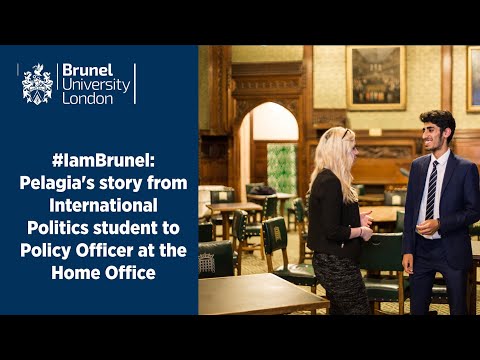
Please enable cookies to view this video.
Click here to view the videoYou can explore our campus and facilities for yourself by taking our virtual tour.
Course content
The course content is made up of a variety of subject area strands that can be studied across all three years of the programme. At every level, there are modules relating to each strand. After taking the compulsory modules in the first year, you can choose to study across a range of strands, or specialise in particular strands. Below is a list of the strands:
American Politics: The United States is hugely influential both as a global power and as a political beacon. This strand assesses the nature of the American polity exploring across the three years the role of America’s political institutions, key issues facing the American political system and the role and function of the media in fashioning American government policy.
British Politics: The focus of this strand is the United Kingdom: what it looks like, how it operates and where it is going. Key topics will include the nature and working of the British state, the role and function of Parliament and how parties and voters interact.
Comparative Politics: The relationship between different polities is a key area of modern political science research. This strand engages with this by assessing in a comparative frame: different countries, their political systems and the actors engaging with the political systems. Comparisons across countries and/or across time are used to explore the differences and similarities between the systems to answer questions on who gets what, when and how in terms of allocation of resources within and between polities.
Methodology and Research Skills: This strand will help you develop the tools for sustained research in political science. This will include research design, qualitative methods, such as interview techniques, as well as quantitative analysis of, for example, polling data. There will be an opportunity to take this to an advanced level and develop key transferable research skills.
Political Ideology and Theory: This strand explores political thought across the ages from ancient times to the present. You will begin with a broad survey of major ideas in political theory, before being able to look in greater depth at particular ideologies, e.g. liberalism, Marxism, fascism and particular concepts such as multiculturalism and equality.
Public Policy and Public Administration: The focus of this strand is how government decisions, i.e. public policy, is developed, implemented and evaluated and by whom. This will include contentious areas of public policy, for instance welfare policy. It will also look at how public policy is assessed and analysed and the means by which its success (or failure) is judged and what tools can used to increase the success of implementing policy proposals.
Compulsory
- SC1603 - Contemporary Challenges
This module will introduce students to applications of social and political sciences, providing students with the opportunity to practice the skills needed to communicate the results of their work accurately and reliably, and with structured and coherent arguments.
- SC1601 - Fundamentals of the Social Sciences
This module will introduce students to key concepts, theories, thinkers and approaches in the social and political sciences and history. Students will also learn the techniques used by a range of disciplines within the social and political sciences and history for gaining and validating knowledge of the social and political world.
- SC1604 - Special Subjects A
This module will introduce students to the underlying concepts and principles associated with their area(s) of study in relation to other areas of the social and political sciences; to provide students with the opportunity to evaluate and interpret these within the context of that area of study. It will also develop students’ ability to present, evaluate and interpret qualitative and/or quantitative data, in order to develop lines of argument and make sound judgements in accordance with basic theories and concepts of their subject(s) of study.
- SC1605 - Special Subjects B
This module will introduce students to the underlying concepts and principles associated with their area(s) of study in relation to other areas of the social and political sciences; to provide students with the opportunity to evaluate and interpret these within the context of that area of study. It will also develop students' ability to present, evaluate and interpret qualitative and/or quantitative data, in order to develop lines of argument and make sound judgements in accordance with basic theories and concepts of their subject(s) of study.
Compulsory
- PP2633 - Explaining Politics: Quantitative Political Science in Practice
This modules aims to provide students with the skills to analyse political data and introduce methods for gathering and understanding data. Students will be encouraged to critically engage with the use of existing statistical data in political discourse and demonstrate the importance of quantitative analysis in domestic and international politics.
- PP2631 - From Student to Scholar: Successful Research in the Modern World
Preparing students for their final year dissertation begins in the second year in From Student to Scholar: Successful Research in the Modern World. This module introduces students to a variety of analytical perspectives, research methods and techniques used in designing a research project in politics, international relations and international politics.
- PP2638 - Theories of International Relations
This module introduces students to major theoretical approaches in the study of International Relations. These theories are employed to examine and understand contemporary actors in world politics such as states, international organisations, non-governmental actors as well as major issues and problems such as war, terrorism, climate change or nuclear proliferation. The aim is to give students a critical understanding of IR theory
Optional
- PP2636 - Climate Politics
This module aims to enable students to attain a comprehensive understanding of key concepts and theories in the politics and political economy of climate change. It will provide students with resources to assist them in making informed judgments on a range of questions and debates.
- SO2609 - Gender, Sexuality and Feminism
This module will introduce students to core ideas in feminism via the key concepts of gender and sexuality. It will develop students’ understandings of social structures, human cultures, and economic inequalities and political relationships. The course will offer theoretical tools and historical insights into gendered, feminised, and sexualised socio-cultural worlds.
- PX2620 - Insurgency and Counter-insurgency
This module examines the concept and development of insurgency and counter-insurgency from the classical period to the present, with an emphasis on the post-1789 period, especially the post-1945 wars of decolonisation. The module will conclude with the post-9/11 ‘war on terror’ and current examples of insurgency and counter-insurgency.
- PP2627 - Issues in American Politics
This module familiarises students with contemporary issues on the American political agenda and demonstrates how politicians adapt policy stances and organisational and electoral strategies to accommodate change in political debate. Students are encouraged to adopt a more interdisciplinary and multidisciplinary approach to learning about American politics by examining social, moral, cultural and economic issues through a partisan political perspective.
- SA2624 - Middle East: Societies, Religion and Politics
This module examines a particular ethnographic region, assessing in the first instance whether these regions can usefully be considered cultural areas, and going on to examine the key issues for the different parts of each region. The module covers topics such as religion, gender, economics, and local politics in the area of study.
- PX2XXX - Military History and Strategic Thought
This module looks at and evaluates a range of military and political thinkers and commanders who have been influential in shaping and understanding the nature of modern warfare. This will include those who have looked at war holistically (Grand Strategy, Strategy, Tactics and Operations) and through the prism of political thought and structures, as well as those who have considered certain distinct elements of it – e.g. land, sea and air warfare. Consideration will also be given to the idea of distinct national ways of warfare, for example the so-called “American way of warfare” or the “British Way of warfare”. There will also be an exploration of such concepts as asymmetric warfare, insurgency and counter-insurgency.
During the module students will be exposed to major pieces of writing (in translation where necessary) from key military thinkers and theorists and will develop an understanding of how to approach the analysis and evaluation of such sources.
It aims to give students coverage from the Classical period to the present, and it introduces students to strategy as a global concept, with thinkers such as Sun Tzu and Mao Zedong, and ideologies such as Focosim. It assess students summatively through the prism of document analysis of primary sources from different theories across time and space.
- PP2628 - National Security Intelligence
This module furnishes students with an overview to the field of national security intelligence. It also examines in greater detail intelligence collection, analysis, counterintelligence, covert action, and other selected topics.
- PP26XX - Plato’s Republic
- To explore in depth the foundational text in the history of political thought
- To develop an understanding of some of the main ideas, themes, images and tropes in the Western tradition of political theory as they emerge from its original text.
- To develop writing and analytical skills within political thought.
- To develop the skill of thinking politically.
- SA2625 - South Asia: Cultures, Societies and Development
This module examines the region of South Asia, assessing whether the geographical region can usefully be considered as a cultural area, and going on to examine the key issues for the different parts of the region. The module covers topics including colonial histories, caste and class, gender, kinship, globalisation, and South Asian diasporas. It draws, in particular, on the disciplines of anthropology and history and on the field of development studies.
- PP2629 - The State and Revolution
This module provides students with an understanding of the historical emergence of two of the central concepts of modern political thought: the state and revolution, or the constitution of political order and the process of fundamental political transformation. We study the development of these concepts in some of the major events of political modernity, from the 16th to the 19th centuries.
Compulsory
- SC3602 - Advanced Research Skills for History
- To introduce and guide students on the research and writing process for dissertations or Major Final Projects
- To support students to develop their reading, writing, and analytical skills for their dissertation.
- To introduce students to the techniques used in designing and executing a research project in their discipline.
- To encourage students’ critical engagement with their chosen dissertation topic
- SC3601 - Dissertation
To develop students’ abilities to plan, design and execute a research project in the subject area of their degree programme, to communicate their ideas and critically evaluate the success of their project.
Optional
- SO3614 - Apocalypse! Crisis and Society
Explore the social & political significance of representations of national and global crises, and public perceptions of controversies. Students analyse dystopian popular and scientific discourses that dwell on disorder and catastrophe. Indicative content includes risk, uncertainty, globalisation, the environment, disease, capitalism. Public understanding, perception and engagement with popular and scientific controversies and notions of crisis.
- CO3617 - Digital Media, Social Movements and Change
This module gives you an in‑depth, critical understanding of how social movements emerge, succeed or fail to create social or political change, using real‑world cases to explore media tools, leadership, collective identity and governmental or international responses. You’ll build strategic thinking by analysing how historical and contemporary movements organise, mobilise and coordinate in the digital age.
- SA3631 - Environment and Sustainability
The aim of this module is to look at environment and sustainability from a multipronged perspective. The module will help students develop a nuanced understanding about managing our natural resources. Both top down and bottom up approaches to manage nature will be explored.
- PP3629 - European Union Politics: Problems and Prospects
In this module students will discuss the development and functioning of the EU from its inception to the present day and be introduced to and learn to evaluate a range of theoretical perspectives on the EU’s creation, development and functioning. Students will examine a range of political problems in the European integration process, such as legitimacy, domestic and social impact, institutional and policy reform, enlargement, and future directions.
- PP3xxA - Great Power Competition: Russia, China and the USA
Students will be able to:
- Relate the great power competition today to historical precedents.
- Understand the motivations behind Chinese, Russian, and U.S. national security policies.
- Define the tools that great powers use to further their interests in the world.
- Compare the ways smaller states influence great powers in the international sphere.
- Interpret the security risks involved with great powers competing in the political, economic, and military spheres.
- PP5628 - International Development: Politics and Policy
This module will analyse the origins of the ‘development’ paradigm, competing theories of different development. trajectories observed globally, and contemporary scholarly perspectives on international development. It will examine and assess global and local challenges and policy solutions, drawing on a wide range of country case studies and will review empirical challenges in international development including data, measurement and evaluation methods.
- PP3631 - Marx and the Critique of Political Economy
This module involves reading several key works by Marx, culminating in several weeks on Das Kapital
- PP3623 - Media, Politics & Power in America
This module seeks to familiarise students with the contemporary issues agenda in American politics. It seeks to demonstrate the ways in which politicians and institutions adapt policy stances and organisational strategies to accommodate changes in the nature, content and direction of political debate.
- GY3610 - Modern Slavery and Human Trafficking
This module provides a ‘meta-critique’ of both the dominant and critical claims related to modern slavery and human trafficking. The module aims to introduce students to the historical debates on labour and migration that led to the current international laws on ‘human trafficking’ (and national laws on ‘modern slavery’ in the UK and Australia). Students will be able to critically analyse the geopolitics of several competing terminologies, such as ‘human trafficking’, ‘modern slavery’, ‘forced labour’, and ‘unfree labour’. They will be able to critically evaluate whether and how these terms help address labour exploitation and/or are selectively deployed to serve certain political ideologies. Not only will students develop critical lenses to analyse the dominant paradigm of ‘modern slavery’ and ‘human trafficking’, but they will also be able to critically interrogate the strengths, weaknesses, and biases of the critical literature. Overall, the module is designed to encourage students first to engage with critical perspectives and then to go beyond them to decolonise one of the most politically charged debates of the 21st century, enabling them to develop original ideas on how to address the exploitation, oppression, and rightlessness of all workers.
- PP3621 - Parliamentary Studies
This module aims to provide students with a detailed understanding of the UK Parliament by examining its structure, internal processes, and different committees, and to give students an understanding how to transfer the skills they have acquired when thinking about social, historical and political issues to practical ongoing issues that parliament is encountering in its committees or in legislation it is devising.
- CO3xxD - Politics and Digital Cultures
- PP3640 - Political Economy of the Changing World Order
The module introduces students to political economy, in particular international political economy (IPE), and to geopolitics. It explores the evolution of world orders, with a focus on the current period. It examines relationships between economic forces and state strategies (economic and geopolitical) on the international stage. It will familiarise students with key concepts and topics in IPE.
- CO3xxC - Political Satire and Comedy
This module provides students with a sophisticated and critical knowledge and understanding of the relationships between politics, satire and comedy. These relationships are explored in relation to their institutional, historical and social contexts and their textual conventions. The module explores political satire and comedy as it exists in a broad range of texts (e.g. television, cartoons, live stand-up and digital comedy). The module equips students with appreciation and understanding of the continuities and changes in political satire and comedy in national and global political systems and international relations, and its relationship with concepts of political power and hegemony.
- PP3634 - Public Policy Analysis
How do governments make public policy? Why do public policies vary across countries? How can public policy be analysed? These are the questions that will be explored in this module. The module will provide the participants with a strong theoretical foundation for analysing public policy and skills to communicate the analyses to non-academic stakeholders in public policy.
- PP3622 - Terrorism and Counterterrorism
This module aims to address a series of empirical questions regarding the causes, conduct, and consequences of campaigns of terrorism in the modern world. It provides students with an understanding of a series of key debates in the social science literature.
- PX3626 - The Arab-Israeli Conflict
We survey the Arab-Israeli conflict, covering three overarching themes: 1) Origins of the Conflict; 2) Evolution of the Conflict; and 3) Peace and its Limits. The module covers the origins of both national movements, the development of the conflict under British rule, the major Arab-Israeli wars, peace agreements, and it ends with recent events.
This course can be studied undefined undefined, starting in undefined.
This course has a placement option. Find out more about work placements available.
Please note that all modules are subject to change.
Careers and your future
Our students pursue a wide variety of jobs after graduating. Some go into Politics and the civil service and have worked for Members of the Parliament such as John McDonnell MP, or former Labour party general secretary Baroness McDonagh. Other graduates have joined Foreign and Commonwealth Office, the Home Office, GCHQ and military intelligence.
Others work in the public and private sectors, law and NGOs whilst some graduates become researchers, teachers and librarians.
UK entry requirements
2026/7 entry
Please check our Admissions pages for more information on other factors we use to assess applicants as well as our full GCSE requirements and accepted equivalencies in place of GCSEs.
A minimum of five GCSEs (grade C/4 or above) are required, including GCSE English Language (grade C/4) or GCSE English Literature (grade B/5)
Standard Offer: GCE A level BBB
Contextual Offer: GCE A level BCC
We apply a contextual admissions process for UK undergraduate applicants who meet one or more of our contextual markers – please see our contextual admissions page for more information.
Standard Offer: BTEC Level 3 National Extended Diploma DDM in any subject
Contextual Offer: BTEC Level 3 National Extended Diploma DMM in any subject
We apply a contextual admissions process for UK undergraduate applicants who meet one or more of our contextual markers – please see our contextual admissions page for more information.
Standard Offer: BTEC Level 3 National Diploma DM in any subject and an A Level grade B
Contextual Offer: BTEC Level 3 National Diploma MM in any subject and an A Level grade B
We apply a contextual admissions process for UK undergraduate applicants who meet one or more of our contextual markers – please see our contextual admissions page for more information.
Standard Offer: BTEC Level 3 National Extended Certificate Merit in any subject, with A level grades BB
Contextual Offer: BTEC Level 3 National Extended Certificate Merit in any subject, with A level grades BC
We apply a contextual admissions process for UK undergraduate applicants who meet one or more of our contextual markers – please see our contextual admissions page for more information.
Standard Offer: International Baccalaureate Diploma 30 points. GCSE English equivalent SL 5 or HL 4
Contextual Offer: International Baccalaureate Diploma 28 points. GCSE English equivalent SL 5 or HL 4
We apply a contextual admissions process for UK undergraduate applicants who meet one or more of our contextual markers – please see our contextual admissions page for more information.
Standard Offer: Obtain a minimum of 120 tariff points in the Access to HE Diploma with 45 credits at Level 3 in any subject
Contextual Offer: Obtain a minimum of 104 tariff points in the Access to HE Diploma with 45 credits at Level 3 in any subject
We apply a contextual admissions process for UK undergraduate applicants who meet one or more of our contextual markers – please see our contextual admissions page for more information.
Merit overall in any subject
If your qualification isn't listed above, please contact the Admissions Office by emailing admissions@brunel.ac.uk or call +44 (0)1895 265265 to check whether it's accepted and to find out what a typical offer might be.
Brunel's committed to raising the aspirations of our applicants and students. We'll fully review your UCAS application and, where we’re able to offer a place, this will be personalised to you based on your application and education journey.
Please check our Admissions pages for more information on other factors we use to assess applicants, as well as our full GCSE requirements and accepted equivalencies in place of GCSEs.
EU and International entry requirements
If you require a Tier 4 visa to study in the UK, you must prove knowledge of the English language so that we can issue you a Certificate of Acceptance for Study (CAS). To do this, you will need an IELTS for UKVI or Trinity SELT test pass gained from a test centre approved by UK Visas and Immigration (UKVI) and on the Secure English Language Testing (SELT) list. This must have been taken and passed within two years from the date the CAS is made.
English language requirements
- IELTS: 6.5 (min 5.5 in all areas)
- Pearson: 59 (59 in all subscores)
- BrunELT: 63% (min 55% in all areas)
- TOEFL: 5 (min 4 in all subscores)
You can find out more about the qualifications we accept on our English Language Requirements page.
Should you wish to take a pre-sessional English course to improve your English prior to starting your degree course, you must sit the test at an approved SELT provider for the same reason. We offer our own BrunELT English test and have pre-sessional English language courses for students who do not meet requirements or who wish to improve their English. You can find out more information on English courses and test options through our Brunel Language Centre.
Please check our Admissions pages for more information on other factors we use to assess applicants. This information is for guidance only and each application is assessed on a case-by-case basis. Entry requirements are subject to review, and may change.
Fees and funding
2026/27 entry
UK
£9,535 full-time
£1,385 placement year
International
£17,400 full-time
£1,385 placement year
Fees quoted are per year and may be subject to an annual increase. Home undergraduate student fees are regulated and are currently capped at £9,535 per year; any changes will be subject to changes in government policy.
For the 2026/27 academic year, tuition fees for home students will be £9,790, subject to Parliamentary approval.
In England and Wales, tuition fees for home undergraduate students are subject to the Government fee cap. The Government has confirmed that this will be £9,790 for 2026/27 and £10,050 for 2027/28 (subject to Parliamentary approval).
From 2028 onwards, the fee cap is expected to rise annually in line with inflation. This means your tuition fees in future years may increase to reflect these changes.
International fees may change annually, by no more than 5% or RPI (Retail Price Index), whichever is the greater.
More information on any additional course-related costs.
See our fees and funding page for full details of undergraduate scholarships available to Brunel applicants.
Please refer to the scholarships pages to view discounts available to eligible EU undergraduate applicants.
Scholarships and bursaries
Teaching and learning
You'll be taught by world leading experts in your field of study, and have the opportunity to interact with fellow students on London’s leading campus University.
Your programme will consist of various learning and studying activities, including lectures, seminars and discussions. Students will study six modules during two terms across the academic year (4 modules and a dissertation in the third year). Each module will have on average two-to-three hours in person contact time per week in lectures, seminars and workshops in the teaching terms. There will also be the opportunity for a further six hours per week to seek guidance during module lecturers’ feedback and consultation hours. Additionally, students can seek support in individual meetings with their personal tutors, both on campus and online. There will also be regular cohort meetings and student society events, at both programme and departmental levels. Field trips and excursions to support students’ learning will be organised throughout the year.
All lectures, seminars, cohort meetings and other social activities will occur in person on the Brunel campus. It is expected that students will regularly attend these events, as sustained engagement with a learning community is a central dimension of the Brunel experience. Online provision of some activities will be made available when it is appropriate to the learning outcomes of your programme.
Students are strongly advised to purchase core texts from module reading lists, although copies are also available via Brunel Library.
Access to a laptop or desktop PC is required for joining online activities, completing coursework and digital exams, and a minimum specification can be found here.
We have computers available across campus for your use and laptop loan schemes to support you through your studies. You can find out more here.
You’ll be taught in lectures and seminars by academic staff who are internationally known for publishing and presenting papers worldwide. Their research is often reported in the press and media, which will help to keep your learning contemporary and cutting edge.
You’ll also benefit from the expertise of staff who are consultants to government departments including the Cabinet Office, Home Office and Ministry of Defence in the UK; the council of Europe; the Georgian Ministry of Defence and the Canadian Department of Citizenship Abroad.
Also, the proximity of the Brunel campus to central London’s world-class research facilities, the British Library, Westminster and Whitehall, means you'll be best placed to immerse yourself in an established political arena.
Should you need any non-academic support during your time at Brunel, the Student Support and Welfare Team are here to help.
Assessment and feedback
You’ll be assessed by a combination of coursework and exams, but most of your time will be spent in private study and reading. In your final year you will produce a final dissertation on a subject of your choice under the guidance of a dissertation supervisor.
Read our guide on how to avoid plagiarism in your assessments at Brunel.
