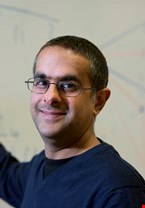
Dr Shash Virmani
Senior Lecturer
Tower A 035
- Email: shash.virmani@brunel.ac.uk
- Tel: +44 (0)1895 267352
Teaching
Mathematics is important, and its importance is often not communicated well at the point of learning. For example, we all learn about the pythagoras rule for triangles in school, and we might be told that it is used to help us design buildings or work out the diagonal dimension of a television screen. However, it is not usually explained that without our understanding of pythagoras there would be - for very fundamental reasons - no MRI scanners, xray machines, or ultrasound in hospitals (why? you can look it up, but if you are not satisfied with what you hear then drop me an email).
So it is not an exaggeration to say that mathematics is a matter of life and death.
I could give many many examples other than medical imaging, both positive and negative, that justify that claim (e.g. the misuse of probability in medical and legal cases).
Having said this, similar importance could be attached to any other subject that helps us understand the way the world and universe we live in seems to work.
This strong belief in the importance of mathematics underpins the way that I teach. Society needs mathematics not to be the preserve of a few people - if so it is only they who could meaningfully use it and decide how it is used by others.
One obstacle to spreading the word about mathematics, or STEM in general, is the general idea that some people are just good at it and others aren't. It is much much more nuanced than that. I am not a "genius" and in general I am sceptical of the emphasis on "natural talent" that is often prevalent. Any academic or research success I have had has been down to hard work, a healthy dose of luck, and a whole load of setbacks. Moreover, there is evidence that the educational assessment system doesn't always reflect people's full potential (see e.g. here), even when we ignore additional hidden factors such as socio-economic disadvantage.
So when I teach students I do not spend my time judging "innate ability", I just want to help them grow as best as they can from whatever their starting point. In return I expect a constructive attitude to mathematics - I hope that the students I teach realise that mathematics is important and empowering, and are not just studying it for the degree certificate, but for the knowledge and power that they will gain.
I understand that going to university is a big commitment both financially and otherwise. However, it is important to note the strong evidence of the benefits maths degrees bring both in terms of future earnings (see e.g. Longitudinal Education Outcomes (LEO) data - GOV.UK), and in terms of personal empowerment.
Over the years I have taught many courses, but at the time of writing I am teaching a second year module in Machine learning for AI and a final year module in Mathematical finance, as well as supervising final year projects and a PhD student.