
Overview
Our Chemical Engineering BEng degree is an innovative course that has been developed to equip you with a broad range of knowledge and skills to meet the needs of the chemical and biochemical industry. The course is internationally accredited by the Institution of Chemical Engineers.
Throughout your studies, you’ll have access to a new, modern laboratory with equipment and rigs for your experimental work. The latest industry standard engineering software packages are available for you to use in the purpose-built computer laboratories.
Our BEng chemical engineering course can be studied full-time over three years, or four years with a placement year. We encourage the placement year option because time spent in industry prepares you for the world of work and you’ll benefit from a year’s professional experience when you graduate. If you opt for the placement year, you could find yourself making a difference in the real world working in energy, pharmaceutical or consumer goods.
At the end of their final year, engineering and maths students are invited to showcase their project work at Brunel Engineers +, an event that both celebrates their achievements and gives them the chance to network with industry figures and employers. This video shows some of the projects exhibited at the 2024 Brunel Engineers + event, with explanations by the students themselves.
National salary surveys consistently place chemical engineers at the top of the engineering pay scales, meaning you will be studying for a lucrative and successful career with our degree.

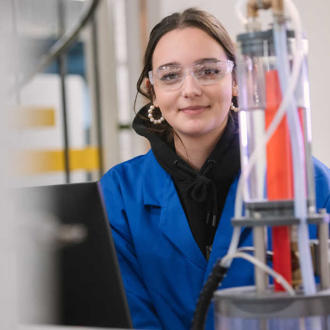
"Joining the chemical engineering department has helped me grow academically and professionally as I’ve been allowed to work at the Uni doing a summer internship." - Emilie Diaz
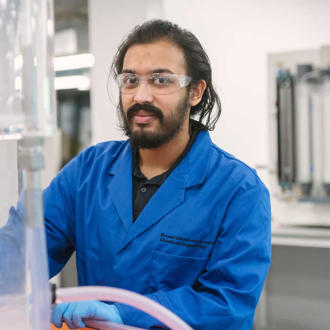
" I have been able to take on a selection of roles within my department allowing me to network with others doing my degree or similar research and development projects." - Pranay Hirani
"Joining the chemical engineering department has helped me grow academically and professionally as I’ve been allowed to work at the Uni doing a summer internship." - Emilie Diaz
" I have been able to take on a selection of roles within my department allowing me to network with others doing my degree or similar research and development projects." - Pranay Hirani
You can explore our campus and facilities for yourself by taking our virtual tour.
Course content
Course delivery is a well-balanced mix of theory and practical sessions. In your first two years, you will gain solid knowledge and understanding of key areas in chemical engineering. You’ll also be introduced to process plant operation, control and safety through the Chemical Engineer’s Toolbox module. In your final year, you move on to modern topics such as big data analytics and you will work on your major design project.
Compulsory
- BE1607 - Engineering Mathematics and Programming I
This module aims to equip students with a solid foundation in engineering mathematics and introductory programming. It develops their ability to understand and apply fundamental mathematical methods relevant to engineering practice, introduces programming as a tool for solving engineering problems, and enhances their skills in formulating, representing, and solving problems using algorithmic and computational approaches.
- BE1608 - Engineering Mathematics and Programming II
This module aims to equip students with a solid foundation in engineering mathematics and introductory programming. It develops their ability to understand and apply fundamental mathematical methods relevant to engineering practice, introduces programming as a tool for solving engineering problems, and enhances their skills in formulating, representing, and solving problems using algorithmic and computational approaches.
- BE1609 - Engineering Practice
This module will develop essential skills required by students across all engineering disciplines, supporting their progression through higher education and into professional practice, with the aim of maximising employability. Skills development will be addressed in the following areas: problem solving; personal and professional development; career planning; basic engineering design; introductory project management; communication; working effectively in inclusive teams; and health, safety, and security.
- BE1610 - Engineering Systems and Energy I
This module will provide a grounding in the concepts of measurement and uncertainty. It will also develop students’ knowledge of the applied physics relationships that govern engineering systems, focusing on system boundaries and variables of interaction, and will establish the ability to define system boundaries and apply relevant simple models.
- Engineering Systems and Energy 2
Aims: To provide a grounding in concepts of measurement and uncertainty; to provide knowledge about applied physics relations that govern engineering systems within their boundaries and via their variables of interaction; to establish ability to define system boundaries and apply relevant simple models.
- Engineering Mechanics - Statics
Aims: To provide a grounding in the fundamental principles of engineering mechanics; to provide knowledge and understanding of Newton’s laws and their application for the solution of static problems; to provide experience and confidence in problem-solving.
- Engineering Mechanics and Materials
Aims: To provide a grounding in the fundamental principles of engineering mechanics, including statics and dynamics; to provide knowledge and understanding of the common and important material properties for various engineering applications; to provide experience and confidence in problem-solving.
- Chemical Engineering Introduction
The aim of this module is to provide an overview of the roles chemical engineers play both from an industrial perspective and in research in development. The module will cover the basic principles of chemical engineering aspects, processes and their applications. It will provide students with examples of successfully implemented industrial processes, processes under development, and open-ended challenges by incorporating principles of heat and mass balances, safety and sustainability, and finally process economics.
Compulsory
- Chemical Engineer’s ToolboxThe primary aim of this module is to prepare and arm our graduates with interpersonal skill sets, practical hands-on experience, and tools essential for a modern chemical engineer to approach, develop and solve day to day challenges attractive to employers. Topics include unit operations, process control, computer-aided simulation, and all aspects of process safety.
- Engineering Computing and StatisticsThe aim of this module is to develop knowledge and skills of applied mathematics and statistical concepts useful to solve engineering problems. This includes the ability to develop simple mathematical models that represent experimental data set, estimate relevant model parameters and assess model performance as well solving differential equations describing chemical engineering phenomena. Students will be introduced to relevant statistical software (e.g. R, Python).
- Chemical Engineering ThermodynamicsThe aim of this module is to introduce the theory and applications of chemical-engineering thermodynamics including the fundamentals of phase equilibria, solution thermodynamics and chemical-reaction equilibria, various types of power generation systems and main thermodynamic cycles. The students will learn to interpret and apply theories in analysing equilibrium thermodynamic systems.
- Chemical Reaction EngineeringThe aim of this module is to introduce chemical and biochemical reaction engineering and basic (bio)reactor system design. It includes studying the principles of reaction kinetics and their optimisation, in order to define the best reactor design for homogeneous and heterogeneous processes. The application of fundamental theory will be demonstrated using traditional and modern industrial examples.
- Fluids MechanicsThe main aim of this module is to present the various forms of transport phenomena and their mechanisms (momentum, heat and mass transfer) and to apply knowledge to typical chemical engineering problems.
- Engineering ChemistryThis module aims to provide fundamental chemical science knowledge and deliver principles of scientific problem analysis and problem-solving skills through the integration of chemical concepts, materials processing, and analytical methodology
- Heat and Mass TransferThis module introduces the basic concepts and governing laws of heat and mass transfer.
- Separation Processes IThe primary aim of this module is to introduce the unit operations of distillation absorption/desorption, humidification, adsorption and solvent extraction, based both on equilibrium stage design and on transfer rate limited operation deploying varying analytical and numerical methods. Rigorous calculation of binary and multicomponent system and back mixing will be taught. Concept of stage efficiency will be introduced to address real life scale up challenges for industrial applications.
Compulsory
- CL5611 - Process Design and Safety
This module develops students' advanced understanding of the principles, methodologies, and considerations involved in the design of chemical processes and low carbon technologies. Students will learn to design, analyse, and synthesise complex processes while evaluating their techno-economic, environmental, and societal impacts. The module integrates process safety principles and techniques to support the development of safe and sustainable process designs, while also enhancing engineering management skills including project management, critical thinking, decision-making, reflective practice, and conflict resolution for solving complex engineering challenges.
- Chemical Engineering Design ProjectThe aim of the design project is to allow students to take full responsibility for a major “individual” design exercise in Chemical or Biochemical Engineering which allows them to be innovative and creative while balancing technical risk versus profit with full economic evaluation. The complexity arising from the interaction and integration of the different parts of the process or system will be addressed. The major project will be undertaken by teams of students so contributing to the development of the students’ transferable skills including communication and team working.
- Separation Processes IIThe primary aim of this module is to meet the growing need of industry for graduates with high level knowledge and skills in materials processing and separation technology. The students will develop an understanding of the unit operations processes which incorporate adsorption and membrane technologies, such organic or ceramic systems, as alternatives to equilibrium stage traditional processes.
- Process Design and Safety IIThis module helps students to understand process synthesis through proper selection and integration, develop and evaluate reaction-operation-recycle flowsheet together with process design optimisation, process safety concepts and basics of design of experiment in quality engineering
- Biochemical EngineeringThe main aim of this module is to provide the students with knowledge and understanding of the grand challenges and key principles in energy, water and food sustainability. The students will be introduced to energy and economic policies as well as knowledge of technology aspects and skills needed to analyse energy systems. They will learn to use analytical methods to critically assess and compare energy systems with respect to sustainability issues.
- Process ControlThe main aim of this module is to teach graduates how to design and implement control systems for continuous chemical processes in modern chemical plants which are dynamic systems and therefore require automated control. Students will be introduced to key process variables (and how they change with time), control methods, control philosophy and examples of control systems for common unit operations, including combustion, compressors and distillation.
- Big Data AnalyticsThe main aim of this module is to familiarise students with the key concepts in Big Data Analytics, enabling the students to identify appropriate advanced statistical methodologies to gain insights in process plant operations. Students will be exposed to the practical use of advanced statistical packages (e.g. R) to consolidate their understanding.
This course can be studied undefined undefined, starting in undefined.
This course has a placement option. Find out more about work placements available.
Please note that all modules are subject to change.
Careers and your future
Brunel’s pioneering chemical engineering courses have been designed in close collaboration with the Institution of Chemical Engineers (IChemE) accreditation body to prepare you for an exciting and rewarding career in one of the fastest growing engineering disciplines.
UK entry requirements
2026/7 entry
Brunel University London is committed to raising the aspiration of our applicants and students. We will fully review your UCAS application and, where we’re able to offer a place, this will be personalised to you based on your application and education journey.
Please check our Admissions pages for more information on other factors we use to assess applicants as well as our full GCSE requirements and accepted equivalencies in place of GCSEs.
A minimum of five GCSEs are required, including GCSE Mathematics grade C or grade 4 and GCSE English Language grade C or grade 4 or GCSE English Literature grade B or grade 5.
Standard Offer: GCE A-level ABB including Maths and one of the following subjects; Physics, Chemistry, Biology, Geography, Geology, Environmental Science, Environment Studies, Computer Science, Electronics or Design and Technology (Use of Maths, Mathematical Studies, Critical Thinking and General Studies not accepted).
Contextual Offer: GCE A-level BBB including Maths and one of the following subjects; Physics, Chemistry, Biology, Geography, Geology, Environmental Science, Environment Studies, Computer Science, Electronics or Design and Technology (Use of Maths, Mathematical Studies, Critical Thinking and General Studies not accepted).
We apply a contextual admissions process for UK undergraduate applicants who meet one or more of our contextual markers – please see our contextual admissions page for more information.
Standard Offer: DDD in Engineering, Electronic and Electrical Engineering, Computer Engineering, Mechanical Engineering, Manufacturing Engineering, Aeronautical Engineering with Distinctions in Engineering Principles and Calculus to Solve Engineering Problems.
Contextual Offer: DDM in Engineering, Electronic and Electrical Engineering, Computer Engineering, Mechanical Engineering, Manufacturing Engineering, Aeronautical Engineering with Distinctions in Engineering Principles and Calculus to Solve Engineering Problems.
We apply a contextual admissions process for UK undergraduate applicants who meet one or more of our contextual markers – please see our contextual admissions page for more information.
Standard Offer: DD in Engineering, Electronic and Electrical Engineering, Computer Engineering, Mechanical Engineering, Manufacturing Engineering, Aeronautical Engineering with Distinction in Engineering Principles and Calculus to Solve Engineering Problems and A level grade B in Maths or a Science subject (Biology, Chemistry or Physics). OR
DD in Applied Science with Distinctions in Principles and Applications of Science I & Principles and Applications of Science II and A level grade B in Maths or a Science subject (Biology, Chemistry or Physics).
Contextual Offer: DM in Engineering, Electronic and Electrical Engineering, Computer Engineering, Mechanical Engineering, Manufacturing Engineering, Aeronautical Engineering with Distinction in Engineering Principles and Calculus to Solve Engineering Problems and A level grade B in Maths or a Science subject (Biology, Chemistry or Physics). OR
DM in Applied Science with Distinctions in Principles and Applications of Science I & Principles and Applications of Science II and A level grade B in Maths or a Science subject (Biology, Chemistry or Physics).
We apply a contextual admissions process for UK undergraduate applicants who meet one or more of our contextual markers – please see our contextual admissions page for more information.
Standard Offer: Distinction in any subject with A-Levels grades BB to include grade B in Maths and grade B in one of the following subjects: Physics, Chemistry, Biology, Electronics, Geography, Geology, Environmental Science, Environment Studies, Computer Science, Design and Technology
Contextual Offer: Merit in any subject with A-Levels grades BB to include grade B in Maths and grade B in one of the following subjects: Physics, Chemistry, Biology, Electronics, Geography, Geology, Environmental Science, Environment Studies, Computer Science, Design and Technology
We apply a contextual admissions process for UK undergraduate applicants who meet one or more of our contextual markers – please see our contextual admissions page for more information.
Standard Offer: International Baccalaureate Diploma 31 points, including 5 in Higher Level Maths (Analysis and Approaches) and Higher Level 5 in one of the following subjects; Physics, Chemistry, Biology, Computer Science, Geography or Design Technology.
Contextual Offer: International Baccalaureate Diploma 30 points, including 5 in Higher Level Maths (Analysis and Approaches) and Higher Level 5 in one of the following subjects; Physics, Chemistry, Biology, Computer Science, Geography or Design Technology.
We apply a contextual admissions process for UK undergraduate applicants who meet one or more of our contextual markers – please see our contextual admissions page for more information.
Standard Offer: Obtain a minimum of 128 UCAS tariff points in the Access to HE Diploma Engineering or Engineering Science and Maths with 45 credits at Level 3. All Maths and Science units must be Distinctions at level 3.
Contextual Offer: Obtain a minimum of 120 UCAS tariff points in the Access to HE Diploma Engineering or Engineering Science and Maths with 45 credits at Level 3. All Maths and Science units must be Distinctions at level 3.
We apply a contextual admissions process for UK undergraduate applicants who meet one or more of our contextual markers – please see our contextual admissions page for more information.
For subjects accepted and grade requirements please contact the admissions office. Please note, A-level Maths will be needed alongside T levels in order to be considered for entry.
If your qualification isn't listed above, please contact the Admissions Office by emailing admissions@brunel.ac.uk or call +44 (0)1895 265265 to check whether it's accepted and to find out what a typical offer might be.
Brunel's committed to raising the aspirations of our applicants and students. We'll fully review your UCAS application and, where we’re able to offer a place, this will be personalised to you based on your application and education journey.
Please check our Admissions pages for more information on other factors we use to assess applicants, as well as our full GCSE requirements and accepted equivalencies in place of GCSEs.
International entry requirements
If you require a Tier 4 visa to study in the UK, you must prove knowledge of the English language so that we can issue you a Certificate of Acceptance for Study (CAS). To do this, you will need an IELTS for UKVI or Trinity SELT test pass gained from a test centre approved by UK Visas and Immigration (UKVI) and on the Secure English Language Testing (SELT) list. This must have been taken and passed within two years from the date the CAS is made.
English language requirements
- IELTS: 6 (min 5.5 in all areas)
- Pearson: 59 (59 in all sub scores)
- BrunELT: 6 (min 5.5 in all areas)
- TOEFL: 4.5 (min 4 in all sub scores)
You can find out more about the qualifications we accept on our English Language Requirements page.
Should you wish to take a pre-sessional English course to improve your English prior to starting your degree course, you must sit the test at an approved SELT provider for the same reason. We offer our own BrunELT English test and have pre-sessional English language courses for students who do not meet requirements or who wish to improve their English. You can find out more information on English courses and test options through our Brunel Language Centre.
Please check our Admissions pages for more information on other factors we use to assess applicants. This information is for guidance only and each application is assessed on a case-by-case basis. Entry requirements are subject to review, and may change.
Fees and funding
2026/27 entry
UK
£9,790 full-time
£1,955 placement year
International
£21,795 full-time
£1,955 placement year
Fees quoted are per year and may be subject to an annual increase. Home undergraduate student fees are regulated and are currently capped at £9,535 per year; any changes will be subject to changes in government policy.
For the 2026/27 academic year, tuition fees for home students will be £9,790, subject to Parliamentary approval.
In England and Wales, tuition fees for home undergraduate students are subject to the Government fee cap. The Government has confirmed that this will be £9,790 for 2026/27 and £10,050 for 2027/28 (subject to Parliamentary approval).
From 2028 onwards, the fee cap is expected to rise annually in line with inflation. This means your tuition fees in future years may increase to reflect these changes.
International fees may change annually, by no more than 5% or RPI (Retail Price Index), whichever is the greater.
More information on any additional course-related costs.
See our fees and funding page for full details of undergraduate scholarships available to Brunel applicants.
Please refer to the scholarships pages to view discounts available to eligible EU undergraduate applicants.
Scholarships and bursaries
Teaching and learning
Engineering Year 1 (Level 4)
The Engineering Year 1 is common to all engineering disciplines during term 1 (Chemical; Civil; Electronic and Electrical; Mechanical; Automotive and Aerospace Engineering), providing a broad educational base and opportunities for cross-disciplinary study. While much of the teaching will remain common to all disciplines during term 2, there will also be some opportunity for discipline-specific teaching activities.
Lectures will be delivered using a variety of different methods. Some will be delivered live online or in-person on-campus, while others will be pre-recorded and made available online for you to access prior to engaging in interactive in-person tutorials or seminars on campus. Some on-campus live lectures will be simultaneously livestreamed; all live lectures, whether delivered online or on-campus, will be recorded and made available for you to review after each lecture has taken place.
All lecture-based modules will be supported by regular (in most cases, weekly) tutorials or seminars that will all be held on campus, allowing you to work with both staff and other students on the practical application of what has been discussed during lectures.
Laboratory classes will be held on campus. You'll have the opportunity to perform experiments and carry out other hands-on practical activities in the College’s labs and workshop spaces. Small group project work will also be carried out in person on campus, supported by regular on-campus interactive discussion sessions and workshops.
You'll need to come onto campus on most days to participate in all the teaching activities that make up the Engineering Year 1.
The online digital assessment platform will be used for the submission of written course work. All examinations will take place in person on campus. Other forms of assessment, such as presentations, are also expected to be run on campus.
Access to a laptop or desktop PC is required for joining online activities, completing coursework and digital exams, and a minimum specification can be found here.
We have computers available across campus for your use and laptop loan schemes to support you through your studies. You can find out more here.
Our chemical engineering degrees are delivered by staff with recent industrial experience. This means you’ll be learning from an enthusiastic teaching team with deep knowledge of the chemical process industry. There will also be guest lectures from our industrial collaborators, and site visits to process plants are arranged.
Study will combine lectures, tutorials, laboratory work, computer simulation, debates, self-study, and project work.
Should you need any non-academic support during your time at Brunel, the Student Support and Welfare Team are here to help.
Assessment and feedback
Your progress will be assessed via assignments, coursework, presentations, laboratory reports and the final year major design project.
In your first two years, assessment is through a combination of exams and assignments. In your third year, assessment is assignment-based only. This gives you the opportunity to put into practice your soft skills (such as communication and teamwork) as well as your technical abilities, so better preparing you for the work environment.
Read our guide on how to avoid plagiarism in your assessments at Brunel.
