
Overview
In addition to a love of films and TV shows, do you enjoy reading novels, stories or poems and thinking about how they might translate onto the screen? Do you want to understand story-telling techniques more fully, giving you an additional skillset applicable to the creative sector and beyond?
If so, the joint English with Film and Television Studies degree at Brunel may be just what you’re looking for!
In addition to your English coursework, this degree provides you with an opportunity to study audio-video practices alongside a range of modules that focus on how screen media have been variously theorised. You will have the flexibility to map your own route through the programme by combining theory and practice modules in a way that work best for you. On the English side, you will study the major historical areas of English literature, through to recent publications in poetry, fiction and drama, whilst developing ‘human’ skills – critical and creative thinking, communication, and collaboration – all crucial to employability in the world of AI.
Finally, as a joint honours student, you will have access to Film and Television’s partnerships with the ScreenCraft Works and the BAFTA Albert programme, among others. These opportunities will help you develop an additional range of skills to further enhance your employability and open doors across a wide range of careers.
Our editing suites have up-to-date production software such as Adobe Creative Cloud; Avid Media Composer; Avid ProTools, and others. We also have a range of high quality camera (including a Netflix approved 12K camera), sound, lighting, and grip equipment for you to use throughout your degree – whether that is for course work or for your personal projects outside of the classroom. For more information, visit our Film Studies and Film Production Facilities page.
Put your learning into practice with the option of doing a placement year between your second and third year of study. With the support of our award-winning Student Development team, you can secure work experience that is a good fit in terms of your professional aspirations. If that’s not for you, though, you’ll still have plenty of opportunities over the course of your studies to hone your career.
The Film and Television Studies and English BA is a part of the BAFTA albert education partnership. This accreditation provides students with exclusive access to the industry’s BAFTA albert carbon calculator, a tool used by Netflix, BBC, ITV, Channel 4, UKTV and Sky when producing their content. Participating students will work towards creating environmentally-friendly, sustainable content.
Our academics are published researchers in the fields of both Film and English, and award-winning filmmakers and can support you in establishing your own path in this exciting but competitive field.


"The editing suites at Brunel are industry standard and all the cameras we use are really high technology" - Amy Peacock

"The clearing process at Brunel was very straightforward and simple. Speaking to Brunel made me much more comfortable during results day as I had been disappointed with my results. The person on the other side had such a calm voice and was easy to talk to." - Ira Devibar

"I chose to study at Brunel because it offered the opportunity to study a joint degree covering two subjects I was particularly interested in. " - Ria Hebden
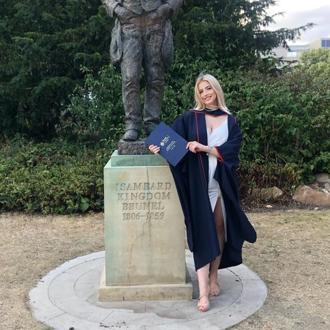
"I fell in love with the campus I found the structure of my course to be really good also. I highly recommend studying at Brunel for its commitment to creating an inclusive environment, providing good support, and offering numerous opportunities to students" - Daniela Lucaci
"The editing suites at Brunel are industry standard and all the cameras we use are really high technology" - Amy Peacock
"The clearing process at Brunel was very straightforward and simple. Speaking to Brunel made me much more comfortable during results day as I had been disappointed with my results. The person on the other side had such a calm voice and was easy to talk to." - Ira Devibar
You can explore our campus and facilities for yourself by taking our virtual tour.
Course content
On our joint Film and Television Studies and English BA you will enhance your understanding of how meaning is created on the page and on the screen whilst developing your technical skills.
Compulsory
- FM1625 - The Professional Self
This module aims to engage you in your own professional development with workshop sessions on activities like CV workshops and networking simulations. Throughout the module there will be an emphasis on developing professional behaviours such as timekeeping, attendance, participation, organisation and communication. You will have the opportunity to engage with students in other levels of study and learn to effectively work in a filmmaking team. You will also be required to engage in your professional development on an individual basis, getting you to think about the gaps in your knowledge, skills and experience.
This is a 15 credit module.
- FM1623 - Representation and Identity
Studying culture demands that we think about identity and, of course, representation. It’s important in the film and television industry to consider whose stories are being told, who is in creative roles behind the camera and how people are being represented. This module will explore identity politics and consider theory such as feminism, queer theory, postcolonialism and disability studies, among others. We will consider how certain identities are portrayed onscreen both historically and now.
This is a 15 credit module.
- EN1606 - The Reader’s Toolkit
Most people take reading for granted, but active, well-informed, interpretative and critical reading is a highly advanced skill. And with the rise of AI and disinformation, it is one of the most important skills in the world today. This module focuses on the key skills of critical and close reading, as central to the study of literature, but also more widely to allow you to sort out truth from troll. The central aim of this module is to enhance and develop students’ engagement with primary and secondary texts as central to your critical thinking abilities. Students will learn how to analyse and interpret complex texts in various genres, making use of the established techniques and approaches of the discipline. They will engage with the idea of critical reading as a culturally-informed act that must be learned and developed. Teaching is shaped around the goal of developing students’ “reading resilience”, that is, the ability to read, discuss, and write about, varied and challenging texts with confidence. Through discussion, group workshops, lectures and individual tasks, students will become proficient in working with literary and rhetorical texts, learning skills that are essential throughout the degree.
- EN1607 - The Writer's Toolkit
With the rise of social media and now generative AI, the core skills of our degree, reading and writing, have come under fire. Yet just as reading is not about passive reception of information, but rather critical engagement with what you have read, so writing is more than simply following a blueprint. Writing, on our course, is a form of thinking, it is where the critical faculties are tested and developed, and importantly, it is a form of human-centred creativity that the world desperately needs.
The purpose of this module is to enable English students alongside Creative Writers to develop a grounding in effective writing practices and core competencies of textual production. Students will develop an understanding of the different stages of textual production, from prewriting, research, planning and outlining, to drafting, feedback and editing, polishing and submission, as well as an understanding of core writing mechanics. This module will enable students to explore and practice differing conventions of textual production across academic disciplines and in the creative industries. Its focus ranges from non-fiction modes such as the academic essay, critical and reflective writing, to screenplays and fiction manuscripts. Any machine in the future will be able to put words together in some form of narrative, but this module trains you to become writers, with critical minds and creative practices, which is a very different thing.
- EN1611 - World Literature
Brunel campus is a global majority campus with over 150 different countries represented and well over 150 different languages spoken. It is located in West London, one of the most culturally diverse places on earth, and is just down the road from Heathrow airport. Since its inception, postcolonial studies and diversity in general have always been at the forefront of our programs. This truly innovative module aims to introduce students to the study of World Literature, presenting key critical approaches and engaging with texts from contrasting cultural locations. Students will learn about rich and varied world literary traditions and forms; acquire theoretical perspectives; build a world literary critical vocabulary; engage in debates about the meaning and role of world literature and reflect on creative practice and literary production in world contexts.
- EN1610 - Literary London
Brunel is proud of its West London location and celebrates being a campus university in one of the most exciting cultural capitals in the world today. London is defined by its modernity, its complex history, its challenges, its diversity and, of course, by its global centrality. This module aims to introduce students to the study of the literature of London, introducing key critical approaches and engaging with texts from a range of cultural backgrounds. Students will learn about London’s rich and varied literary traditions and forms; acquire theoretical perspectives; build a literary critical vocabulary; engage in debates about the meaning and role of London in literature; and reflect on creative practice and literary production in relation to London’s diverse past and present.
Optional
- FM1624 - The Craft of Filmmaking
With the central aim of developing your creative and technical skills, this module will introduce you to the vocabulary, concepts and equipment needed in film production. You will work collaboratively with your peers to train with our technical and academic staff. From directing to producing, cinematography to editing and sound recording and sound designing, you'll be introduced to professional practices and industry workflows as you develop your own craft. This is where you begin your journey learning the conventions and practices of filmmaking using our industry standard equipment.
This is a 30 credit module.
- FM1627 - Creative Project Development
This module – spread across two terms – focusses on what is needed to prepare a creative project before you begin filming it. You may have difficulty generating ideas, or maybe you have too many! How do you know which of your ideas is best told visually? And once you settle on an idea, how do you develop the idea so you can present your vision to others? You will study how projects are developed in the industry and will develop your own original short film idea.
- EN1608 - Literature and History
The purpose of this module is to study selected texts in light of their historical, political, cultural, religious, and other contexts. Through the study of a selection of five texts that belong to a particular period or genre, the module will introduce students to the historicist study of literature while at the same time training them in close textual analysis.
- EN1609 - Writing and Difference
This modular block introduces key critical and cultural concepts in modern literary studies and gives students the opportunity to deepen their understanding of these ideas through engagement with a wide range of texts.
Compulsory
- FM2641 - Alternative Film and Video Practices
If you are interested in alternative or more experimental approaches to filmmaking, then this module is for you. Exploring a range of examples from distinct periods of filmmaking history, this module will also allow you to create your own experimental film. You will also examine connections between the economic, formal-aesthetic and social-political aspects of these alternative practices.
This is a 30 credit module. You are only able to take one 30 credit module in Year 2.
- EN2609 - Professional Life
When you leave university – what happens next? What are your career aspirations? How will you realise them? In this module, you will gain confidence and experience in using your unique-to-you interests and skills to stand out from the crowd. At its heart are four professional activities, which you will choose, complete, and reflect on. These could range from work experience in a field that interests you, to volunteering, learning a language, completing business or skills development courses, publishing a website, blogging, or gaining editorial or media production experience. You are encouraged to think creatively: providing that each activity is developmental for you and your tutor agrees, the sky is the limit.
- FM2631 - Critical Perspectives
This module uses classic and more recent critical frameworks in film studies to provide readings and interpretations of film and television. Influential theories – such as the 'gaze', ideology and affect – will be explored in relation to particular film and television examples. Students will learn to debate the rival claims of different perspectives.
This is a 15 credit module.
- FM2635 - Understanding the Film and TV Industries
This module is a key element in the employability strand that runs through every level of our programme. It focuses primarily upon the British context but it also pays careful attention to where the film and television industries in the UK are located in relation to the wider global nexus of production, distribution and exhibition. Designed to prepare students for careers in the creative sector, it explores the challenges of negotiating a job market in which freelancing is the dominant mode of employment and long-standing patterns of discrimination continue to deny equal access to minoritised groups.
This is a 15 credit module.
Optional
- EN2612 - Genre Fiction
If you’re a fan of genre fiction – Detective, Gothic, Science Fiction, Fantasy, and all things in between – then this module is for you! Besides gaining an understanding some of the key thematic and formal conventions of these genres, and how these have changed over time and with respect to changing social and political contexts, you will get to grips with the critical public sphere that exists outside academic institutions. Beyond academia, there is a world of reviews, blogs, conventions, and festivals relating to books. Therefore, while this module will cover the academic study of genre fiction and require you to write a conventionally structured and referenced academic essay, it will also branch out to consider this wider context by looking at some reviews and debates from the public sphere and require you to write a review of your own.
- EN2613 - Literatures of Inequality: Global Fictions
Contemporary globalisation has brought us cheap food, cheap clothing, and cheap goods, including the smartphone, tablet, or laptop you are probably reading this on – but it has also brought tremendous inequality. In this module, you will look at a range of twenty-first century fiction originating from Africa, Asia, Latin America, the Middle East, and the Caribbean, to explore diverse experiences of inequality in an era of globalisation. You will interrogate a range of novels, stories, and poetry in light of theoretical concepts drawn from world-literary theory and materialist feminism, asking whether and how socially committed fiction can challenge the overlapping oppressions of contemporary times.
- EN2614 - The Novel: The Nineteenth Century
The nineteenth century was an era of innovation. Technological invention, scientific breakthrough, geographical discovery, imperial expansion, the abolition of slavery, the rise of the middle classes, the emergence of mass culture, and an ever-stronger push for women’s equality. Within this culture, the novel – as its name suggests, a literary genre founded on newness – came of age. Through the chronological study of a representative selection of five texts, the module will introduce the key generic elements of the nineteenth-century novel, and chart changes in their deployment over the course of the century. Particular attention will be paid to Realism and Gothic. In addition to narrative form, a range of social and cultural contexts will be suggested as a means of accounting for, and understanding, textual features. Stress will be placed throughout on close textual analysis.
- EN2615 - Literary Movements: Modernism
Have you ever felt overwhelmed by everything that’s going on in the world? You are not alone! Written during the opening decades of the twentieth century, the texts we study on this module were processing a modern world that was changing rapidly and radically. There were new technologies and ideas, empires were in decline, religion was losing its hold, and established class and gender relations were disintegrating. Then the First World War happened, followed by revolutions, a global pandemic, economic depression, and the rise of fascism. Writers responded in different ways. Some, like TS Eliot, Virginia Woolf, and Katherine Mansfield, experimented with content and form, confronting topics that were formerly taboo or using language and structure that shattered convention. Others, including Daphne du Maurier, Dorothy L Sayers, and Christopher Isherwood, used more ‘realist’ styles to work through their anxieties and concerns. Examining novels, short stories, poetry, and experimental artistic manifestos – by these writers and more, and from diverse perspectives – we will explore a modern world in crisis.
- EN2616 - Literature and Revolution: Romanticism
The political events of the late eighteenth century – the American War of Independence, French Revolution, and Napoleonic wars – dramatically changed lives, ideas, and aesthetics in Britain. From the mid 1770s to the mid 1820s, the period we now call Romanticism signalled profound changes in the form and content of literature. Working in a range of genres, including the novel, pamphlets, poetry, and philosophical, satirical, and travel writing, Romantic writers responded to a set of urgent, ethical, aesthetic, and environmental changes. In the module we consider the ‘first generation’ (Wordsworth, Coleridge, William Blake) and ‘second generation’ Romantics (Shelley, Byron, and Keats), and important political writers such as Edmund Burke, Thomas Paine, Mary Wollstonecraft, and William Godwin. Alongside these now-canonical names we read a diverse range of women and Black writers who contributed just as significantly to key Romantic debates: Anna Aikin, Anna Laetitia Barbauld, Ottobah Cugoano, Ouladah Equiano, Hannah More, Ann Radcliffe, Mary Robinson, Ignatius Sancho, Mary Shelley, Helen Maria Williams, Dorothy Wordsworth, Phillis Wheatley, and Anne Yearsley
- EN2617 - Texts and Afterlives: Shakespeare
Shakespeare died over 600 years ago, but his works maintain their relevance, captivating readers and audiences worldwide. In this module, you will study Shakespeare at an advanced level, in greater depth, and with an emphasis on the types of study skills required for advanced critical work in the fields of ‘book history’ and ‘performance studies.’ Using advanced methods of analysis, you will explore early modern texts, both in their original contexts and in their subsequent manifestations in print. You will consider language, performance, and the visual layout of text – both in Shakespeare’s time and in the present day. Overall, you will gain an understanding and experience of the concept of the Shakespearean text as an artefact and art form, one constantly evolving through criticism, editorial intervention and performance
- EN2618 - Contemporary Fiction: Britain and Ireland
This module introduces students to a range of contemporary British and Irish fiction, developing knowledge of the variety and complexity of contemporary writing and its relation to social and cultural context. The module examines texts which employ a range of themes, forms, and styles. It asks what we mean by the term ‘contemporary’ and encourages analysis of the relationship between texts and the historical moments in which they are produced and consumed.
- EN2619 - Postcolonial Writing
Postcolonial writing often comes out of difficult circumstances. Its writers sometimes risked everything to publish what they needed to say. These are the new pioneers of Literature in English, whose works would inspire and define the writings of the future. In this module, we get to grips with key concepts encountered in postcolonial studies, which have been developed to investigate phenomena including colonialism and resistance, multiculturalism and globalization, racism, and Islamophobia. Using these, we will explore works by important and fascinating writers, whose texts show a variety of perspectives on colonialism and its legacies, including those of imperialists and the peoples they tried to suppress.
- FM2635 - Understanding the Film and TV Industries
This module is a key element in the employability strand that runs through every level of our programme. It focuses primarily upon the British context but it also pays careful attention to where the film and television industries in the UK are located in relation to the wider global nexus of production, distribution and exhibition. Designed to prepare students for careers in the creative sector, it explores the challenges of negotiating a job market in which freelancing is the dominant mode of employment and long-standing patterns of discrimination continue to deny equal access to minoritised groups.
This is a 15 credit module.
- FM2633 - Film and Television Genres
Genre as a cultural category is central to the production, consumption and analysis of films and television shows. This module explores a range of genres in film and television, some of them specific to one medium and others found across both. It examines how genre has been variously theorised and considers how we might approach genre from a range of different perspectives, including the industrial, the formal/stylistic, and the socio-cultural. Case studies include the Western, science fiction, crime fictions, horror, comedy, fantasy, reality TV and the Hollywood musical.
This is a 15 credit module.
- FM2634 - World Cinemas
Interested in exploring the dynamic relationships that exist between different cinemas from different places? Then this option is for you. We will consider a range of world cinemas from the Global South, Asia and beyond. We will consider global art and alternative cinemas as well as more mainstream practices, considering films in terms of globalisation and the transnational, as well as the regional and the national.
This is a 15 credit module.
- FM2631 - Critical Perspectives
This module uses classic and more recent critical frameworks in film studies to provide readings and interpretations of film and television. Influential theories – such as the 'gaze', ideology and affect – will be explored in relation to particular film and television examples. Students will learn to debate the rival claims of different perspectives.
This is a 15 credit module.
- FM2636 - Animation
Firstly, this module will allow you to explore the medium specificity of animation, the range of techniques available, as well as different industries and their development. We will then go on to teach you a range of animation production skills which will allow you to create your own short form animation in a style and medium of your choosing. This is a 30 credit module.
- CW2604 - Screenwriting I
The module introduces students to the professional practice and theory of screenwriting for film and television. Although the short film is the main focus of study, the classic, feature length narrative fiction film, television drama, and films from alternative and non- narrative traditions will also be considered. The module is substantially practice-based. All students will write an original screenplay to a maximum length of 10 pages. Students will also produce supporting documents, such as a Story Proposal, Beat Sheet, and Scene Outlines. The module also requires students to analyse films and scripts – including their own and contemporaries’ – from a screenwriting perspective. Students will produce analyses of key features of films and screenplays and write the screenplay for a short film.
Compulsory
- FM3642 - Written Dissertation in Film and Television Studies
The final-year written dissertation allows you to research a topic you are passionate about in order to produce an independent study project. For the dissertation you will conduct your research, which can involve any aspect of film and television, under supervision of an expert from the team.
- EN3621 - English Special Project
The English Special Project offers third year students a crucial opportunity to undertake extended independent research, developing their critical and creative skills to investigate a topic of their own choice. Pursuing subjects as diverse as short stories or screen writing, sci fi or romance, and Shakespeare or Salman Rushdie, students construct a 9,500-word dissertation across the course of the year. Guided by regular tutorials with a personal supervisor, this module represents a key stepping stone in their academic career, a culminating moment in the completion of their undergraduate trajectory.
Optional
- FM3644 - Gender and Sexuality
This module is largely led by feminist theory and queer theory where we examine a range of identities onscreen in relation to gender and sexuality. A number of case studies are examined across the module from historical examples to more contemporary work.
This is a 15 credit module.
- FM3645 - The Horror Film
This module provides students with an in-depth examination of the horror genre across both film and television. Critical frameworks and theories relevant to the study of horror will be explored in depth across a range of case studies from historical and more contemporary contexts, as well as from a range of global contexts.
This is a 15 credit module.
- FM3646 - Documentary: Image and Violence
This module will give you the skills to analyse cinematic representations of violence and develop a critical awareness of different types of violence in relation to warfare and military technology. You will gain skills in developing insights into visual themes, narrative structures and techniques used in moving images’ engagements with violence. You will also have the opportunity to develop techniques for the use of found footage to research and communicate different types of violence.
This is a 15 credit module.
- FM3641 - Analysis of Film and Television Work Experience
This module is unique in our portfolio in that it requires students to complete a 70-hour placement with a company/organisation in which they can apply the skills they have acquired over the course of the programme and to reflect critically on their experience. With a taught component that is structured around the contributions of a range of industry speakers, it also gives students the opportunity to begin building professional networks and to hone their understanding of employment practices in the media industry.
This is a 30 credit module.
- FM3649 - Movies and Migration
Films are border-crossing entities. From the early days of cinema, films, cast and crew have travelled internationally to find audiences and sometimes, to flee persecution or conflict. In this module, we will consider how contemporary cinema treats migration, diaspora, trafficking and related phenomena. We will do this in relation to a wide variety of genres, national cinemas and production styles.
This is a 15 credit module.
- CW3607 - Screenwriting II
This module enables students to explore and develop the theory and professional practice of contemporary screenwriting. By the end of the module, students who participate in weekly assignments will produce a marketable pitch deck/series bible for a film or TV project, along with the first 15-20 pages of the script. The module is substantially practice-based and requires students to analyse screen works and scripts (including their own and peers’) from a screenwriting perspective.
This is a 15 credit module.
- EN3622 - Literature, Culture, Society: The Victorians
Shaped by industrial revolution and radical social reform, the Victorian period was a time of enormous historical and literary change, introducing key values, institutions, and narratives still shaping modern Britain. Typical of Brunel’s innovative approach to more traditional period studies, this module examines three integral 19th century ‘case studies’, each focused on a specific aspect of Victorian literature and culture. Case studies may include ‘Working-Class Voices, ‘Crime and Sensation’, 'Victorian Black Lives' and ‘Women and Society’. Its aims are to explore some of the ways in which Victorian literature might encode or challenge particular cultural assumptions; to analyse the relationships between literary forms and social contexts; and finally, to consider how the knowledge of the period may contribute to the interpretation of texts produced during this time.
- EN3623 - Literature, Gender, Sexuality: The Women's Movement
Brunel English has been a leader in feminist theory since its formation over 25 years ago. The Women’s Movement is a defining modern social undertaking, a radical inheritance from the 19th century, which has since redefined itself in multiple ways across numerous contexts. Focusing primarily on Second and Third Wave feminist movements, but also with a nod to First Wave influences and an emergent Fourth Wave, this module considers 20th century women’s writing in dialogue with relevant feminist theory. The Women’s Movement’s relationship to related gender/sexual equality programmes is offered as a central focus of class debate, especially in connection with LGBT perspectives and masculinity studies. Each week brings feminist critical thought into dialogue with literature, considering key concepts, including patriarchy, desire, and intersectionalism, and paying close attention to the interrelationship between literature and activism. An indicative reading list might include theorists such as Simone de Beauvoir, Betty Friedan, Patricia Hill Collins, Judith Butler, and Chandra Talpade Mohanty. Texts will address the range and diversity of feminisms as articulated across history.
- EN3624 - Writing Otherness: The Muslim World in Early Modern Literature
Canonical studies of Early Modern literature often ignore the central role of ethnic and religious Otherness, situating texts primarily in relation to European cultures and geographies. Contesting this tendency, this module prioritises early modern interaction between Christians and Muslims, viewed from the perspective of both, specifically with a focus on English drama. It will explore post-Reformation England’s self-redefinition as a Christian nation and how it dealt with increased trade and negotiations with Muslim nations. Main topics of study include common literary tropes about Muslims in early modern literature; Christian and Islamic beliefs and fears in key texts; travel writing and interactions between West and East; prose propaganda and multicultural London; and writings in captivity. Central to all these critical discussions is the space of the Muslim world in Early Modern Literature and how this space shapes Early Modern culture in compound ways.
- EN3625 - Post-War and Late Twentieth-Century Literature 1945 - 2001
Brunel English has consistently been a national leader in contemporary literary studies for over two decades. We have a complex and increasingly global understanding of what contemporary literatures can and should mean. In this module we consider the period of the latter half of the 20th century starting with the Second World War which had a major impact on almost every aspect of 20th century life, with radical implications for society, politics, economics, and culture. This module confronts this shifting global context with a focus on both established and experimental writers, developing students’ awareness of Post-War and Late Twentieth-Century Literatures via a focus on fiction’s negotiation with history. The module foregrounds key sensibilities of this period through an initial discussion of postwar life and art, then moves forward to explore the emergence of the ‘postmodern’ condition. It concludes by examining the experimental fiction of various leading British writers, also considering the influence of late-twentieth century theorists, such as Jean Baudrillard, Fredric Jameson, and Judith Butler.
- EN3626 - Special Topic: Violence
When it was first launched the Violence module caused quite a stir with its combination of contemporary critical theory and inspiration from the Finnish phenomenon-based learning, leading to a feature on the module in the TLS. Violence, sadly, represents a shaping force in contemporary life, a site or mode of influence dominating government, society, culture, and the media. This module aims to develop students’ awareness of violence and its representations within modern culture, enlisting a variety of cultural materials, literary, visual, conceptual and technological. It asks a series of questions as regards violence and coercion as they surface in everyday lives, splitting its focus between conceptual understanding and textual readings. Part one, ‘Bioviolence and Biopolitics’, looks at biopolitical theories of power, force, violence, coercion and exclusion as introduced by philosophers such as Michel Foucault, Georgio Agamben, and Roberto Esposito. By contrast, part two, ‘Discourses of Coercion 2015-2020’, applies the theory to case studies taken from contemporary events, such as #Blacklivesmatter, Grenfell Tower, Coronavirus, Zombies and of course serial killers.
- EN3627 - Author Study: Chaucer to Shakespeare
This module is an exploration of two canonical English writers, Geoffrey Chaucer and William Shakespeare. It examines a number of key texts by these two authors from a range of perspectives combining the historical and theoretical. The module pays specific attention to such issues as the representation of society and class in Chaucer’s and Shakespeare’s work, the portrayal of the author in the context of the emergence of English as an authoritative language replacing Latin and French as during the period 1381 – 1625, the relationship between rhetoric, power and ethics in the context of the development of an embryonic literary sphere or space in England after the events of 1381, and the depiction and interrogation of gender norms in late medieval and early modern literature.
The module will develop and extend some of the critical thinking students have developed in a number of second-year modules. Most important, it teaches students to read texts even more closely, playing detailed attendance to the historical context alongside the theoretical. The modules provides a critical examination of key works by Chaucer and Shakespeare and is therefore ideal for students considering a career in teaching, particularly at secondary level.
This course can be studied undefined undefined, starting in undefined.
This course has a placement option. Find out more about work placements available.
Please note that all modules are subject to change.
Careers and your future
With one of Brunel’s film degrees, you can head out into the world of work secure in the knowledge that you have access to multiple avenues of opportunity – and that there is no single route you must follow.
Many of our students go on to take up production and post-production roles in the film and television industries in the UK and beyond: amongst our alumni there are TV presenters, newsreaders, screen actors, production managers, editors, camera operators, and award-winning independent filmmakers.
As well as gaining a firm grounding in the theoretical and practical aspects of film and television while you are a student with us, you will enhance your transferable employment skills. You will develop your written and spoken communication, presentation skills and your ability to work productively and efficiently in a team.
We encourage students to think expansively in terms of how they might apply their skill set and we have developed close links not only with film and television production companies but also with post-production houses, charities, marketing companies, corporate video producers, and podcasting studios. In recent years our students have completed short placements with Scott Free Productions (Napoleon), Shondaland (Bridgerton), IMG Sports, the British Red Cross, Rex Brown Studios, NextShoot, Antonia Claudie, CaviarTV, and the National Theatre.
Brunel’s Student Development team is a dedicated service that are committed to increasing our students' employability, helping you to develop the skills and experience you need to stand out in the job market. They will help you research placements, refine your CV and give you mock interviews and will still be on-hand to help you for two years after you graduate.
UK entry requirements
2026/7 entry
Please check our Admissions pages for more information on other factors we use to assess applicants within our grade range as well as our full GCSE requirements and accepted equivalencies in place of GCSEs.
A minimum of five GCSEs (grade C/4 or above) are required, including GCSE English Language (grade C/4) or GCSE English Literature (grade B/5)
Standard Offer: GCE A level BBB
Contextual Offer: GCE A level BCC
We apply a contextual admissions process for UK undergraduate applicants who meet one or more of our contextual markers – please see our contextual admissions page for more information.
Standard Offer: BTEC Level 3 National Extended Diploma DDM in any subject
Contextual Offer: BTEC Level 3 National Extended Diploma DMM in any subject
We apply a contextual admissions process for UK undergraduate applicants who meet one or more of our contextual markers – please see our contextual admissions page for more information.
Standard Offer: BTEC Level 3 National Diploma DM in any subject and an A Level grade B
Contextual Offer: BTEC Level 3 National Diploma MM in any subject and an A Level grade B
We apply a contextual admissions process for UK undergraduate applicants who meet one or more of our contextual markers – please see our contextual admissions page for more information.
Standard Offer: BTEC Level 3 National Extended Certificate Merit in any subject, with A level grades BB
Contextual Offer: BTEC Level 3 National Extended Certificate Merit in any subject, with A level grades BC
We apply a contextual admissions process for UK undergraduate applicants who meet one or more of our contextual markers – please see our contextual admissions page for more information.
Standard Offer: International Baccalaureate Diploma 30 points. GCSE English equivalent SL 5 or HL 4
Contextual Offer: International Baccalaureate Diploma 28 points. GCSE English equivalent SL 5 or HL 4
We apply a contextual admissions process for UK undergraduate applicants who meet one or more of our contextual markers – please see our contextual admissions page for more information.
Standard Offer: Obtain a minimum of 120 tariff points in the Access to HE Diploma with 45 credits at Level 3 in any subject
Contextual Offer: Obtain a minimum of 104 tariff points in the Access to HE Diploma with 45 credits at Level 3 in any subject
We apply a contextual admissions process for UK undergraduate applicants who meet one or more of our contextual markers – please see our contextual admissions page for more information.
Merit overall in any subject
If your qualification isn't listed above, please contact the Admissions Office by emailing admissions@brunel.ac.uk or call +44 (0)1895 265265 to check whether it's accepted and to find out what a typical offer might be.
Brunel's committed to raising the aspirations of our applicants and students. We'll fully review your UCAS application and, where we’re able to offer a place, this will be personalised to you based on your application and education journey.
Please check our Admissions pages for more information on other factors we use to assess applicants, as well as our full GCSE requirements and accepted equivalencies in place of GCSEs.
International entry requirements
If you require a Tier 4 visa to study in the UK, you must prove knowledge of the English language so that we can issue you a Certificate of Acceptance for Study (CAS). To do this, you will need an IELTS for UKVI or Trinity SELT test pass gained from a test centre approved by UK Visas and Immigration (UKVI) and on the Secure English Language Testing (SELT) list. This must have been taken and passed within two years from the date the CAS is made.
English language requirements
- IELTS: 6.5 (min 5.5 in all areas)
- Pearson: 59 (59 in all subscores)
- BrunELT: 6.5 (min 5.5 in all areas)
- TOEFL: 5 (min 4 in all subscores)
You can find out more about the qualifications we accept on our English Language Requirements page.
Should you wish to take a pre-sessional English course to improve your English prior to starting your degree course, you must sit the test at an approved SELT provider for the same reason. We offer our own BrunELT English test and have pre-sessional English language courses for students who do not meet requirements or who wish to improve their English. You can find out more information on English courses and test options through our Brunel Language Centre.
Please check our Admissions pages for more information on other factors we use to assess applicants. This information is for guidance only and each application is assessed on a case-by-case basis. Entry requirements are subject to review, and may change.
Fees and funding
2026/27 entry
UK
£9,790 full-time
£7,335 part-time
£1,955 placement year
International
£17,400 full-time
£13,050 part-time
£1,955 placement year
Fees quoted are per year and may be subject to an annual increase. Home undergraduate student fees are regulated and are currently capped at £9,535 per year; any changes will be subject to changes in government policy.
For the 2026/27 academic year, tuition fees for home students will be £9,790, subject to Parliamentary approval.
In England and Wales, tuition fees for home undergraduate students are subject to the Government fee cap. The Government has confirmed that this will be £9,790 for 2026/27 and £10,050 for 2027/28 (subject to Parliamentary approval).
From 2028 onwards, the fee cap is expected to rise annually in line with inflation. This means your tuition fees in future years may increase to reflect these changes.
International fees may change annually, by no more than 5% or RPI (Retail Price Index), whichever is the greater.
More information on any additional course-related costs.
See our fees and funding page for full details of undergraduate scholarships available to Brunel applicants.
Please refer to the scholarships pages to view discounts available to eligible EU undergraduate applicants.
Teaching and learning
In-person attendance is required for this degree programme. Beyond facilitating teaching and learning, your in-person attendance cultivates collaboration and develops your personal and professional networks.
Each module (class) will offer its own blend of teaching, which can range from live lectures, pre-recorded lectures, film screenings, seminars, practical, technical and/or creative workshops and small group or individual tutorials. Module leaders are always available for individual meetings (in-person or online) throughout the term and each student is assigned a personal tutor who will meet with them on a regular basis throughout their degree.
Students will be given an Adobe Creative Cloud license for the duration of their studies.
Access to a laptop or desktop PC is required for joining online activities, completing coursework, and a minimum specification can be found here.
We have computers available across campus for your use and laptop loan schemes to support you through your studies. You can find out more here.
Depending on your schedule each term, you might only have 4 – 5 classes per week. University study is about independent study, and we encourage students to spend as many hours studying (this means reading, closely watching films and television programmes, practicing on the technical equipment, etc) outside the classroom as they spend inside the classroom with their peers and lecturers.
To enhance your learning, you will have access to fantastic state-of-the-art facilities and equipment.
Should you need guidance on the module, coursework and any other matters that may wish to discuss, module tutors are available for one-to-one tutorials.
Should you need any non-academic support during your time at Brunel, the Student Support and Welfare Team are here to help.
Assessment and feedback
On your practical modules, assessments can include short films produced in a small production group, a portfolio of production paperwork, pitch decks, post-production and other technical exercises, creative writing exercises and reflective and critical essays. Assessments in your theoretical modules can include presentations, portfolios and academic essays. In some modules, students can choose which assessment to complete. Please note that the type of assessment in each module is always subject to change.
Read our guide on how to avoid plagiarism in your assessments at Brunel.
