
Overview
The Brunel Engineering Management MSc gives graduates and professional engineers seeking to move into management the technical skills and understanding of business, operations and strategy to pursue successful careers in engineering management.
You'll get a solid grounding in managerial essentials within engineering including logistics and supply chain management, manufacturing and production systems design, product development, quality assurance and project management.
You’ll also study how finance and assets are managed within a business, managing people and organisations, customer care, and effective teamworking and motivation techniques. Additionally, with an eye on the future, you’ll examine the challenges new technologies pose to management in the engineering sector.
This on-campus course is studied full-time over one year, with the choice of either a September or January start date. It is accredited by the Institution of Mechanical Engineers (IMechE). This means your degree will put you on track to gain Chartered Engineer (CEng) status in the UK.
Throughout your studies you’ll have 24-hour access to industry standard specialist software for engineering design at dedicated computer clusters on campus, so you’ll have the opportunity and equipment to explore ideas and tackle problems.
With the increasing complexity of the engineering sector, job candidates with expertise in business and management as well as engineering are increasingly in demand. Your Brunel postgraduate engineering degree will equip you with the knowledge and skills that will make you a sought-after prospect across the industry.
This course is also available online, giving you a unique learning experience, allowing you to build connections with like-minded professionals worldwide. Find out more about the Engineering Management MSc Online.
"As an international student, it was really important for me to study in a secure and comfortable place. My professors were always open to answer questions and guide me through my learning process." - Santiago Chaglla

"Recognise your skill set, no matter what course you are doing, work out how you are translating that course to real life business." - Sachin Patel

"Make sure you seize the opportunity to make your experience personal, get immersed in Brunel beyond the academics. " - Kennedy Ameh
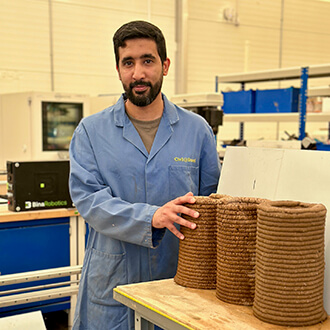
"My passion for robotics and sustainable technology really came to life during my PhD at Brunel, where I focused on the intersection of advancing 3D printing and sustainable construction materials." - Dr Abdulrahman Albar
"As an international student, it was really important for me to study in a secure and comfortable place. My professors were always open to answer questions and guide me through my learning process." - Santiago Chaglla
"Recognise your skill set, no matter what course you are doing, work out how you are translating that course to real life business." - Sachin Patel
You can explore our campus and facilities for yourself by taking our virtual tour.
Course content
The course is designed to give graduates and professional engineers the managerial skills and understanding of business operations need for careers in engineering management.
Coursework for your engineering management degree consists of compulsory and optional modules and a 10,000-word dissertation.
Please note that the module description provided under Year 1 below applies only to September starters. January starters take no optional modules, they study the seven compulsory modules listed plus (MN5610) Advanced Measurement Systems and Data Analysis and (MN5552) Robotics and Manufacturing Automation.
Compulsory
- Manufacturing Systems, Design and EconomicsThis module aims to meet the growing need of manufacturing industry for graduates with very high levels of knowledge and skills in advanced manufacturing processes, design of manufacturing systems and management of production facilities, including the understanding of materials and their properties in relation to production processes, the design of products for automated manufacture, advanced, automated production and assembly systems, and advanced and micro manufacturing and production processes.
- Managing People and OrganisationsThis module aims to give students a comprehensive understanding and critical awareness of the latest advanced management theories for managerial decision making and leadership in global organisations.
- Project Management
This module aims to give students a comprehensive understanding and critical awareness of the latest advanced techniques and strategies for project management, including management tools, management and reporting methods and team building.
- Systems Modelling and SimulationThis module aims to encourage systematic thinking and acquiring knowledge and skills to model and analyse modern complex systems.
- Logistics and Global Supply Chain ManagementThis module aims to introduce and develop the fundamental principles and concepts of supply chain management, to investigate the structuring of global supply chain networks, outsourcing and the co-ordination of network partners, to highlight the importance of the customer service dimension as a means of differentiation and the role of logistics in achieving this, and to identify the contribution and impact on supply chains made by E-commerce and emerging IT applications, especially with regard to time based competition.
- Quality Management and ReliabilityThis module aims to provide an in-depth understanding of the principles of modern quality assurance which underpin the discipline and their applications in engineering, manufacturing and enterprise, and to provide a professional-level working knowledge of the advanced techniques of reliability engineering and an ability to apply them to improving the maintenance, the maintainability and the safety of existing and proposed plant in their workplace.
- DissertationThe dissertation aims to help students develop their problem solving, communication and project management skills to work independently in consultation with their academic supervisor and carry out in-depth investigation of a suitable topic relevant to the course.
Optional
- Advanced Measurement Systems and Data AnalysisThis module aims to help students to gain an in-depth knowledge of basic measurement theory, operating principle of modern measurement techniques, capabilities of practical measuring machines and advanced data analysis.
- Computer Aided Design and Manufacturing TechniquesThis module aims to identify technical challenges in design modelling, communications and design integration in the context of global product design and development, to critically review IT technologies, computer aided design, evaluation and integration techniques in a range of integrated product design activities, to develop in depth knowledge in creative and virtual design theories, methods and evaluation tools, and to familiarise students with a range of different types of IT, CAD, CAE and UX/UI software enabling them to make informed evaluations of current and future systems.
- Robotics and Manufacturing AutomationThis module aims to provide an understanding and critical awareness to designing and controlling modern automated manufacturing systems, and employs a systems approach in doing so. The module provides an exposure to a variety of industrial and factory automation practices and also an understanding in selecting appropriate automation and control methods for the equipment or process at hand.
- Sustainable Design and ManufactureThis module aims to provide students with methods for analysing sustainability in design, quantifying the quality parameters, calculating and assigning appropriate tolerances, analysing the manufacturing operations for achieving the required quality targets. The emphasis will be on the link between design information and manufacturing operations to produce products and propose operations that reduce the environmental impact of manufacturing.
- Design of Mechatronic SystemsThe main aims of this module are to teach the students how to integrate mechanical, electronic and control functions, to critically analyse and use mechatronic design concepts, to apply multiple discipline expertise in an integrating mechatronic process, and to use a contemporary software to simulate power electronic circuits.
This course can be studied undefined undefined, starting in undefined.
Please note that all modules are subject to change.
Read more about the structure of postgraduate degrees at Brunel
Careers and your future
As a Brunel Engineering Management MSc graduate, there's the opportunity to enter a broad range of careers in the manufacturing, service and government sectors.
Our graduates are employed in industries ranging from metal cutting to process. They are working for such companies as Atkins, Canon Europe, Ford, Jaguar Land Rover, Rolls-Royce and Unilever. Others have developed their own consultancy companies.
UK entry requirements
- A 2:2 (or above) UK Honours degree or equivalent internationally recognised qualification in an Engineering, Science, Maths or technology subject.
EU and International entry requirements
If you require a Tier 4 visa to study in the UK, you must prove knowledge of the English language so that we can issue you a Certificate of Acceptance for Study (CAS). To do this, you will need an IELTS for UKVI or Trinity SELT test pass gained from a test centre approved by UK Visas and Immigration (UKVI) and on the Secure English Language Testing (SELT) list. This must have been taken and passed within two years from the date the CAS is made.
English language requirements
- IELTS: 6 (min 5.5 in all areas)
- Pearson: 59 (59 in all sub scores)
- BrunELT: 58% (min 55% in all areas)
- TOEFL: 4.5 (min 4 in all sub scores)
You can find out more about the qualifications we accept on our English Language Requirements page.
Should you wish to take a pre-sessional English course to improve your English prior to starting your degree course, you must sit the test at an approved SELT provider for the same reason. We offer our own BrunELT English test and have pre-sessional English language courses for students who do not meet requirements or who wish to improve their English. You can find out more information on English courses and test options through our Brunel Language Centre.
Please check our Admissions pages for more information on other factors we use to assess applicants. This information is for guidance only and each application is assessed on a case-by-case basis. Entry requirements are subject to review, and may change.
Fees and funding
2026/27 entry
UK
£14,435 full-time
International
£24,795 full-time
More information on any additional course-related costs.
Fees quoted are per year and are subject to an annual increase.
See our fees and funding page for full details of postgraduate scholarships available to Brunel applicants.
Scholarships and bursaries
Teaching and learning
To ensure you receive the maximum support and have the greatest opportunity to reach your full potential the expectation is that you attend in-person all teaching activities including examinations that are scheduled on campus. This will be the majority of all activities. However, where for pedagogical reasons alternative methods of delivery are used for activities you'll be notified and expected to engage with the activity at the time of delivery.
Laboratory Support
For modules with practical learning content, these will be delivered in-person on campus in the laboratories.
Assessment
Traditional examinations will be taken in-person on campus.
Access to specialist software
You'll have access to relevant engineering software on campus. You're also able to install software on your own personal laptop and connect to the Brunel License server through a VPN connection. This provides continued access to all services.
Access to a laptop or desktop PC is required for joining online activities, completing coursework and digital exams, and a minimum specification can be found here.
We have computers available across campus for your use and laptop loan schemes to support you through your studies. You can find out more here.
Our staff have national and international reputations for their research, publications and applied work. Many carry out much of their research in collaboration with major oil companies, plant and equipment manufacturers, leading industrial firms and governmental laboratories. This means that your education will be at the forefront of scholarship and practice, covering the most up-to-date industry knowledge.
Your course will consist of combinations of lectures, seminars, tutorials, laboratory and practical sessions, coursework and group work.
The taught element of the course takes place from September to April. From May to September you’ll conduct an individual project and prepare your dissertation.
Should you need any non-academic support during your time at Brunel, the Student Support and Welfare Team are here to help.
Assessment and feedback
Modules are assessed by combinations of formal examination and written assignments. Examinations are normally sat in May.
Successful completion of the taught modules allows you to proceed to the dissertation stage. To qualify for the award of the MSc degree, you must submit a satisfactory dissertation.
Read our guide on how to avoid plagiarism in your assessments at Brunel.