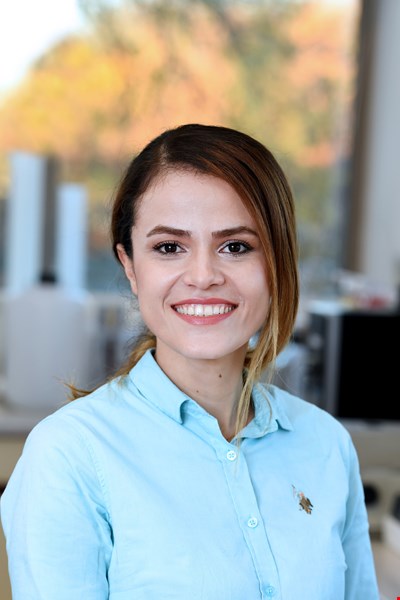
Sara was educated at the University of Tehran, where she was awarded a Bachelor degree in animal sciences with first class honours in 2008. She moved to the Biosciences Division at Brunel University London to undertake her MSc in Molecular Medicine and Cancer Research. In 2011, Sara was awarded a scholarship by the School of Health Sciences and Social Care, Brunel University London to investigate Friedreich’s ataxia (FRDA) disease mechanisms using FRDA mouse models and cells under the supervision of Dr Mark Pook. She finished her PhD in 2013 and was awarded Vice Chancellor's best doctoral research prize. She continued her work as a Postdoctoral Research Fellow at Brunel University London to study the efficacy and tolerability of histone methyltransferase (HMTase) inhibitors in FRDA. Sara then joined the Institute of Cancer Research (ICR) as a Postdoctoral Research Fellow in 2015 to study the signaling and metabolic networks in breast cancer. In 2018, she was awarded a research grant from Friedreich’s Ataxia Research Alliance (FARA) and joined Brunel University London as a Principal Investigator to investigate the metabolic signatures of FRDA. Subsequently, she was appointed as a lecturer in Biosciences. Her research continues to investigate FRDA disease pathogenesis and therapy and identify the most effective therapy for FRDA.
We are seeking a highly motivated and creative PhD candidate to work on a collaborative project aimed at the identification of therapies for an inherited neurodegenerative disease, Friedreich’s Ataxia (FRDA). The aim of this project is to identify potential and novel targets for the development of therapeutic strategies in the disease. This novel project has great potential to provide insight into the molecular mechanisms of FRDA and inform future therapy development.
Overview
The PhD studentship in the Ataxia group will involve the identification and validation of novel targets for the treatment of FRDA using various molecular and cell biology approaches. The successful applicant is expected to meet the project aims and objectives in line with the proposed project plan. The candidate will work closely with the Principal Investigator, other researchers in the Ataxia group and internal/external collaborators and is expected to present and disseminate project findings to partners and the wider scientific community.
The successful candidate will be supervised by Dr Sara Anjomani Virmouni. Informal enquiries can be made via email to Dr Sara Anjomani Virmouni (Sara.Anjomani-Virmouni@brunel.ac.uk).
Eligibility
The successful applicant should hold an undergraduate degree (first or upper second class) or equivalent qualification in biology, genetics, or a related discipline, with particular experience in molecular and cellular biology. A Masters qualification in a relevant area would be desirable. Experience in some of the following molecular biology techniques and in vitro approaches is essential:
- passaging
- transfection
- siRNA
- overexpression
- stable line generation
- cloning
- PCR
- qPCR
- western blot
- immunofluorescence staining and imaging
How to apply
If you are interested in applying for the above PhD topic please follow the steps below:
- Contact the supervisor by email or phone to discuss your interest and find out if you would be suitable. Supervisor details can be found on this topic page. The supervisor will guide you in developing the topic-specific research proposal, which will form part of your application.
- Click on the "Apply here" button on this page and you will be taken to the relevant PhD course page, where you can apply using an online application.
- Complete the online application indicating your selected supervisor and include the research proposal for the topic you have selected.
Good luck!
This is a self-funded topic
Brunel offers a number of funding options to research students that help cover the cost of their tuition fees, contribute to living expenses or both. The UK Government is also offering Doctoral Student Loans for eligible students, and there is some funding available through the Research Councils. Many of our international students benefit from funding provided by their governments or employers. Brunel alumni enjoy tuition fee discounts of 15%.