
Overview
The Brunel Automotive Engineering MEng gives students interested in pursuing careers in automobile engineering an extra year of advanced study and training that will deepen their knowledge of the subject, expand their skill sets and put them on a fast-track to becoming a chartered engineer.
As with our Automobile Engineering BEng degree, you’ll get a solid grounding in the fundamentals of mechanical engineering, including maths, engineering science and design, and an in-depth knowledge of the technical workings of current and future automotive systems. You’ll study all aspects of automotive development and manufacture from vehicle design and performance to engine and transmission systems to materials, structures and safety. You’ll also get hands-on practice troubleshooting engineering problems that inevitably arise during the construction and testing processes.
Your education will profit, too, by your access to the work done at our Centre for Advanced Powertrain and Fuels (CAPF). One of the largest and most active engine research groups in the UK, CAPF focuses on minimising pollutant emissions and improving fuel efficiency while maintaining performance levels.
In your final year, along with studying specialist topics taught at master’s degree level, you’ll take part in a major group project to design, manufacture and test an automotive product, typically aimed at low-carbon use. This will give you valuable experience working in a team-based environment and on-the-job opportunities to develop your leadership and management skills, competencies sought by employers. A current project concerns the use of mechanical kinetic energy recovery to help eliminate the feel of turbocharger lag in future fuel-efficient road vehicles.
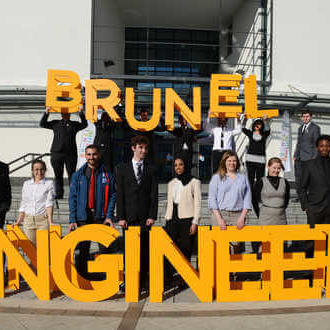
At the end their final year, engineering and maths students are invited to showcase their project work at Brunel Engineers +, an event that both celebrates their achievements and gives them the chance to network with industry figures and employers. This video shows some of the projects exhibited at the 2024 Brunel Engineers + event, with explanations by the students themselves.
Throughout your studies you’ll have use of our state-of-the-art laboratory facilities, which comprise our motorsport workshop, and 24-hour access to industry standard specialist software for engineering design at dedicated computer clusters on campus, so you’ll have the opportunity and equipment to explore ideas and tackle problems.
Our automotive engineering MEng course is accredited by the Institution of Mechanical Engineers (IMechE). (NB: we are seeking accreditation for the with-placement route). We offer two study options. You can choose four years full-time or five years full-time with a professional placement that will allow to put what you’ve learned into practice in real-world situations.
In an industry facing the challenges of rapidly-changing technology, heightened customer expectations and growing environmental concerns, employers are looking for graduates with the technical and managerial skills to keep ahead of the changes. Your Brunel MEng will give you this and equip you to play leading roles in industry and public service.

"Recognise your skill set, no matter what course you are doing, work out how you are translating that course to real life business." - Sachin Patel

"My passion for robotics and sustainable technology really came to life during my PhD at Brunel, where I focused on the intersection of advancing 3D printing and sustainable construction materials." - Dr Abdulrahman Albar
"It provided a sound technical background but more importantly the Sandwich Degree gave me more relevant industrial experience on graduation than many of my peers." - David Fowles
"Brunel provided the opportunity for me to go on an industrial placement during my course, which gave me a wealth of experience and aided in my continued employment with the company." - Matt Price
"Recognise your skill set, no matter what course you are doing, work out how you are translating that course to real life business." - Sachin Patel
"My passion for robotics and sustainable technology really came to life during my PhD at Brunel, where I focused on the intersection of advancing 3D printing and sustainable construction materials." - Dr Abdulrahman Albar
You can explore our campus and facilities for yourself by taking our virtual tour.
Course content
The course is designed to give you a thorough understanding of mechanical engineering, specialist training in automotive engineering and a fast-track route to qualification as a chartered engineer.
Your Automotive Engineering MEng degree consists of compulsory modules and major independent and group projects.
Compulsory
- BE1607 - Engineering Mathematics and Programming I
This module aims to equip students with a solid foundation in engineering mathematics and introductory programming. It develops their ability to understand and apply fundamental mathematical methods relevant to engineering practice, introduces programming as a tool for solving engineering problems, and enhances their skills in formulating, representing, and solving problems using algorithmic and computational approaches.
- BE1608 - Engineering Mathematics and Programming II
This module aims to equip students with a solid foundation in engineering mathematics and introductory programming. It develops their ability to understand and apply fundamental mathematical methods relevant to engineering practice, introduces programming as a tool for solving engineering problems, and enhances their skills in formulating, representing, and solving problems using algorithmic and computational approaches.
- BE1609 - Engineering Practice
This module will develop essential skills required by students across all engineering disciplines, supporting their progression through higher education and into professional practice, with the aim of maximising employability. Skills development will be addressed in the following areas: problem solving; personal and professional development; career planning; basic engineering design; introductory project management; communication; working effectively in inclusive teams; and health, safety, and security.
- BE1610 - Engineering Systems and Energy I
This module will provide a grounding in the concepts of measurement and uncertainty. It will also develop students’ knowledge of the applied physics relationships that govern engineering systems, focusing on system boundaries and variables of interaction, and will establish the ability to define system boundaries and apply relevant simple models.
- Engineering Systems and Energy 2
Aims: To provide a grounding in concepts of measurement and uncertainty; to provide knowledge about applied physics relations that govern engineering systems within their boundaries and via their variables of interaction; to establish ability to define system boundaries and apply relevant simple models.
- Engineering Mechanics - Statics
Aims: To provide a grounding in the fundamental principles of engineering mechanics; to provide knowledge and understanding of Newton’s laws and their application for the solution of static problems; to provide experience and confidence in problem-solving.
- ME1621 - Mechanical Engineering Science
The aims of this module are to introduce the principles governing the mechanics of solid bodies under static conditions; to present, interpret, and apply concepts and theories of classical engineering thermodynamics, fluid mechanics, and heat transfer to engineering systems; to develop knowledge, understanding, and skills in the modelling and analysis of engineering problems; and to foster an appreciation of laboratory instrumentation and data analysis.
- Engineering Mechanics - Dynamics
Aim: To provide a grounding in the fundamental principles of engineering mechanics - dynamics of rigid bodies; to provide experience and confidence in problems solving.
Compulsory
- Dynamics of MachinesThis module helps to establish a foundation for vibration analysis and machine dynamics. It will introduce analytical and graphical methods for mechanism analysis and synthesis.
- ME2611 - Design Process for Machine Elements, Manufacturing Processes, Materials and CAD
This module will introduce relevant mechanical components and assemblies in an engineering design context and consolidate the disciplines of materials science, materials engineering and modern manufacturing processes. The module will introduce the principles of Computer Aided Design (CAD) and students will develop experience in the use and practice of industry-standard CAD computer code for general engineering applications. Students will also gain experience of the workshops, lab environments and technical staff, install professional practice ideals and maintaining health and safety within a workshop environment.
- Engineering Business (Core)This module helps to develop and demonstrate an understanding of project management by working as part of a team to research and plan a project and enhances student preparedness for work placement and employment.
- ME2613 - Fluid Mechanics
This module will introduce students to the fundamental principles of fluid mechanics and their application to biomedical engineering systems. Students will develop an understanding of the behaviour of fluids at rest and in motion, including the analysis of fluid properties, flow behaviour, and conservation laws. The module also supports the application of theoretical concepts to practical engineering problems, enabling students to analyse and model fluid flow in a range of biomedical engineering contexts.
- Solid Mechanics and Intro to FEAThis module helps to establish a solid foundation for the analysis of solids and structures based on the fundamental principles of continuum mechanics. Students learn to link models and engineering applications with a range of real-life examples, experimental testing and comparative analysis of experimental measurements and theoretical results.
- Thermodynamics and Heat TransferThis module introduces new fundamental concepts of thermodynamics and apply to relevant thermal power and heating/cooling systems. Students learn basic concepts of heat transfer.
- Vehicle Design and PerformanceThis module aims to enable students to critically analyse and design key road vehicle components and systems suitable for the target manufacturing volume. Students will characterise basic road vehicle performance.
- Engineering Mathematics and Programming
The aim of this module is to enhance knowledge about application of mathematical modelling to engineering problems and to provide knowledge and understanding about various mathematical techniques that are used to solve mathematical problems relevant to engineering. Programming techniques will also be introduced for solving mathematical models
Compulsory
- ME3620 - Major Individual Project
This module provides students with the opportunity to plan, research, and conduct a substantial individual project within their chosen area of biomedical engineering. Students will apply appropriate biomedical engineering principles, methods, and techniques at an advanced level to investigate a defined problem. The module develops skills in critical analysis, evaluation of results, and assessment of validity in relation to engineering practice and existing literature. Students will also demonstrate self-directed learning through independent problem-solving, the development of original ideas, and the communication of well-reasoned conclusions.
- ME3618 - Mechatronics and Control Engineering
The aim of this module is to introduce knowledge and methods for designing and implementing mechatronic systems for control and robot systems, and to provide a mathematical foundation for control systems analysis, design and performance improvement. Students will develop an understanding of modelling dynamic systems using transfer functions and block diagrams.
- ME3619 - Sustainable Engineering Management and Practice
This module introduces students to key environmental, quality, health and safety, and regulatory issues that influence engineering practice, with relevance to biomedical and healthcare engineering contexts. Students will develop professional and technical skills to assess, manage, and mitigate these impacts using industry-recognised management systems, supporting sustainable, safe, and compliant engineering practice in regulated engineering and healthcare environments.
- Technologies for Future TransportThis module aims to provide an understanding of the components of Intelligent Transportation Systems and contextualise employment of Intelligent Transportation Systems within the framework of global challenges in transport, energy and sustainability to optimise and better manage the transportation networks of the future.
- Vehicle Dynamics and AerodynamicsThis module aims to provide a comprehensive background of vehicle aerodynamics, vehicle dynamics and Computational Fluid Dynamics. Students will learn practical and theoretical principles underlying Computational Fluid Dynamics (CFD).
- Vehicle Structures and FEAThis module aims to introduce advanced concepts for the analysis and design of lightweight vehicle structures. Students to develop further the Finite Element Analysis (FEA) for the solution of vehicle structures.
- Vehicle PropulsionThis module aims to provide an overview of vehicle powertrain systems and their fuels, vehicle CO2 and pollutant emission legislation. Students to learn and understand about the thermodynamic aspects and combustion processes of reciprocating IC engines.
Compulsory
- Advanced Vehicle Dynamics and Advanced CADThis module aims to enable students to model and analyse complex dynamics of automotive vehicles. It will introduce students to the applications and challenges of vehicle testing and advanced features of CAD.
- Advanced Materials and ManufacturingThis module aims to provide a comprehensive understanding of properties of various types of materials used in vehicles and materials choices for lightweight and high performance vehicle structure.
- Advanced Vehicle Propulsion Technologies and SystemsThis module aims to provide an overview of the state-of-art automotive vehicle powertrain technologies and systems, the legislated CO2 and pollutant emission regulations.
- Major Group ProjectThe project aims to give experience of design practice and engineering systems design through undertaking a large multidisciplinary project. It aims to develop the necessary skills in design project management and planning, and to enable students to apply these skills in diverse situations.
- Strategy and Business PlanningThis module aims to critically evaluate the strategic positioning of an organisation for strategy decisions, analyse and assess an organizations resources and capabilities, in relation to an organisations strategic direction in order to develop an effective business development plan for an engineering company.
Optional
- Advanced Solid Body Mechanics and FEA
This module aims to introduce students to the main principles of nonlinear modelling of solids and structures; nonlinear finite element analysis (FEA); and failure modes of solids and structures, including plastic collapse, fracture and buckling.
- Advanced Thermofluids
This module aims to introduce advanced simulation and modelling techniques for thermofluids; advanced experimental techniques for thermofluids and teach skills of numerically solving engineering flow using advanced modelling techniques and reporting, analysing results.
- Robotics and Automation
This module aims to introduce principles of actuation, sensing, and control methods. Students will have an understanding of robot modelling overview including forward and inverse kinematics, and control methods.
- EE5624 - Applied Sensors Instrumentation and ControlThis module aims to enable students to focus on particular aspects of sensors, instrumentation and control through the use of real-world examples and hence to acquire knowledge and understanding of the characteristics of sensors and associated systems for monitoring and control, and the skills to evaluate, design and implement them.
This course can be studied undefined undefined, starting in undefined.
This course has a placement option. Find out more about work placements available.
Please note that all modules are subject to change.
Careers and your future
If you opt for a sandwich course, you’ll go on a year’s paid placement and put your theory into practice. Some of our students are offered jobs at the companies where they carried out their industrial placements.
Your automotive engineering degree from Brunel is highly regarded. Many of our graduates now work in technical and managerial positions within the automotive industry. Recent destinations include Jaguar Land Rover, Aston Martin, McLaren Automotive, Ricardo, Nissan Technical Centre Europe, Bentley Motors, Ford, BMW (Mini), Lotus Cars, Tata Motors, BP, MAHLE Powertrain, Cummins, JCB, Perkins and Delphi.
UK entry requirements
2026/7 entry
Entry requirements may be reduced during Clearing, subject to the number of places available - please contact us during Clearing for the latest information.
Applicants who will need an Academic Technology Approval Scheme (ATAS) Certificate. To find out if you will need an ATAS certificate, please visit this webpage: https://www.gov.uk/guidance/find-out-if-you-require-an-atas-certificate#when-you-need-an-atas-certificate.
The deadline for Admissions to make offers to applicants who will require an ATAS certificate is 2nd August 2026. This is to ensure any offer holders who need an ATAS certificate have plenty of time to obtain the certificate before their course starts.
For Engineering with Integrated Foundation Year progression requirements, see the course page.
Brunel University London is committed to raising the aspirations of our applicants and students. We will fully review your UCAS application and, where we’re able to offer a place, this will be personalised to you based on your application and education journey.
Please check our Admissions pages for more information on other factors we use to assess applicants as well as our full GCSE requirements and accepted equivalencies in place of GCSEs.
A minimum of five GCSEs are required, including GCSE Mathematics grade C or grade 4 and GCSE English Language grade C or grade 4 or GCSE English Literature grade B or grade 5.
Standard Offer: GCE A-level ABB including Maths and one of the following subjects; Physics, Chemistry, Biology, Geography, Geology, Environmental Science, Environment Studies, Computer Science, Electronics or Design and Technology (Use of Maths, Mathematical Studies, Critical Thinking and General Studies not accepted).
Contextual Offer: GCE A-level BBB including Maths and one of the following subjects; Physics, Chemistry, Biology, Geography, Geology, Environmental Science, Environment Studies, Computer Science, Electronics or Design and Technology (Use of Maths, Mathematical Studies, Critical Thinking and General Studies not accepted).
We apply a contextual admissions process for UK undergraduate applicants who meet one or more of our contextual markers – please see our contextual admissions page for more information.
Standard Offer: DDD in Engineering, Electronic and Electrical Engineering, Computer Engineering, Mechanical Engineering, Manufacturing Engineering, Aeronautical Engineering with Distinctions in Engineering Principles and Calculus to Solve Engineering Problems.
Contextual Offer: DDM in Engineering, Electronic and Electrical Engineering, Computer Engineering, Mechanical Engineering, Manufacturing Engineering, Aeronautical Engineering with Distinctions in Engineering Principles and Calculus to Solve Engineering Problems.
We apply a contextual admissions process for UK undergraduate applicants who meet one or more of our contextual markers – please see our contextual admissions page for more information.
Standard Offer: DD in Engineering, Electronic and Electrical Engineering, Computer Engineering, Mechanical Engineering, Manufacturing Engineering, Aeronautical Engineering with Distinction in Engineering Principles and Calculus to Solve Engineering Problems and A level grade B in Maths or a Science subject (Biology, Chemistry or Physics). OR
DD in Applied Science with Distinctions in Principles and Applications of Science I & Principles and Applications of Science II and A level grade B in Maths or a Science subject (Biology, Chemistry or Physics).
Contextual Offer: DM in Engineering, Electronic and Electrical Engineering, Computer Engineering, Mechanical Engineering, Manufacturing Engineering, Aeronautical Engineering with Distinction in Engineering Principles and Calculus to Solve Engineering Problems and A level grade B in Maths or a Science subject (Biology, Chemistry or Physics). OR
DM in Applied Science with Distinctions in Principles and Applications of Science I & Principles and Applications of Science II and A level grade B in Maths or a Science subject (Biology, Chemistry or Physics).
We apply a contextual admissions process for UK undergraduate applicants who meet one or more of our contextual markers – please see our contextual admissions page for more information.
Standard Offer: Distinction in any subject with A-Levels grades BB to include grade B in Maths and grade B in one of the following subjects: Physics, Chemistry, Biology, Electronics, Geography, Geology, Environmental Science, Environment Studies, Computer Science, Design and Technology
Contextual Offer: Merit in any subject with A-Levels grades BB to include grade B in Maths and grade B in one of the following subjects: Physics, Chemistry, Biology, Electronics, Geography, Geology, Environmental Science, Environment Studies, Computer Science, Design and Technology
We apply a contextual admissions process for UK undergraduate applicants who meet one or more of our contextual markers – please see our contextual admissions page for more information.
Standard Offer: International Baccalaureate Diploma 31 points, including 5 in Higher Level Maths (Analysis and Approaches) and Higher Level 5 in one of the following subjects; Physics, Chemistry, Biology, Computer Science, Geography or Design Technology.
Contextual Offer: International Baccalaureate Diploma 30 points, including 5 in Higher Level Maths (Analysis and Approaches) and Higher Level 5 in one of the following subjects; Physics, Chemistry, Biology, Computer Science, Geography or Design Technology.
We apply a contextual admissions process for UK undergraduate applicants who meet one or more of our contextual markers – please see our contextual admissions page for more information.
Standard Offer: Obtain a minimum of 128 UCAS tariff points in the Access to HE Diploma Engineering or Engineering Science and Maths with 45 credits at Level 3. All Maths and Science units must be Distinctions at level 3.
Contextual Offer: Obtain a minimum of 120 UCAS tariff points in the Access to HE Diploma Engineering or Engineering Science and Maths with 45 credits at Level 3. All Maths and Science units must be Distinctions at level 3.
We apply a contextual admissions process for UK undergraduate applicants who meet one or more of our contextual markers – please see our contextual admissions page for more information.
For subjects accepted and grade requirements please contact the admissions office. Please note, A-level Maths will be needed alongside T levels in order to be considered for entry.
If your qualification isn't listed above, please contact the Admissions Office by emailing admissions@brunel.ac.uk or call +44 (0)1895 265265 to check whether it's accepted and to find out what a typical offer might be.
Brunel's committed to raising the aspirations of our applicants and students. We'll fully review your UCAS application and, where we’re able to offer a place, this will be personalised to you based on your application and education journey.
Please check our Admissions pages for more information on other factors we use to assess applicants, as well as our full GCSE requirements and accepted equivalencies in place of GCSEs.
International entry requirements
If you require a Tier 4 visa to study in the UK, you must prove knowledge of the English language so that we can issue you a Certificate of Acceptance for Study (CAS). To do this, you will need an IELTS for UKVI or Trinity SELT test pass gained from a test centre approved by UK Visas and Immigration (UKVI) and on the Secure English Language Testing (SELT) list. This must have been taken and passed within two years from the date the CAS is made.
English language requirements
- IELTS: 6 (min 5.5 in all areas)
- Pearson: 59 (59 in all sub scores)
- BrunELT: 6 (min 5.5 in all areas)
- TOEFL: 4.5 (min 4 in all sub scores)
You can find out more about the qualifications we accept on our English Language Requirements page.
Should you wish to take a pre-sessional English course to improve your English prior to starting your degree course, you must sit the test at an approved SELT provider for the same reason. We offer our own BrunELT English test and have pre-sessional English language courses for students who do not meet requirements or who wish to improve their English. You can find out more information on English courses and test options through our Brunel Language Centre.
Please check our Admissions pages for more information on other factors we use to assess applicants. This information is for guidance only and each application is assessed on a case-by-case basis. Entry requirements are subject to review, and may change.
Fees and funding
2026/27 entry
UK
£9,790 full-time
£1,955 placement year
International
£21,795 full-time
£1,955 placement year
Fees quoted are per year and may be subject to an annual increase. Home undergraduate student fees are regulated and are currently capped at £9,535 per year; any changes will be subject to changes in government policy.
For the 2026/27 academic year, tuition fees for home students will be £9,790, subject to Parliamentary approval.
In England and Wales, tuition fees for home undergraduate students are subject to the Government fee cap. The Government has confirmed that this will be £9,790 for 2026/27 and £10,050 for 2027/28 (subject to Parliamentary approval).
From 2028 onwards, the fee cap is expected to rise annually in line with inflation. This means your tuition fees in future years may increase to reflect these changes.
International fees may change annually, by no more than 5% or RPI (Retail Price Index), whichever is the greater.
More information on any additional course-related costs.
See our fees and funding page for full details of undergraduate scholarships available to Brunel applicants.
Please refer to the scholarships pages to view discounts available to eligible EU undergraduate applicants.
Scholarships and bursaries
Teaching and learning
First Year Students
The Engineering Year 1 is common to all disciplines during term 1 (Chemical; Civil; Electronic and Electrical; Mechanical; Automotive and Aerospace Engineering), providing a broad educational base and opportunities for cross-disciplinary study. While much of the teaching will remain common to all disciplines during term 2, there will also be some opportunity for discipline-specific teaching activities.
Lectures
Lectures will be delivered using a variety of different methods. Some will be delivered live online or in-person on-campus, while others will be pre-recorded and made available online for you to access prior to engaging in interactive in-person tutorials or seminars on campus. Some on-campus live lectures will be simultaneously livestreamed; all live lectures, whether delivered online or on-campus, will be recorded and made available for you to review after each lecture has taken place.
Tutorials
All lecture-based modules will be supported by regular (in most cases, weekly) tutorials or seminars that will all be held on campus, allowing you to work with both staff and other students on the practical application of what has been discussed during lectures.
Laboratory classes
Laboratory classes will be held on campus. Students will have the opportunity to perform experiments and carry out other hands-on practical activities in the engineering labs and workshop spaces. Small group project work will also be carried out in person on campus, supported by regular on-campus interactive discussion sessions (workshops).
You'll need to come onto campus on most days to participate in all the teaching activities that make up the Engineering Year 1.
The University’s online digital assessment platform will be used for the submission of written course work. All examinations will take place in person on campus. Other forms of assessment, such as presentations, are also expected to be run on campus.
All other undergraduate students (year 2, 3 and MEng year)
To ensure you receive the maximum support and have the greatest opportunity to reach your full potential; the expectation is that you enrolled on these programmes and attend in-person all teaching activities including examinations that are scheduled on campus. This will be the majority of all activities. However, where for pedagogical reasons alternative methods of delivery are used for activities; you'll be notified and be expected to engage with the activity at the time of delivery.
Laboratory Support
- For modules with practical learning content, these will be delivered in-person on campus in the laboratories.
Assessment
- Traditional examinations will be taken in-person on campus.
Access to specialist software
- You'll have access to relevant engineering software on campus. You're also able to install software on your own personal laptops and connect to the Brunel License server through a VPN connection. This provides continued access to all services.
Contingency
If for any reason there are access restrictions imposed on staff or students, alternative arrangements will be made and due notice given.
Access to a laptop or desktop PC is required for joining online activities, completing coursework and digital exams, and a minimum specification can be found here.
We have computers available across campus for your use and laptop loan schemes to support you through your studies. You can find out more here.
Our staff have national and international reputations for their research, publications and applied work. Many carry out much of their research in collaboration with motor vehicle manufacturers and leading industrial firms. This means that your education will be at the forefront of industry knowledge.
Your course will consist of lectures, laboratory practicals, design workshops, individual and group projects and one-to-one supervision.
You’ll be introduced to the practical aspects of automotive engineering at Level 1 in the form of laboratory experiments on existing vehicle sub-systems, which will lead to more advanced laboratories at Level 2.
At Levels 2 to 4 you’ll use advance computer software in design, structural analysis and dynamics, and our laboratory facilities to run experiments you’ve designed.
Should you need any non-academic support during your time at Brunel, the Student Support and Welfare Team are here to help.
Assessment and feedback
Modules are assessed by combinations of coursework, project work, reports on laboratory practicals, oral presentations and short tests. There are written examinations in May of each year. In Level 3, all students undertake a major individual project. This is worth a third of the overall marks for the year. All final year MEng students participate in a team project of five to six people to manufacture and test an automotive product.
Read our guide on how to avoid plagiarism in your assessments at Brunel.