
Overview
Diagnostic ultrasound is redefining musculoskeletal (MSK) medicine, and this programme prepares you to play a leading role in that advancement.
The Musculoskeletal Ultrasound PgCert, PgDip and MSc at Brunel is a staged, part-time programme designed to give you advanced expertise in MSK ultrasonography while you continue your clinical practice. You can stop at the end of each stage - staged study - or, choose to continue your studies for the full master’s (MSc) qualification. This flexible, staged approach allows you to build your educational portfolio over time, achieving the PgCert after one year of study, the PgDip after two years, and the full MSc after three years.
On this course, you'll develop high-level diagnostic skills and learn how to integrate ultrasound into clinical decision-making across a wide range of healthcare settings. You'll gain the ability to perform and interpret musculoskeletal ultrasound scans, apply advanced scanning techniques, and carry out ultrasound-guided injections.
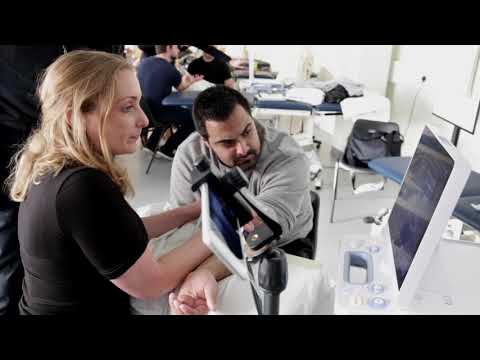
Throughout the programme, you'll benefit from Brunel’s state-of-the-art ultrasound facilities, small-group practical sessions, and teaching from expert faculty with real-world clinical experience. You'll also strengthen your clinical reasoning and practical competence with modules in applied pharmacology and prescribing. Beyond technical skills, you'll expand your expertise in leadership, education, and research, preparing you to influence service development and evidence-based practice.
This course is accredited by the Consortium for the Accreditation of Sonographic Education (CASE), however your work-based learning experience must be carried out in the UK or Republic of Ireland in order to gain this accreditation. This provides you with comprehensive training combined with workplace learning to help you become a musculoskeletal sonographer.
This programme has been developed in partnership with The Ultrasound Site Ltd, who are established market leaders in musculoskeletal ultrasound training.
Got a question about this course? Read our Musculoskeletal Ultrasound Frequently Asked Questions.


Please enable cookies to view this video.
Click here to view the videoYou can explore our campus and facilities for yourself by taking our virtual tour.
Course content
You can study the course in three stages: PgCert, PgDip and MSc, with a recognised qualification at the end of each, or as a full master's degree. This means you can build your learning step by step and finish at the level that works best for you. The modules listed below show the typical path of the full MSc course.
Year 1 - PgCert stage
This is an ideal course for clinicians looking to bring MSK ultrasound into their everyday practice and enhance the care they provide. You’ll study two modules, giving you a solid grounding in how to carry out musculoskeletal ultrasound safely and effectively, before helping you apply it in real clinical settings. You’ll learn the core principles behind high‑quality imaging - from understanding the technology to optimising images, and start developing the practical skills you need to assess the peripheral MSK system. As you progress, you’ll explore how to interpret what you see, recognise common pathology and understand how ultrasound findings can influence a patient’s pathway.
Year 2 - PgDip stage
The PgDip follows on from the PgCert to give you the skills to work confidently with evidence, lead within your service and progress your specialist clinical practice. You can tailor the PgDip with modules to match your professional goals, from advanced MSK ultrasound and prescribing, to clinical leadership, teaching in practice and ultrasound‑guided injections. Each option blends academic study with practical application, helping you enhance your clinical reasoning, strengthen your decision‑making and expand your scope of practice.
If you plan to continue to the MSc, you'll need to take both PH5603 Quantitative Methods and PH5604 Qualitative Research modules, as these form the foundation for your dissertation. If you're completing the PgDip only, these modules remain optional.
This stage is designed to support clinicians stepping into advanced roles, and a natural next step if you want to progress to the full MSc.
Year 3 - MSc stage
After completing both the PgCert and PgDip stages, you’ll be able to progress to the MSc dissertation. This final stage gives you the opportunity to design and conduct a research project with an academic supervisor, and explore a question that matters to your practice, adding new insight to the field of musculoskeletal imaging.
CPD
You can also take these modules as separate CPD units, if you meet the entry requirements for that module, so you don’t need to apply for the full course. Explore our CPD modules and view their entry requirements.
Compulsory
- PH5638 - The Fundamentals of Musculoskeletal Ultrasound
This module aims to develop the practical skill of performing a diagnostic musculoskeletal ultrasound examination for the peripheral MSK system. Core foundation topics such as professional issues, quality assurance and science and technology including physics, knobology, image optimisation will be addressed in taught lectures and through supporting online material
Module dates
- 9 September 2026 (online)
- 18 - 20 September 2026 (on campus)
- 7-8 November 2026 (on campus)
- 1 Decemeber (on campus)
- PH5639 - Integrating Musculoskeletal Ultrasound into Practice
This module aims to develop students ability to recognise pathology on imaging, report it accurately but also develop an understanding of the evidence base surrounding the impact that those sonographic findings have upon a patient pathways.
Considering normal ageing changes and determining relevance of imaging findings. A significant focus of the module will be clinical mentorship, but taught contact days to refine skills and develop an understanding of tissue appearances will be provided. Group based working, online resources and learning materials will further supplement this.
Module dates
- 16-17 January 2027 (on campus)
- 20-21 March 2027 (on campus)
- 10 May (online)
Compulsory
- PH5603 - Quantitative Methods and Design for Health Science Research
In this module we aim to develop your critical understanding of quantitative clinical research methodology and the principles of how to use clinical evidence to constructively inform your practice. This means developing skills and knowledge of quantitative research methods and design, understanding data and how to analyse and interpret it and learning how to critically appraise published research.
- PH5604 - Qualitative Research in Health and Social Care
This module aims to critically explore, reflect upon and develop qualitative research skills and knowledge in health, and to explore qualitative approaches in research in the context of their philosophical, societal, and cultural underpinnings and use in clinical settings.
In additional to theoretical perspectives, through online lectures and interactive workshops you will be introduced to and practice different methods of collecting data and data analysis.
You will learn how to evaluate the quality of qualitative research and consider aspects such as ethics, power, reflexivity and the role of co-construction. This is made relevant to research projects but also service evaluations, quality improvement projects and practice.
Optional
- PH5612 - Advanced Clinical Leadership
This module aims to develop advanced knowledge, skills, qualities and behaviours of leadership for clinical healthcare professionals working in a range of roles in healthcare settings in the NHS. This knowledge and skills literacy will nurture and enhance existing team-working skills and clinical leadership requirements in order to evidence advanced level skills.
Indicative content includes principles of clinical leadership, leadership theories and change management. Effective team working, partnership working and communication will be explored alongside service development tools including service co-design.
Process analysis will support your understanding of how to audit and measure systems and identify and track change.
- PH5696 - Advanced Musculoskeletal Ultrasound Skills
This is a post registration module aimed at medical and allied healthcare professionals who are working at a clinically advanced level using musculoskeletal ultrasound, and who wish to advance their practice with highly specialised skilled use of musculoskeletal ultrasound scanning. This module combines clinical and academic learning with an emphasis on the development of technical skills, clinical reasoning and critical evaluation of current research. This module aligns with the professional standards of conduct and ethics stated by the Health & Care Professions Council, General Medical Council and Brunel University professional standards.
- PH5693 - Advancing Competence in Independent and Supplementary Prescribing Core
This module will equip you with the competence required to practice as Independent Prescribers and/or Supplementary Prescribers within your clinical scope of expertise and be eligible to be recorded as a V300 Independent/Supplementary prescriber.
- PH5692 - Applied Pharmacology
This module is designed to provide, independent and supplementary prescribing students with an in-depth understanding of safe prescribing practice and the important groups of drugs encountered by clinical practitioners as part of evidence-based healthcare. This includes drug actions, therapeutic and adverse effects, significant interactions and an examination of individual drug responses related to the disease conditions that students will encounter in their practice.
- PH5691 - Learning and Teaching in Advanced Clinical Practice
This module aims to provide practitioners with advanced knowledge and skills for the planning, organisation, delivering, teaching and evaluation of effective programmes for clinical training in specialist practice.
Current research and theory underpinning the educational process which support a challenging and supportive teaching and learning environment for clinical practice will be explored aiming to enhance practitioners’ individual ability to critically appraise and augment their skills, knowledge and actively contribute to the education awareness for members of their healthcare team, patients, service users and carers.
Note: Students must currently be in practice and have formally identified and entered an agreement with a mentor and/or supervisor for the learning-in-practice elements of this module, prior to commencing the module.
- PH5646 - Ultrasound Guided Injections
This is a post registration standalone module aimed at medical and allied healthcare professionals working at an appropriate level who wish to practice ultrasound guided corticosteroid injection therapy. This course combines clinical and academic learning with an emphasis on the development of technical skills, clinical reasoning and critical evaluation of current research. For more information, visit our page on Musculoskeletal Ultrasound work-based learning.
Compulsory
- PH5611 - Dissertation
On the dissertation module, students will learn about research by working with an academic supervisor on a topic relevant to their advanced clinical specialist practice. Students will demonstrate their ability to integrate conceptual and theoretical issues, and learn how to design and conduct an original piece of research in an area relevant to their clinical specialist practice or discipline. They will also show their ability to communicate the research process and outcomes in writing and verbally, in a manner appropriate for professional and academic consumption.
This course can be studied undefined undefined, starting in undefined.
Please note that all modules are subject to change.
Read more about the structure of postgraduate degrees at Brunel
Careers and your future
By the time you graduate, you’ll be equipped with advanced skills in scanning, interpretation, and clinical integration. You’ll be ready to lead MSK imaging services, shape policy, and improve patient care pathways. This positions you not only as a highly skilled practitioner but also as a leader and innovator in musculoskeletal ultrasound, opening doors to advanced clinical roles, service leadership, and academic contributions within healthcare.
Graduates of Brunel’s Musculoskeletal Ultrasound PgCert, PgDip and MSc programme go on to highly specialised and rewarding careers across healthcare. You’ll be joining a growing community of alumni who lead MSK imaging services within NHS trusts, private clinics, and elite sports organisations, applying advanced diagnostic skills to improve patient care pathways. Others choose to move into education and research, shaping future practice and influencing policy through evidence-based innovation.
UK entry requirements
2026/7 entry
- A UK 2:2 honours degree, or equivalent internationally recognised qualification in Health Care related subject that is registered with the Health and Care Professionals Council (HCPC), General Medical Council (GMC) or CORU (Regulating Health and Social Care Professionals). After you apply email the Admissions Office with your HCPC, GMC or CORU registration number. We need this to assess your application.
- It is mandatory for applicants to complete this form in full as part of their application. Once complete, please upload this to your My Applications portal
- MSc top-up specific: applicants must have already passed a PGDip and have passed modules PH5603 and PH5604. If these modules haven't been taken as part of the PGDip they must complete an Associate Study course with these two modules. This is because these modules are compulsory to be awarded the MSc.
International entry requirements
If you require a Tier 4 visa to study in the UK, you must prove knowledge of the English language so that we can issue you a Certificate of Acceptance for Study (CAS). To do this, you will need an IELTS for UKVI or Trinity SELT test pass gained from a test centre approved by UK Visas and Immigration (UKVI) and on the Secure English Language Testing (SELT) list. This must have been taken and passed within two years from the date the CAS is made.
English language requirements
- IELTS: 7 (min 6.5 in all areas)
- Pearson: 64 (59 in all subscores)
- BrunELT: 7 (min 6.5 in all areas)
- TOEFL: 5 (min 5 in all areas)
You can find out more about the qualifications we accept on our English Language Requirements page.
Should you wish to take a pre-sessional English course to improve your English prior to starting your degree course, you must sit the test at an approved SELT provider for the same reason. We offer our own BrunELT English test and have pre-sessional English language courses for students who do not meet requirements or who wish to improve their English. You can find out more information on English courses and test options through our Brunel Language Centre.
Please check our Admissions pages for more information on other factors we use to assess applicants. This information is for guidance only and each application is assessed on a case-by-case basis. Entry requirements are subject to review, and may change.
Fees and funding
2026/7 entry
| UK | International | |
| PgCert (60 credits) | £4,040 part-time | £8,265 part-time |
| PgDip (120 credits) | £8,080 part-time | £16,530 part-time |
| MSc (180 credits) | £12,125 part-time | £24,795 part-time |
| Staged Study (60 credits per stage) | £4,040 per stage part-time | £8,265 per stage part-time |
More information on any additional course-related costs.
Fees quoted are per year and are subject to an annual increase.
See our fees and funding page for full details of postgraduate scholarships available to Brunel applicants.
Scholarships and bursaries
Teaching and learning
Teaching on these MSc programmes is delivered through a blended approach that combines lectures, seminars, tutorials, and interactive workshops with practical sessions using Brunel’s state-of-the-art ultrasound equipment. You’ll benefit from small-group teaching for scanning skills, supported by expert faculty and technical specialists who bring extensive clinical experience into your learning. Online resources, recorded lectures, and virtual case discussions complement the face-to-face teaching blocks, giving you the flexibility to balance study with your professional commitments.
Access to a laptop or desktop PC is required for joining online activities, completing coursework and digital exams, and a minimum specification. We have computers available across campus for your use and laptop loan schemes to support you through your studies.
You'll also need access to an ultrasound machine suitable to musculoskeletal scanning.
You’ll have access to comprehensive study packages that you can engage with at a time that suits you. These include videos of your tutors introducing and explaining subjects, linked with study materials and workbooks. Scheduled live online seminars will allow you to work closely with your tutor and a small group of fellow students, providing opportunities to discuss topics, ask questions, and strengthen your understanding of clinical theories and skills. Each module also provides a wide range of online study materials, including case studies, workbooks, clinical skills videos, and discussion forums.
All students have access to Brunel’s Virtual Learning Environment (Brightspace), which hosts recorded lectures, interactive tutorials, discussion forums, reading lists, and assessment guidance. You’ll also find case-based learning activities, research support materials, and links to external resources, ensuring flexible and accessible learning alongside your face-to-face teaching.
The schedule of teaching and assessment has been designed to maximise your enjoyment and support throughout the programme. By combining campus-based teaching with interactive online delivery, you’ll experience an engaging and stimulating learning environment that helps you to achieve your professional development goals.
Assessment and feedback
The programme will use a range a flexible and engaging approaches to assessment. The choice of the specific type of assessment will be appropriate to the intended learning outcomes of the taught modules.
The assessment strategies will balance the need to demonstrate knowledge and competencies with more in-depth and critical approaches to learning. Such assessment approaches will include examinations, presentations of relevant clinical case scenarios, and coursework, which will take the form of critical assessment of literature and research, critical essays, and the development of the selected portfolio of learning. Finally, the dissertation provides demonstration of an ability to synthesise and critically evaluate current research underpinning clinical practice, and to develop and undertake relevant research as well as its dissemination.
Coursework Submission
Non-submission of course work by the designated submission deadline will be considered unprofessional and warrant the award of a fail (0% F) for non-submission.
CASE have accredited all aspects of teaching and assessment for the MSc in Musculoskeletal Ultrasound.
Read our guide on how to avoid plagiarism in your assessments at Brunel.
