Over the last two decades, the telecommunication industry has witnessed sustained growth in the number of mobile user devices driven by the introduction of data services, the take-off of the internet and smart user equipment.
This growth, which is forecasted to continue, has continued to push the data transfer capacity requirement on mobile networks and has motivated research into the design of 5th generation (5G) mobile networks. A key concern in the design of 5G is the infrastructure and power consumption cost of the base station network which is expected to be significantly more advanced and denser than of existing conventional mobile networks. This research has produced an optimisation framework for the cost efficient design of 5G base station networks, based on the application of meta-heuristic algorithms.
The optimisation framework is centred on the ability to exploit three key technologies of 5G, a heterogonous base station network with small-cells, multi-antenna spatial multiplexing MIMO and cell range extension. The framework includes mathematical integer programming models for supporting the decisions about the optimal base station topology in a 5G mobile network and provides a clear core for the application of meta-heuristics for optimising 5G base station deployment. The core optimisation framework includes the definition of solution encoding/decoding and fitness mechanisms. To increase power consumption awareness of base station network design, an independent base station deployment strategy has been presented and evaluated. Simulation results show that the strategy can improve base station network design power consumption by as much as 34%.
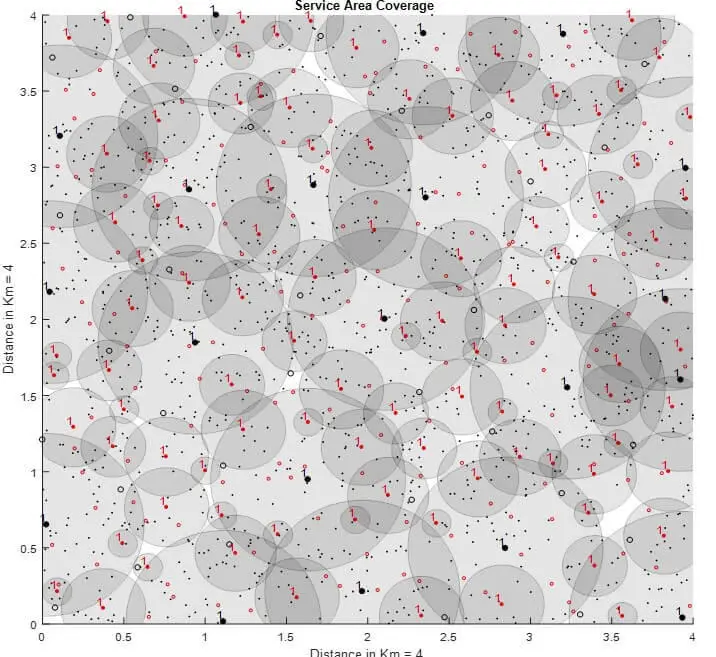 Optimal Cell plan result of scenario ‘A’ (1x1). In this scenario all base stations are deployed with single antenna, consequently an increase base station density is deployed to provide the required capacity.
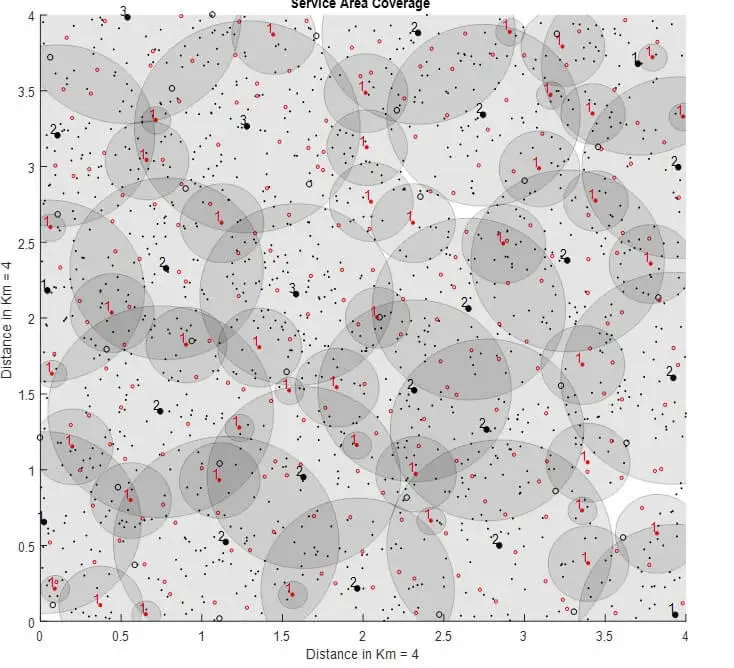 Optimal Cell plan result of proposed model. (The MIMO setup per base station is not fixed homogenously but optimized). It can be seen that in contrast to Figure 4, the MIMO set up per base station different. For example, some base stations use a 3x3 configurations others are deployed with 1x1 and 2x2 configurations. A visual decrease in the number of sites can also be clearly observed.
Publications
Aondoakaa, D., Cosmas, J. and Swift, S. (2018) ‘Exploiting Heterogeneity For Cost Efficient Cellular Base Station Deployment Using Metaheuristics’, in 482nd International Conference on Communication and Signal Processing (ICCSP). Dubai, UAE. [Awarded Best Paper certificate]
Aondoakaa, D., Cosmas, J. and Swift, S. (2018) ‘Exploiting Heterogeneity For Cost Efficient Cellular Base Station Deployment Using Metaheuristics’, International Journal of Advances in Electronics and Computer Sciences (IJAES), 5(10).
David Tyona Aondoakaa, John Paul Cosmas, Stephen Swift “EXPLOITING HETEROGENEITY FOR COST EFFICIENT 5G BASE STATION DEPLOYMENT USING METAHEURISTICS” IET Networks, Manuscript ID: NET-2019-0111, 23rd July 2019
D. Aondoakaa, J. Cosmas and S. Swift “Energy-Aware Network Planning Strategy for 5G Heterogeneous Networks” submitted to the IEEE Networking Letters, April 2020.
Meet the Principal Investigator(s) for the project

Professor John Cosmas - John Cosmas is currently a Professor of Multimedia Systems in the College of Engineering, Design and Physical Sciences at Brunel University London. He is co- Director of the University Research Centre: Intelligent Digital Economy and Society Research Centre (IDEAS) and has been an associate editor of IEEE Transactions on Broadcasting.
His research interests are concerned with the development of Multimedia Networked Systems applied to Future of Broadcasting, Cellular Communications, 2D/3D digital video/graphics media and the synergies between these technologies towards their application towards the benefit of the smart homes, cities environment, health and societies.
He has participated in sixteen EU ICT and two EPSRC funded research projects since 1986 and he has led three of these (CISMUNDUS, PLUTO and 3D MURALE). He has graduated 36 PhD and 4 MPhil students and published over 91 research journal papers and 200 conference papers. His latest research is concerned with management of heterogeneous cellular networks, convergence of cellular and ad-hoc networks, 3D MIMO and efficient Software Defined Networks architectures.
Partnering with confidence
Organisations interested in our research can partner with us with confidence backed by an external and independent benchmark: The Knowledge Exchange Framework. Read more.
Project last modified 21/11/2023